
Results
-
 £110.00
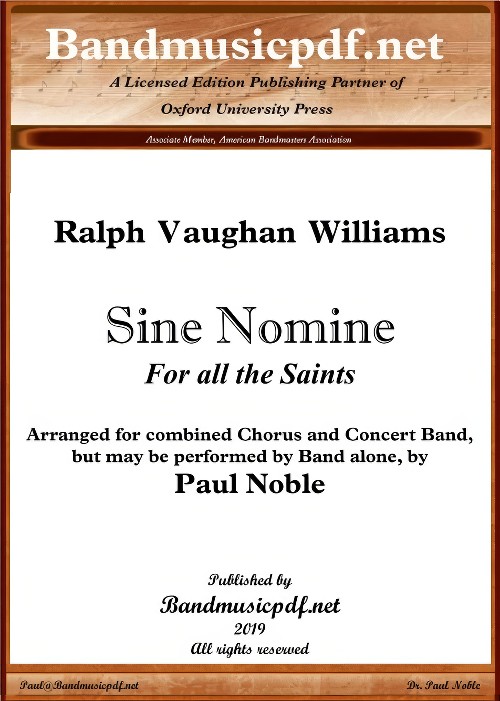
Sine Nomine (For All the Saints) (Concert Band with Optional Choir - Score and Parts) - Williams, Vaughan - Noble, Paul
For All the Saints was written as a processional hymn by the Anglican Bishop of Wakefield, William Walsham How. The setting by Vaughan Williams was included in The English Hymnal which was published in 1906 for the Church of England by Oxford University Press. The music editor was composer and music historian Ralph Vaughan Williams. This hymnal used his new setting which he called Sine Nomine (literally, without name) in reference to its use on the Feast of All Saints, 1 November (or the first Sunday in November, All Saints Sunday). It has been described as one of the finest hymn tunes of the 20th century. This arrangement adheres in form to the original RVW orchestration, including all eight verses and an optional organ part, which is the standard format in many hymnals. It may be performed as accompaniment to a congregational hymn, with choir, or as a band piece alone.
Estimated dispatch 7-14 working days
-
 £89.99
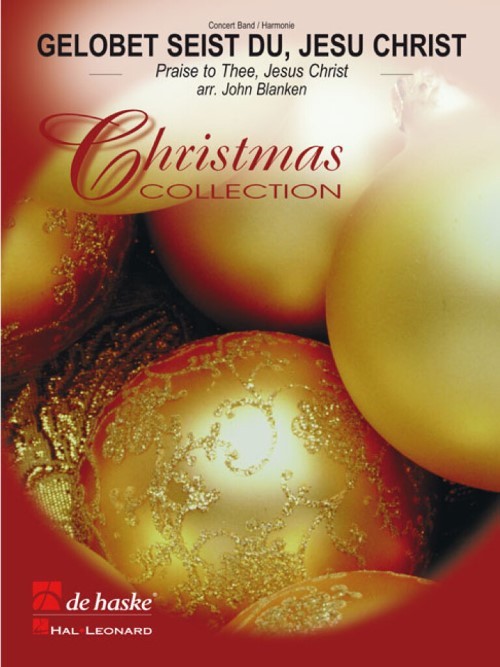
Gelobet seist du, Jesu Christ (Concert Band - Score and Parts) - Blanken, John
Gelobet seist du Jesu Christ (We Praise You Jesus Christ) is an old Christmas hymn dating from the 16th century, which can still be found in many hymnbooks today. John Blanken has created a varied and imaginative arrangement on four verses of the hymn. After the introduction, derived from the opening notes, the hymn is first accompanied by an agile harmonisation. Next, we hear the chorale in a four-part setting with a percussion accompaniment. Then follows a short prologue to the third verse and finally its time for fireworks as the arrangement takes a stylistic leap in time with the festive prelude to the fourth and last verse.Duration: 4:00
Estimated dispatch 7-14 working days
-
 £89.99
1861 (Concert Band) - Newman, Jonathan
1861 is a lyric hymn/fantasia for young concert bands, based on the beautiful 19th century Anglican hymn "Lead Me, Lord" (written in 1861 by Charles Sebastian Wesley). The hymn itself features a gorgeous melodic line over biting harmonies and striking counterpoint, and provides the pillars for this work. First is a soloistic treatment, followed with a dramatic full band tutti, and finally a section of evocative humming. Throughout are unique textures and colourful improvisitory accompaniments.
Estimated dispatch 7-14 working days
-
 £108.90
With Voice of Triumph Raised
Based on the well-loved hymn tune, "Madrid" ("Come, Christians, Join To Sing"), this creatively striking, rousing overture is perfectly suited to be a concert opener or closer. Energetic rhythms, effective orchestration, and warm harmonies make this piece a favorite of band members and concertgoers alike, while remaining practical for conductors to prepare, even with limited rehearsal time. Formally based on the structure of the hymn lyrics, this work features a vigorous opening section, followed by a lyrical repose that eventually transitions into an assertive, climactic crescendo to the finish. "With Voice of Triumph Raised" will be the highlight of your concert!
Estimated dispatch 7-14 working days
-
 £99.99
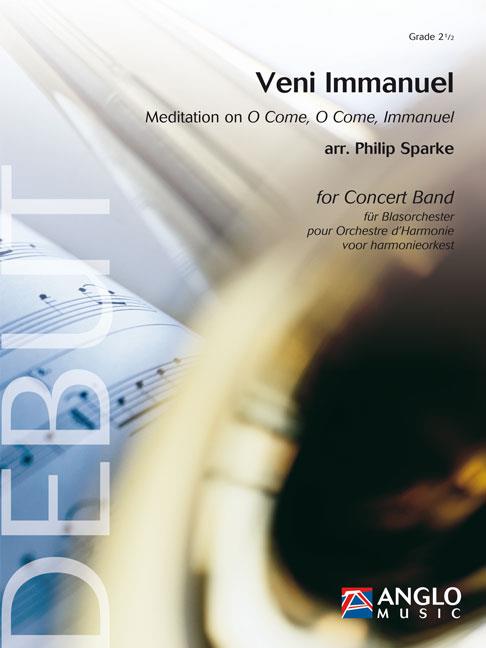
Veni Immanuel (Concert Band - Score and Parts) - Sparke, Philip
Mediation on O Come, O Come ImmanuelThe Advent hymn we all know today as O Come, O Come, Immanuel was arranged in its modern form by Thomas Helmore and published in Hymnal Noted in 1856. Both the words and melody, however, predate this version by centuries.The tune, Veni Immanuel, is taken from a 15th century processional of French Franciscan nuns, part of the setting for the funeral hymn Libera Me. This arrangement aims to expand on the power and mystery of the original tune and will be most effective if the solo trumpet at the start and end of the piece can be placed away from the band, maybe at the back of the auditorium.Duration: 5:30
Estimated dispatch 7-14 working days
-
 £75.00
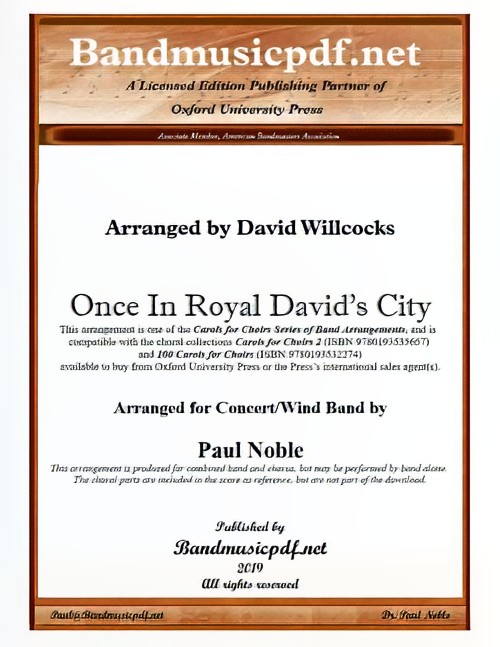
Once in Royal David's City (Concert Band with Optional Choir - Score and Parts) - Noble & Willcocks
Once in Royal David's City is a Christmas carol originally written as a poem by Cecil Frances Alexander. The carol was first published in 1848 in her hymnbook Hymns for Little Children. A year later, the English organist Henry John Gauntlett discovered the poem and set it to music. According to The New Oxford Book of Carols, the text was conceived by Cecil Alexander after overhearing a group of her god children complaining about the dreariness of the catechism. Cecil masterfully took doctrines from the Apostle's Creed and simplified them for her hymns. Cecil wrote about 400 hymns in her lifetime, among which are All things bright and beautiful and There Is a Green Hill Far Away. She used the money for charitable purposes, and was a tireless advocate (and visitor) of the poor and sick. Henry John Gauntlett had spent the first half of his career as a lawyer before abandoning his practice to pursue music. He served as the organist at a number of leading London churches. Gauntlett was a prolific writer and is said to have composed over 1000 hymn tunes. He made tremendous contributions to the world of music, even inventing mechanical improvements to the organ. As a result, he was praised by the famous Felix Mendelssohn and was awarded an honorary doctorate in music from the Archbishop of Canterbury. In 1919, Arthur Henry Mann, organist at King's College (1876-1929), introduced an arrangement of Once in Royal David's City as the processional hymn for the service. In his version, the first stanza is sung unaccompanied by a boy chorister. The choir and then the congregation join in with the organ on succeeding stanzas. This has been the tradition ever since. It is a great honor to be the boy chosen to sing the opening solo--a voice heard literally around the world. In this arrangement for band accompaniment, the first five verses may be performed as directed by the conductor, with different groupings of instruments for each verse, i.e., Vs.1, A cappella; Vs. 2, Fl., Oboe, E.H., Bsns; Vs. 3 Cl., Saxes; Vs. 4, Brass; Vs. 5, All, and Vs. 6 as written with featured descant. This arrangement is one of the Series of Band Arrangements compatible with the David Willcocks Carols for Choir, Book 2 (#31).
Estimated dispatch 7-14 working days
-
 £44.95
The Kings Go Forth (Concert Band - Score only) - Gregson, Edward
This work was commissioned jointly by the Royal Air Force Music Service and an American Universities Consortium and received its world premiere during the 1996 RAF British Tour. It is scored for large symphonic wind band, with the addition of voices.The work is a sequel to the highly successful The Sword and the Crown which was premiered in 1991 by the mass bands of the RAF (and also was an RAF commission). That work was based on music written for the Royal Shakespeare Company productions of The Plantagenets and Henry IV, parts 1 and 2 (for productions between 1988 and 1991).The Kings go Forth is similarly based on musical material for those productions. It uses different thematic elements and incorporates them into a three-movement suite entitled: The Church; The People; The State.This reflects the fact that in Henry IV Parts 1 and 2, Shakespeare introduces The People as an important element in the dramatic structure. The Church and The State are, of course, both leitmotivs throughout the entire plays. An Agnus Dei is heard at the outset from a solo voice. The ensuing Dies Irae is a fast and, at times, quite violent dance. The two sections which form the basis of the second movement, The People, concentrate on popular elements and reflect to some extent the tavern scenes in the plays. The two ideas presented are a harvest hymn reflecting the country scenes set in Gloucestershire, and a jazzy, 'up-tempo' dance based on the medieval song, Sumer is icumen in. The third movement, The State, deals with the Kings theme in the title of the piece. The juxtaposition of battle music with funeral music for Henry IV and Henry VI leads to a reworking of the leitmotif from the beginning of the work. The final section is Coronation music for Henry V, eventually leading to a triumphant climax. - Edward GregsonDuration: 17.15Recorded on QPRM 125D Festival of Music 1996, Massed Bands of the Royal Air ForceRecorded on QPRM 134D The Kings Go Forth, Royal Northern College of Music Wind Orchestra
Estimated dispatch 7-14 working days
-
£164.95
The Kings Go Forth (Concert Band - Score and Parts) - Gregson, Edward
This work was commissioned jointly by the Royal Air Force Music Service and an American Universities Consortium and received its world premiere during the 1996 RAF British Tour. It is scored for large symphonic wind band, with the addition of voices.The work is a sequel to the highly successful The Sword and the Crown which was premiered in 1991 by the mass bands of the RAF (and also was an RAF commission). That work was based on music written for the Royal Shakespeare Company productions of The Plantagenets and Henry IV, parts 1 and 2 (for productions between 1988 and 1991).The Kings go Forth is similarly based on musical material for those productions. It uses different thematic elements and incorporates them into a three-movement suite entitled: The Church; The People; The State.This reflects the fact that in Henry IV Parts 1 and 2, Shakespeare introduces The People as an important element in the dramatic structure. The Church and The State are, of course, both leitmotivs throughout the entire plays. An Agnus Dei is heard at the outset from a solo voice. The ensuing Dies Irae is a fast and, at times, quite violent dance. The two sections which form the basis of the second movement, The People, concentrate on popular elements and reflect to some extent the tavern scenes in the plays. The two ideas presented are a harvest hymn reflecting the country scenes set in Gloucestershire, and a jazzy, 'up-tempo' dance based on the medieval song, Sumer is icumen in. The third movement, The State, deals with the Kings theme in the title of the piece. The juxtaposition of battle music with funeral music for Henry IV and Henry VI leads to a reworking of the leitmotif from the beginning of the work. The final section is Coronation music for Henry V, eventually leading to a triumphant climax.- Edward GregsonDuration: 17.15Recorded on QPRM 125D Festival of Music 1996, Massed Bands of the Royal Air ForceRecorded on QPRM 134D The Kings Go Forth, Royal Northern College of Music Wind Orchestra
Estimated dispatch 7-14 working days
-
 £164.95
Amphibiosity (Concert Band - Score and Parts) - Ellerby, Martin
Amphibiosity was commissioned by the Royal Marines Band Service with funds made available by the Royal Navy and Royal Marines Charities for the 2014 Mountbatten Festival of Music held at the Royal Albert Hall in London.The work was written in celebration of the 350th Anniversary of the Royal Marines Corps and utilises many familiar tunes associated with them. Although the piece is cast in one continuous movement it falls into an introductions, ten sections and a coda.The Introduction sets the tone with the Amphibiosity mofif - a call to attention, it is of serious intent. During the course of the work it returns as a point of reference. The first section makes use of The Globe and Laurel (Original Regimental Slow March of the Royal Marines, the tune (Early One Morning) making an apt appearance, it has been played in the minor and like much of the quotational material in the piece is of a referenced nature being symbolic in meaning. However it soon turns to the major to provide a less sombre aspect to the introduction proper. There follows an interlude, the Amphibiosity motif returning rather like a ritornello to give cohesion to the structure and act as a point of change.Section two presents Sarie Marais (Regimental March Past of the Royal Marine Commandoes), the first half of the tune used as a fugal subject (placed in the minor) and as such providing the impression of a building up of activity. The ensuing third section is light-hearted commencing with an original hornpipe leading into the fourth section, Seascape, representing the fleet at sea. Another interlude follows, the Amphibiosity motif reappearing as a woodwind fanfare making way for the fifth section. Anticipation, serious matters lie ahead, there is trouble in the papers, the Corps will be placed on standby.Section six is subtitled Preparation, all hands-on deck, time to get set: A Life on the Ocean Wave (Regimental March of the Royal Marines) is alluded to. On reaching section seven, Assault, the landing goes ahead. Within this section there is an internal interlude reflecting on things past: other men have been in this position before. It is a taut and trying situation, training must pay off!Section eight is named Victory, but not gung-ho, and here the Seascape music is revisited. The penultimate ninth section is called Rememberances, although all made it this time, it was not always the case in times past and the Naval Hymn (Eternal Father) provides a moment of tribute to the fallen of previous generations.The Finale (section ten) delivers By Land and Sea (Slow March of the Royal Marines) in a bright and positive orchestration, the mood being celebratory. In a brief Code, the Amphibiosity motif makes a last triumphant appearance.Duration: 10.30
Estimated dispatch 7-14 working days
-
 £32.95
Amphibiosity (Concert Band - Score only) - Ellerby, Martin
Amphibiosity was commissioned by the Royal Marines Band Service with funds made available by the Royal Navy and Royal Marines Charities for the 2014 Mountbatten Festival of Music held at the Royal Albert Hall in London.The work was written in celebration of the 350th Anniversary of the Royal Marines Corps and utilises many familiar tunes associated with them. Although the piece is cast in one continuous movement it falls into an introductions, ten sections and a coda.The Introduction sets the tone with the Amphibiosity mofif - a call to attention, it is of serious intent. During the course of the work it returns as a point of reference. The first section makes use of The Globe and Laurel (Original Regimental Slow March of the Royal Marines, the tune (Early One Morning) making an apt appearance, it has been played in the minor and like much of the quotational material in the piece is of a referenced nature being symbolic in meaning. However it soon turns to the major to provide a less sombre aspect to the introduction proper. There follows an interlude, the Amphibiosity motif returning rather like a ritornello to give cohesion to the structure and act as a point of change.Section two presents Sarie Marais (Regimental March Past of the Royal Marine Commandoes), the first half of the tune used as a fugal subject (placed in the minor) and as such providing the impression of a building up of activity. The ensuing third section is light-hearted commencing with an original hornpipe leading into the fourth section, Seascape, representing the fleet at sea. Another interlude follows, the Amphibiosity motif reappearing as a woodwind fanfare making way for the fifth section. Anticipation, serious matters lie ahead, there is trouble in the papers, the Corps will be placed on standby.Section six is subtitled Preparation, all hands-on deck, time to get set: A Life on the Ocean Wave (Regimental March of the Royal Marines) is alluded to. On reaching section seven, Assault, the landing goes ahead. Within this section there is an internal interlude reflecting on things past: other men have been in this position before. It is a taut and trying situation, training must pay off!Section eight is named Victory, but not gung-ho, and here the Seascape music is revisited. The penultimate ninth section is called Rememberances, although all made it this time, it was not always the case in times past and the Naval Hymn (Eternal Father) provides a moment of tribute to the fallen of previous generations.The Finale (section ten) delivers By Land and Sea (Slow March of the Royal Marines) in a bright and positive orchestration, the mood being celebratory. In a brief Code, the Amphibiosity motif makes a last triumphant appearance.Duration: 10.30
Estimated dispatch 7-14 working days
 View Music