
Results
-
 £214.80
Skies - Oliver Waespi
Program notes by Oliver Waespi on his composition Skies:Skies is the plural of Sky. We may wonder are there several skies? Is the sky we all long for not the same for everybody? While travelling on foot and "in the open air" I have observed the firmament often in quite different shapes, so that I can say I have indeed experienced the sky in different ways. Years ago I already wanted to portray "my sky" in music; I finally have been able to realise this long-cherished dream.This composition deals with the sky, more precisely with my sensual and emotional experience of the sky in all its aspects. Two point of views are combined in this composition: one showing the sky as it presents itself to me, the other showing the sky as I observe it. The music was bom simultaneously by intemal and extemal inspiration: it describes nature but also the emotional and spiritual experience of nature. To me, the experience of nature is not abstract, but it is connected with concrete ages, places or people from my neighbourhood. This is why I have combined several parts of this composition with certain landscapes.The sky presents itself in different landscapes in the most varied ways: for the sensual experience, there is no sky as such. The indications of places spread all over the score, are primarily clues for myself; they represent certain atmospheres, which I have experienced especially in England and Scotland. They can however also be useful to the musicians and the audience, providing they know those landscapes and the celestial atmospheres linked to them.The music is independent from the atmospheres described in the subtitles, as those are rather connected to a tragic nature, and so the music is not based on any program. Musically spoken, the composition has a symphonic structure, which means that the complete musical material is derived from three contrasting main themes. In the first part, the description of a noctumal sky ("Night") two themes are developed in an organic way; the first, rather "dusky", is to be found with the horns, the second, "in bright daylight", with the oboe and flute, the third, "more quiet" , with the brass instruments. In the next part, we have clouds and rain over the Isle of Skye (one of the Hebrides islands in Scotland) and here several elements of the first theme are still more developed. Then we get an increasingly dark mood, which is released, in heavy chords. Then suddenly, the sun breaks through and the music gets a majestic character. We have a new shape of the initial theme, first with the French horns and then with the trombones. The music gets a quicker tempo and flows into a quick movement describing the winds and waves at sea ("Wind and Waves"). Three themes are gathering and some variations are developed. The music gets more and more energetic and, after a climax, calms down again. Then we have a kind of "summer pastoral" which suggests summer at the South coast of Cornwall ("South Coast of Penwith Peninsuia in Summer"). This is certainly not the hotte st summer in Europe, but still it is beautiful in this country that is blessed with so much rain. In the "pastoral" , the sea is already sketched in broad outlines in the French horn solo. The magnificence of an aftemoon at the seaside is developed at the end of the composition ("Noon at Treen Cliff', a rock protruding in the sea next to Porthcumo at the South Coast of Cornwall); here the music gets stronger and stronger and after a majestic climax it vanishes completely.
Estimated dispatch 7-14 working days
-
 £118.99
Goodnight Moon - Eric Whitacre
Over the past few years I must have read Goodnight Moon to my son a thousand times - maybe more. Somewhere around reading number 500, I began hearing little musical fragments as I read, and over time those fragments began toblossom into a simple, sweet lullaby. I knew it was a long shot, but I asked my manager, Claire Long, to contact HarperCollins and see if they would allow the text to be set to music. To my surprise and delight they agreed - thefirst time they had ever allowed Goodnight Moon to be used in such a way. I composed the piece relatively quickly, originally setting the text for harp, string orchestra, and my son's mother, soprano Hila Plitmann. I laterarranged Goodnight Moon for SATB choir and piano. More recently, my dear friend Verena Msenbichler-Bryant arranged the piece for wind ensemble and soloist. The melody of Goodnight Moon will forever make me think of those quietnights, reading my son to sleep. -Eric Whitacre
Estimated dispatch 7-14 working days
-
 £38.50
Raise - Suzanne Toolan
InstrumentationPiccoloFlutes I and IIOboeClarinets I, II and III in BbBassoonAlto Saxophones I and IITenor SaxophoneBaritone SaxophoneHorns I and II in FTrumpets I, II and III in C or BbTrombones I and IIBass TromboneEuphonium (B.C) or (T.C.)TubaTimpaniSnare DrumBass DrumCrash CymbalsSuspended CymbalTam-tamSleigh Bells or TambourineChimesGlockenspielXylophoneMarimba
Estimated dispatch 7-14 working days
-
 £164.99
Early Hungarian Dances - Ferenc Farkas
The composer wrote of his work as follows: In the music of Hungary, folk songs are manifestly of great importance, on the other hand our ancient airs and dances play a modest role. For this work I have been influenced by dances of the 17th century, written by unknown amateurs in a relatively simple style. Most of these dances were recorded between the 14th and 18th centuries under the usual form of tablature notation. My interest in this music was first captured in the 1940s. I was so fascinated that I decided to give these melodies new life. I fitted the little eight-bar dances together into ternary and rondo forms, and leaning on early Baroque harmony and counterpoint, I attempted a reminiscence of that atmosphere of the provincial Hungarian Baroque.
Estimated dispatch 7-14 working days
-
 £174.99
Two Symphonic Interludes - Harrie Janssen
Based on the poems by German poet Carl Hauptmann (late Romanticism) and the English poet William Wordsworth (early Romanticism). Carl Hauptmann was in poor health as a child, but highly intelligent. He studied philosophy, psychology and biology. In the latter he was admitted to the degree of doctor. His marriage provided financial independence, so that he could focus on his studies. Hauptmann wrote various novels, plays, poetry and scientific works. Night Twilight floats above the valley's night mists are hanging, there's a whispering brook. Now the covering veil is lifting quite: come and look! See the magicland before our gaze: tall as dreams the silver mountains stand, crossed by silent silver paths shining from a secret land. Noble, pure, the dreaming country sleeps. By the path the shadow black and hogh of a beach. a wisp of a white smoke creeps to the dark'ning sky. Where the valley is the darkest hued countless little lights shine silently. O my soul! Drink of solitude! Carl Hauptmann Wordsworth 'introduced' a new type of poetry, based on the speech of the common man. This was his answer to the poetry of the classicism which was bound by rigid rules. His definition of poetry was: the spontaneous overflow of powerful feelings from emotions recollected in tranquility. My heart leaps up when I behold a rainbow in the sky My heart leaps up when I behold A rainbow in the sky: So was it when my life began. So is it now I am a man. So be it when I shall grow old, Or let me die! The Child is father of the Man. And I could wish my days to be Bound each to each by natural piety. William Wordsworth In a truly poetic manner Harrie Janssen has transformed the contemplative thoughts of the poets into two compositions for Concert Band.
Estimated dispatch 7-14 working days
-
 £186.20
Fin de Siecle - Henk Alkema
About his composition 'Fin de Sicle', completed in 1995, Alkema writes: 'At the end of each century 'everything is allowed' for some time. Everything is being summarized and eventually leads to a last climax. I felt that same feeling of freedom when I started composing 'Fin de Sicle'. Everything is allowed. I did not want to summarize all musical expressions of the twentieth century; I only wanted to summarize my own experiences. To me, this music is the very end and yet also the beginning of something else. I do believe in evolution and growth.'
Estimated dispatch 7-14 working days
-
 £186.20
Music for Gentry - Mickey Nicolas
Let's go back to the fifties. As I have played as a musician at such famous places as Carrre and Maxim's in Paris and the Palm Beach in Cannes, I wanted to recreate the musical climate of that time. This was highly appreciated by the high-life of that time: show business stars, politicians and millionaires alike. Of course, I used the most popular tunes of the fifties as well as the accompaniments to the popular musical acts, the latter mostly using two beat measures. With some nostalgia I used the scale of Jerome Kern's 'I get a kick out of you' to conclude.
Estimated dispatch 7-14 working days
-
 £205.30
Mitt hjerte alltid vanker - Fantasi - Hans Adolph Brorson
This arrangement was commissioned by B3 (The Bergen Woodwind Ensemble). B3 is a large woodwind ensemble located in Bergen with a mix of professional and amateur players. My Heart Remains in Wonder is a well-known Christmas hymn in Scandinavia. I wanted my version to be different to the traditional hymn tune style in which it is normally performed. One day I was outside walking and this idea came to me: an ostinato-like, mechanical skeleton of arpeggio semiquavers on which I could 'hang' the melody. However, I also wanted to do the melody line a bit different. The inspiration for this comes from folk music and the way fiddlers hardly ever lift their bow off the strings when they play. Because of this, it is important that the melody is played in a very sostenuto style in this arrangement. The harmonies lie somewhere between jazz and folk music with a little nod towards Grieg (himself heavily influenced by folk music) in the slow middle section.
Estimated dispatch 7-14 working days
-
 £183.20
Viking Saga - Ray Farr
"Viking Saga" was inspired by my conducting engagements in Norway in the 1980s. Among them was a visit to the Flekkefjord Pike Korps who asked me to write a piece for them. I had just written "Adventures in Brass" which was very popular, particularly with younger bands, so I decided to pursue the creative energy. My teacher, at that time, was Professor Edward Gregson who encouraged me to develop my ideas into a full-scale work. The piece received a few performances in this version but neither I, nor my teacher, were satisfied so the manuscripts lay dormant. In the summer of 2002 a band from Switzerland- Cordula Brass Baden and Christoph Moor, who had played the piece under mydirection in the Swiss National Youth Band, commissioned me to finish the work and make the changes that, I felt, were needed. In 2016 the Tnsberg Wind Band, from Norway, commissioned a wind band version for their performance in the Norwegian Championships held in Trondheim 2017.
Estimated dispatch 7-14 working days
-
 £109.99
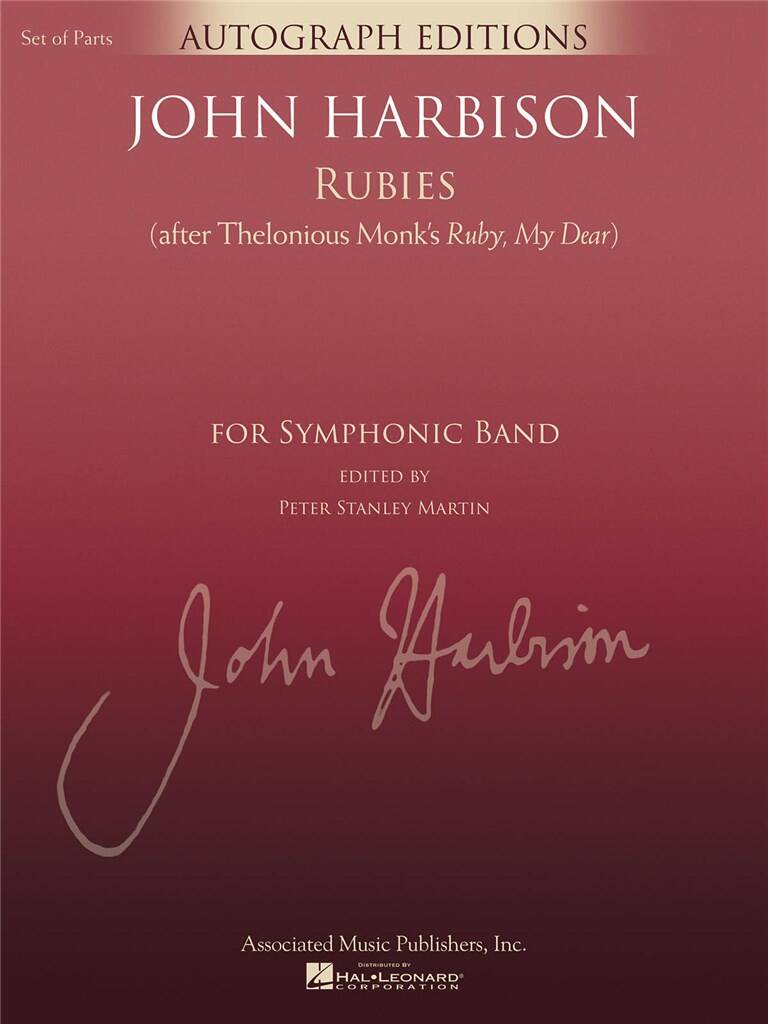
Rubies (After Thelonious Monk's Ruby, My Dear) - John Harbison
Composer John Harbison writes: 'Rubies is a version of Thelonious Monk's 'Ruby, My Dear', which he composed while still in his teens. When I was invited by the Seattle Symphony to make a short piecereflecting my first musical passions, my thoughts were of Bach and Monk. Since I had recently made some Bach-like chorale preludes, I chose to make a version of Monk's tune, first in a chamber-musical, contrapuntal manner, then inthe grand orchestral style I had always heard lurking there.' Dur: 5:30 (Recorded live by the Rutgers Symphony Band - Peter Stanley Martin, guest conductor).
Estimated dispatch 7-14 working days
 View Music