
Results
-
 £154.60
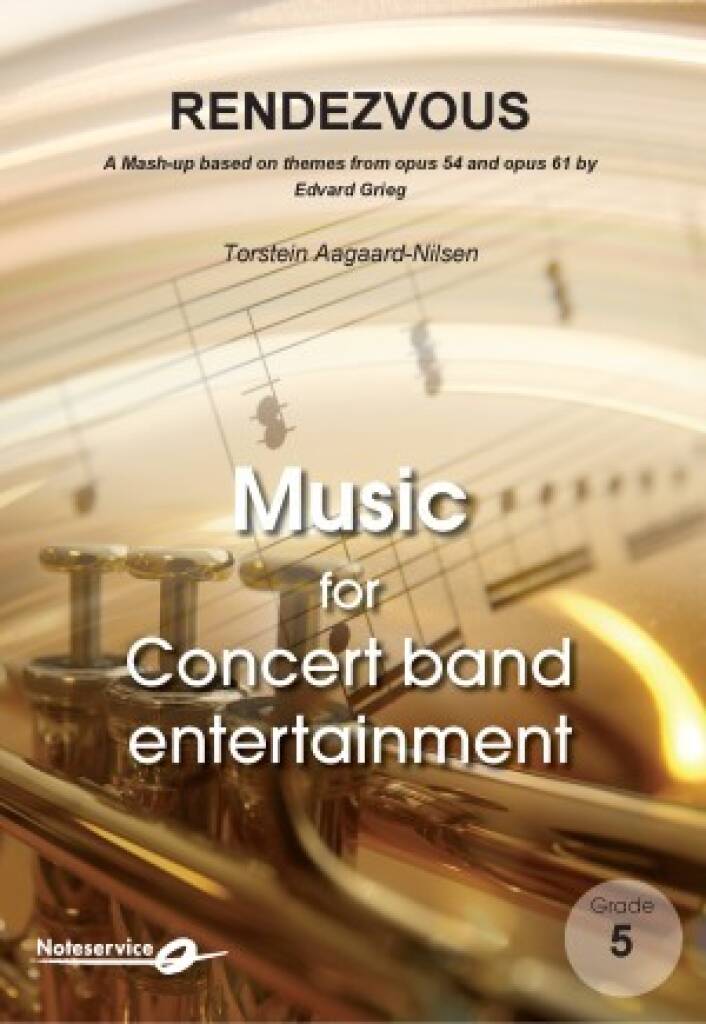
Rendezvous - Torstein Aagaard-Nilsen
Rendezvous was commissioned by Krohnengen Brass Band for their 50th Anniversary in 2019. This version for Concert Band was scored autumn 2020.Rendezvous is devided into three sections. Each section are referring to Edvard Grieg's own titles. but twisted, to make sure that everybody understand that this music is a mash-up of themes Edvard Grieg used in opus 54 (for piano) and opus 61 (songs for children).1. Trolltog med avsporing (March of the Trolls derailment)March of the Trolls is a famous part of Edvard Grieg lyric pieces, opus 54.2. Klokkeklang i feil sang (Bell ringing in wrong tune).Bell ringing show that Grieg was one of the first composers to write the way impressionists did. What happens if this beatiful piece is combined with several other themes from the same book? It somehow works in its own way.3. Pep talk til Blakken (Pep talk to Blakken)The riff used in the first part becomes an important part of the third part: a funky treat of the childrens song "Kveldssang for Blakken" (Evening song for Blakken).I felt that a rather tired old horse needed a pep talk more than a slow tune. So that is why you get this music(!) - and this is how my rendezvous with Grieg ends.Not sure what maestro Grieg would have thougt... But, I have read that the fiddlers that played the tunes Grieg used was not happy with the way Grieg used them.So there you go...Torstein Aagaard-Nilsen
Estimated dispatch 7-14 working days
-
 £435.40
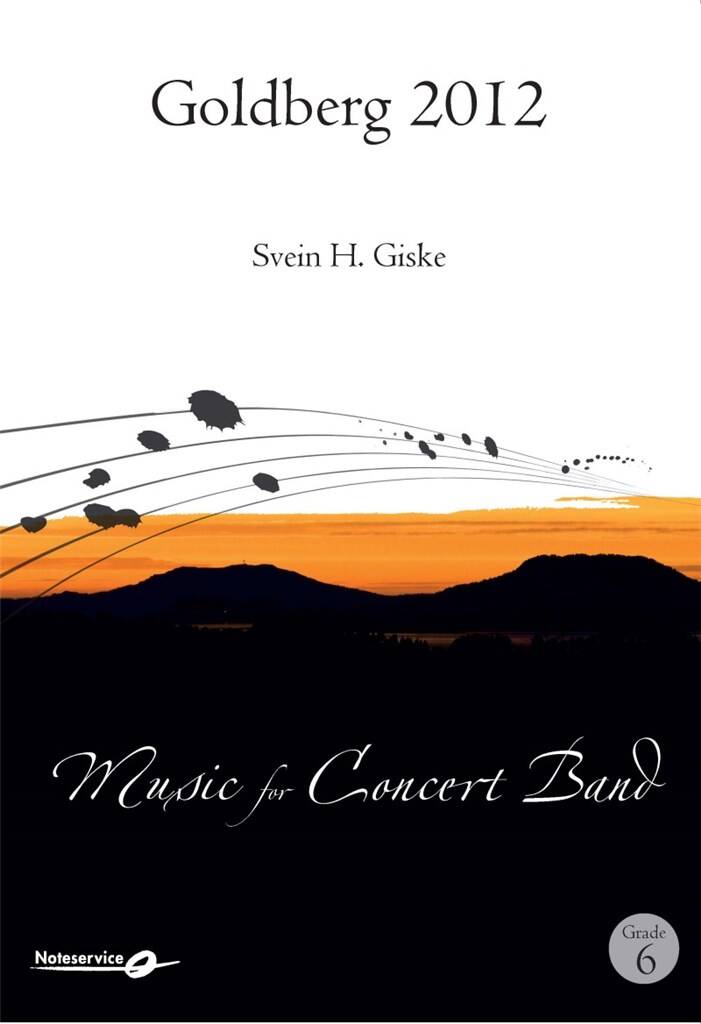
Goldberg 2012 - Svein H. Giske
The first time I heard Bach's Goldberg Variations was in the movie Silence of the lambs, in the early 1990s. I noticed the beautiful background music in one of the scenes, but at that time I didn't know what it was. A few years later, when I was studiying at the Grieg Academy, I got to know the entire piece. For me, this is a piece of music which I can listen to countless times. I think it sounds as fresh today as it did more than 15 years ago and it never ceases to inspire me. Both Bach's composition and Glenn Gould's famous 1955 recording (which was the first one I heard) still makes a great impression on me. Before Gould recorded it at age 22, it wasn't a highly ranked piece amongst pianists and Bach was by many viewed as a bit old-fashioned. The young Canadian turned all this around. He managed to portray Bach in a reformed way, producing fine nuances in phrasing and making the many layers in Bach's music more transparent than anyone before him. Thus he plunged both himself and Bach (back) onto the international music scene. When The Norwegian Band Federation (NMF) asked me to write the test piece for NM in 2012, it was only natural for me to use the Goldberg Variations as a starting point and inspiration for my work. Since I was a teenager at NMF's summer courses in the mid eighties I've always listened to many different styles of music. Growing up in Sunnmre with the Brazz Brothers as teachers and mentors, jazz-, pop/rock- and folk music were early on a natural part of my musical background. I also have my classical education from the Grieg Academy on trumpet. As the title of my piece implies, I've wanted to bring Bach to the present and put his music into various modern musical landscapes. I think you can bring about a special kind of energy when music from different genres are mixed and I've tried to do this by mixing Bach with artists and musical styles from the present. In Goldberg 2012, the music is often constructed by several layers, which in a way are living parallel musical lives. They are seemingly moving or floating freely, almost unaware of each other, but bound together by the same basic pulse. The rythms, however, are often notated on a different rythmic subdivision level than the usual 8th- or 16th note levels. By doing this, I hope to achieve transparent sounds that rythmically are perceived as more free and detached from each other. In large sections of the piece, pop/jazz is fusioned with elements from Bach. I guess you could have this little scene as a synopsis for the piece: picture a group of musicians meeting: some are classical performers, some are jazz. They start to improvise together, each in their own voice or musical dialect and I'm sort of in the middle, trying to write down what they are playing. This is what I feel much of Goldberg 2012 is about. The foundation of the piece, in addition to Bach and references from pop/jazz music, lies also in my own material. This material, basically two chords, is heard in it's purest form in the 1st movement. I use these chords to create scales, new chords and different motifs which contribute to blend together the different moods of the piece. It has not been my intention to copy Bach's form (theme and 30 variations), but rather to use the bits and pieces that I like the most as an inspiration for my own variations. The 1st movement, Aria 2, is for my 3rd son, Olav, who was born on the 21st of April 2011, and the 5th movement, From long ago, is dedicated to the memory of my father, Svein J. Giske, who passed away on the 6th of June 2011. -Svein H. Giske, January 2012-
Estimated dispatch 7-14 working days
-
 £149.40
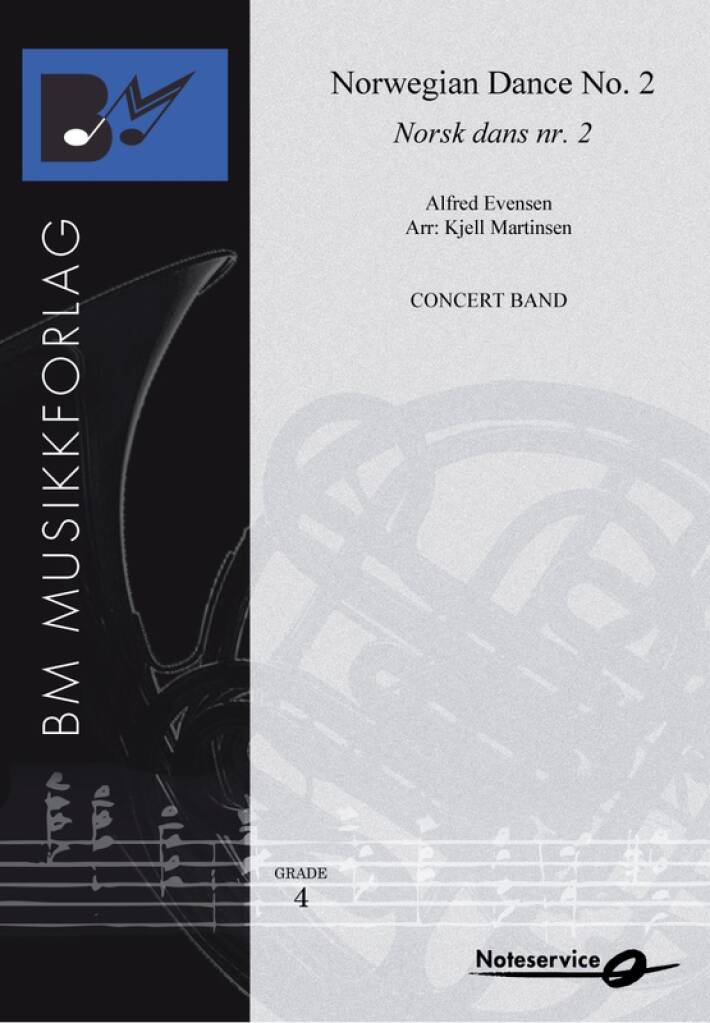
Norwegian Dance No. 2 - Alfred Evensen
Alfred Evensen (1883 - 1942) was born in Troms, but moved to Harstad 16 years old to start as a student at The Military School of Music. He was director and chief of the military band in 1918, and worked there for 12 years. In 1930 he was appointedto conductor of the military band in Bergen, and worked there until he was appointed to take over from Johannes Hanssen (Valdres march) as manager and conductor of the military band in Oslo in 1934.With this band he participated in a majorinternational military music collection in Paris in 1935 With a great success. In addition to his work in military music, he was a highly respected conductor of choir and composed, in additionto his compositions for bands, many songs for choir.He died in Oslo, after he was arrested because of his resistance against the German occupation. At his own request he was buried in Harstad, and there is also a statue of him.Norwegian Dance No. 1 and No. 2 dates from 1911 and 1912respectively. They are composed in the style of Grieg's Norwegian Dances, Op. 35, but, unlike Grieg, Evensen has used his own themes for the compositions.
Estimated dispatch 7-14 working days
-
 £149.40
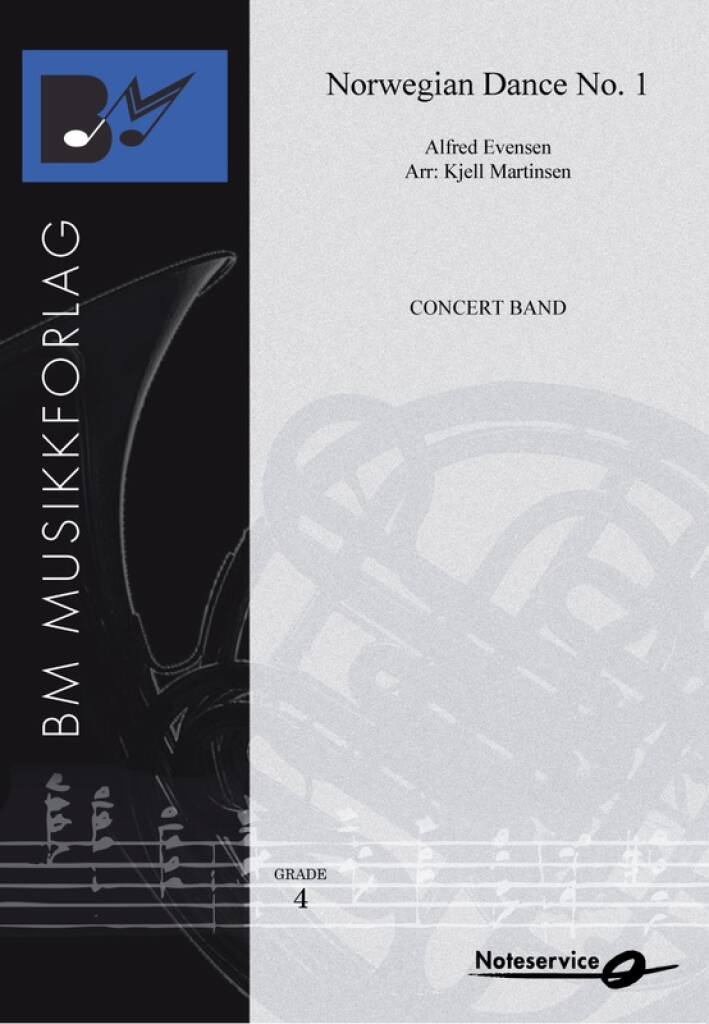
Norwegian Dance No. 1 - Alfred Evensen
Alfred Evensen (1883 - 1942) was born in Troms, but moved to Harstad 16 years old to start as a student at The Military School of Music. He was director and chief of the military band in 1918, and worked there for 12 years. In 1930 he was appointedto conductor of the military band in Bergen, and worked there until he was appointed to take over from Johannes Hanssen (Valdres march) as manager and conductor of the military band in Oslo in 1934.With this band he participated in a majorinternational military music collection in Paris in 1935 With a great success. In addition to his work in military music, he was a highly respected conductor of choir and composed, in additionto his compositions for bands, many songs for choir.He died in Oslo, after he was arrested because of his resistance against the German occupation. At his own request he was buried in Harstad, and there is also a statue of him.Norwegian Dance No. 1 and No. 2 dates from 1911 and 1912respectively. They are composed in the style of Grieg's Norwegian Dances, Op. 35, but, unlike Grieg, Evensen has used his own themes for the compositions.
Estimated dispatch 7-14 working days
-
 £127.30
Takk - Edvard Grieg
"Gratitude" is one of Grieg's beautiful lyrical pieces, Op. 62 No. 2.Eva Knardahl made a beautiful recording that I well remember was used as background for a picture cavalcade by the Norwegian Broadcasting Corporation during the passing of His Majesty King Olav V of Norway in 1991.In this arrangement for band, I have tried to vary the instrumentation, both for the sake of more colours and to emphasize the drama.This piece should be played rubato with elastic phrasing. The form can be described as AABACoda. The most dramatic section is the B part from measure 25, which peaks just before measure 38. The last four measures (from measure 53) can be done a bit 'meno' in tempo.Reid Gilje
Estimated dispatch 7-14 working days
-
£79.50
Tha Mi Sgith - Brian Beck
Tha Mi Sgth is a Gaelic folksong about forbidden love. This stunning arrangement echoes the styles of Grainger, Grieg, and Holst but is very much in the voice of Brian Beck. Every part has attainable challenges that will motivate your students to practice. This work will be a terrific way to open or close your concert.
Estimated dispatch 7-14 working days
-
 £205.30
Mitt hjerte alltid vanker - Fantasi - Hans Adolph Brorson
This arrangement was commissioned by B3 (The Bergen Woodwind Ensemble). B3 is a large woodwind ensemble located in Bergen with a mix of professional and amateur players. My Heart Remains in Wonder is a well-known Christmas hymn in Scandinavia. I wanted my version to be different to the traditional hymn tune style in which it is normally performed. One day I was outside walking and this idea came to me: an ostinato-like, mechanical skeleton of arpeggio semiquavers on which I could 'hang' the melody. However, I also wanted to do the melody line a bit different. The inspiration for this comes from folk music and the way fiddlers hardly ever lift their bow off the strings when they play. Because of this, it is important that the melody is played in a very sostenuto style in this arrangement. The harmonies lie somewhere between jazz and folk music with a little nod towards Grieg (himself heavily influenced by folk music) in the slow middle section.
Estimated dispatch 7-14 working days
-
 £183.20
Fest - Polonaise - Johan Svendsen
Johan Svendsen (1840 - 1911) was the first great Norwegian symphonic composer, as well as one of the leading conductors of his time. Next to Edv. Grieg, he was the most prominent figure in Norwegian music life at the end of the 1800's. Although he came from humble beginnings in Chistiania (now Oslo), he was to become a cosmopolitan who felt at home all over Europa. Svendsen spent most of his adult life abroad, living in Copenhagen for 25 years as maestro for the Royal Theatre Orchestra. Nonetheless he retained contact with Norway troughout these years and was a frequent and popular guest in his native country. He wrote his Festival Polonaise for a ball in 1873. This polonaise ina big ABA style
Estimated dispatch 7-14 working days
-
 £174.10
Tornado - Fredrick Schjelderup
Tornado is based on sketches from the Royal Norwegian Naval Forces' Band (SFMK) Composer Workshop with composition students from The Grieg Aacademy in 2012. The working title of the piece, "Workshopping", reflects a young composer on "shopping" for new timbres and effects within the range of instruments and opportunities. The piece starts with a wind from afar (trills and tremolos) which then builds up in block harmony and various fragments that are processed across different keys and harmonies. Tension between chords and dissonances are then pressed up and develops the character and temperament. The title,Tornado, is selected on the basis of the energy and build up,something that can be translated with the weather phenomenon Tornado . Whirl- wind speed translates into the notation with fast tempo, tremolos and technical parts.
Estimated dispatch 7-14 working days
-
 £149.40
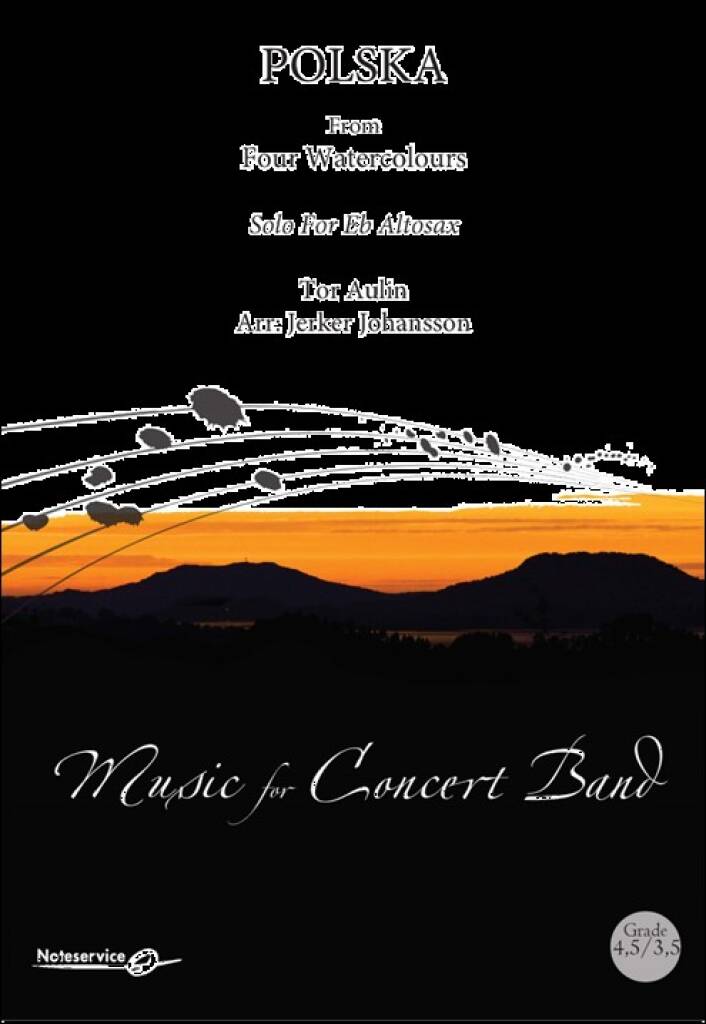
Polska from Four Watercolours - Tor Aulin
Few composers have had such an impact on Swedish music life as Tor Aulin (1866 1914). He studied violin and music theory in Stockholm 1877 83, and in Berlin 1884 86. In 1887 he founded the Aulin Quartet, which for more than 20 years played animportant role in broadening Swedish interest in chamber music. The quartet was often on tour with the composer Wilhelm Stenhammar at the piano.1889 1902 Aulin was the leader of the orchestra at the Royal Opera in Stockholm.At Aulinsinstigation the Concert Association in Stockholm (later The Royal Philharmonic Orchestra) was founded in 1902, and he was its conductor until 1909. From then on he was the conductor of the Gothenburg ConcertAssociation (nowadays The GothenburgSymphony Orchestra).Besides being a first class violinist, Tor Aulin was also an accomplished pianist, and Edvard Grieg was deeply impressed by Aulin's rendering of his piano concerto.Aulins list of works is dominated by his musicfor violin. He wrote three violin concertos, the third of which still has a place in the repertoire.Four Aquarelles for violin and piano from 1899 is his most beloved composition. In 1996 Jerker Johansson arranged this work for soloinstruments, one for each of the four movements, and concert band. The solo instruments being clarinet, trumpet, flute and alto saxophone.
Estimated dispatch 7-14 working days
 View Music