
Results
-
 £113.30
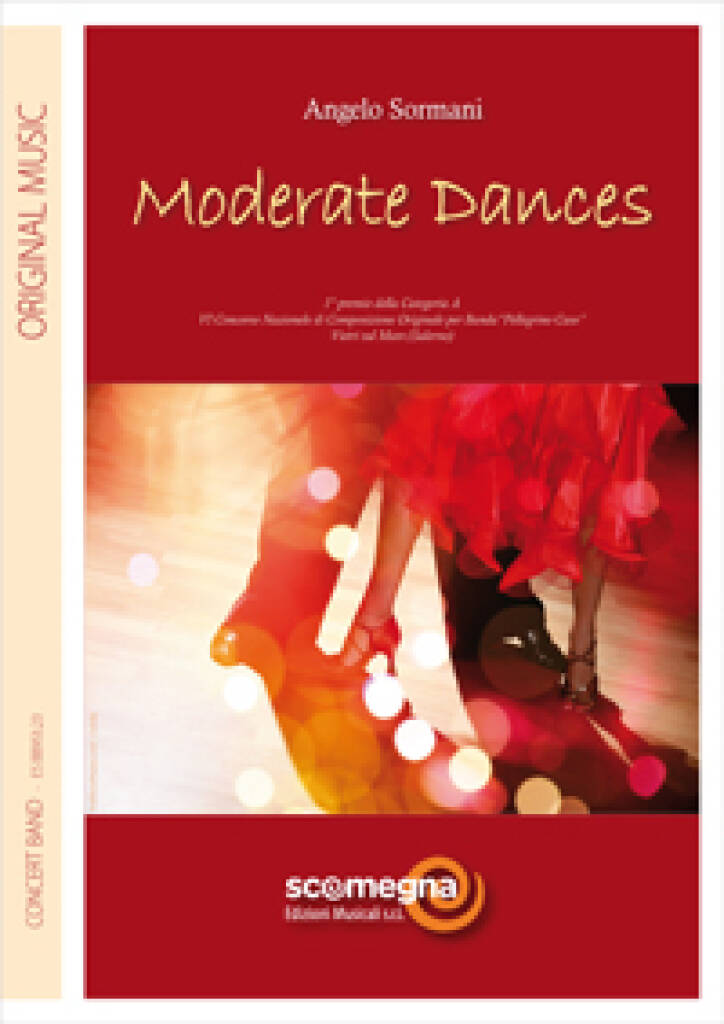
Moderate Dances - Angelo Sormani
This piece is a tribute to dance music, especially passionate, intense and meditative dance music. "Moderate Dances" is divided into three movements: a "Tango", a "Slow Waltz" and a "Bossa Nova". Each movement and each dance has its own particular characteristics but, when combined, these different rhythmic beats and times give the piece a feeling of completeness and uniformity. The Tango started to flourish in the suburbs of Buenos Aires in around 1880. There is still some doubt as to its origins, which may be Cuban (Habanera) but are probably African. It was most popular in Argentina and Brazil: here the male protagonist was originally the "gaucho" with his inseparable guitar, later to be replaced by the proud, elegant "compadre". By around 1910 the Tango had spread to Italy and France. New clubs opened, where the upper classes could watch and dance the Tango. Here the dance also underwent some rapid transformations. The exaggerated and extravagant gestures and body movements disappeared. Slow, gliding steps replaced the old rotational movements. The women's red ankle-boots and the partners "staring into each other's eyes" accentuated the erotic nature and sensuality of this dance. So much so that, in 1913, the German government banned soldiers from dancing the Tango. Those who broke the law were immediately discharged from the army. From a strictly musical perspective, the basic instruments were a flute, a harp (the diatonic harp typically played by the Indians of Paraguay) and a violin, or flute, guitar and violin or even clarinet, guitar and violin. These instruments were easy to transport, ideal for playing at parties, in the streets and in courtyards. The musicians played by ear, frequently improvising: there were no scores, no records, which is the main reason why it is impossible to trace the Tango back to its exact origins. However, the Tango's evolution (and growing popularity) was once again fostered by its fundamental ability to absorb "other" cultures, languages and sounds. And it was the arrival of the "bandoneon" (an accordion-like instrument that was invented in Germany and brought to Rio de la Plata by some immigrant), which replaced the flute, that marked the beginning of the Tango's huge success outside Argentina. A number of talented composers, above all the great Astor Piazzola (1921-1992), transformed the bandoneon from a simple accompanying instrument to a solo instrument that was to become the distinguishing feature of the 20th century Tango. The Slow Waltz originated from the Waltz, the typical dance of the Bavarian and Tyrolese peasants in the 1700s. It was composers like Johann Strauss, father and son, who carried the Waltz to its zenith in the 1800s, creating the sensual and melancholy yet joyful and charming dance we are all familiar with. When the Waltz first became popular in Germany, the members of respectable society were shocked at the closeness of the dancing partners, who had always previously danced apart. The main difference between the Waltz and Slow Waltz is that the latter has a slower, more expressive rhythm: the men wear tails and the women wear ball gowns decorated with beads and feathers and couples dance in graceful rotational movements. "Bossa Nova" is the title of the last movement in the piece. Jobim, the great Brazilian musician, described this musical genre as a combination of modern Jazz and Samba. Bossa Nova means "new wave". This was the name of the artistic and musical movement that evolved in Brazil in the late Fifties and was extremely popular throughout the Sixties. The songs are usually about love or social matters, drawing inspiration from the slums of Rio De Janeiro and the lives of their inhabitants. Bossa Nova, with its original compositions and the artistic talent of its musicians, also became hugely popular in the United States and Europe, and top Jazz musicians (Ella Fitzgerald, Stan Getz, Bob Cooper, Charlie Bird, Sonny Rollins, Dexter Gordon, Dizzy Gillespie) started to include Bossa in their repertoires.
Estimated dispatch 7-14 working days
-
 £104.50
Old Comrades - Carl Teike
This favorite march by the German composer of military band music at the turn of the century is presented in a fresh new scoring of the original complete manuscript as performed by the United States Marine Band, arranged by its conductor.
Estimated dispatch 7-14 working days
-
 £104.50
Symphony #1 In Memoriam Dresden 1945 - Daniel Bukvich
This emotional, contemporary work has gained widespread acceptance in recent years. Written in remembrance of the firebombing of the German city of Dresden, Bukvich combines the most traditional techniques with the most contemporary, including representational notation.
Estimated dispatch 7-14 working days
-
£60.50
Sweeter The Bells Never Sound - Steve Litwiller
Based on a traditional German Christmas folk song popular in Europe. This charming melody makes an effective vehicle for introducing various 3/4 rhythms to young players and mallet instruments to young percussionists. Delightful as well as educational.
Estimated dispatch 7-14 working days
-
 £104.50
Adagio Solo Euphonium and Winds - Woldemar Bargiel
The German composer Woldemar Bargiel was the half-brother of Clara Schumann and composed a significant amount of chamber music. He was supported by fellow composers Robert Schumann and Johannes Brahms. His Adagio, opus 38 for cello and orchestra is an eloquently beautiful solo work and makes a very attractive solo feature for euphonium with wind accompaniment. This setting was premiered with euphonium soloist Misa Meade accompanied by the Loyola University Concert Band.
Estimated dispatch 7-14 working days
-
 £116.40
 -
 £116.40
Christmas Time - Kees Vlak
Kees Vlak composed the 'Christmas Time' suite for band in which he used German, Hungarian and Dutch Christmas carols.
Estimated dispatch 7-14 working days
-
 £186.20
Wald Sinfonie - Kees Vlak
It was during his stay at Freiburg, Germany, where he was attending a Music Festival, that Kees Vlak found his inspiration for this romantic work. At this festival he was awarded a prize for one of his compostitions, which was played by several bands from different countries. The composer was staying in the small village of Horben, hidden among pine woods on a mountain at the border of the Black Forest. From the balcony of his room he had a splendid view on the Schawinsland Valley, scarcely hidden by the tops of the huge pines. Each morning a blackbird singin in a huge pine next to his window woke him up. This bird song opens the composition.Whenever possible the composer and his wife went for a walk in the Black Rorest. The rediscovery of this wonderful area is expressed by the steadily increasing number of tone colours, used in the orchestration. Each village still boasts its own folk music and dances. More than one hundred bands were playing all around; the Black Forest seemed to be the scene of one huge festival. The image of the Black Forest is also linked to that of hunting scenes, so the next theme is being introduced by hunting horn themes. The second theme paints the lake "Titisee". At first the lake is very calm, but a stiff breeze sets both water and music alike in motion. The small town of Titisee is very popular with tourists and is famous for its woodcutting, its clockworks and musical boxes. It is a popular folk tune, played by a musical box that makes the link with the next theme. The joy and cheerfulness of the dancing village people is expressed by a movement which works out the initial theme.On leaving the little town, one can hear once more the hunting music from the wood as well as the song of the birds. The new theme is againg closely linke d to the hunt and played by the typical German helicon-like euphoniums.this theme interacts with the wecond theme and the word ends with a grnd finale meant as a musical hommage tot this wonderful area.
Estimated dispatch 7-14 working days
-
 £140.80
Introduction, Theme and Variations - Johann Wenzel Kalliwoda
Johann Wenzeslaus Calliwoda composed Introduction, Theme and Variations opus 128 in 1844, and he dedicated this piece to the virtusoso contemporary Carl Brmann.. This solo work contains a lot of recognizable influences from German early Romanticism. Long dreamy melody lines and jagged character changes are followed through numerous variations. It seems as so the composer wants to show the listener what the absloute technical capabilities of the clarinet are.
Estimated dispatch 7-14 working days
-
 £116.40
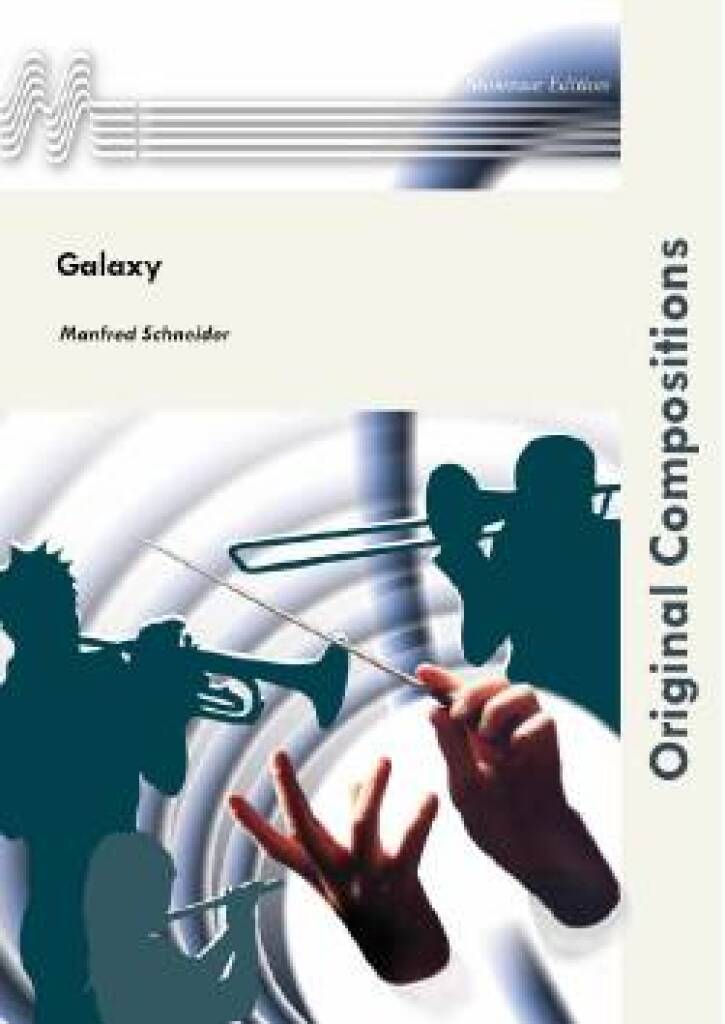
Galaxy - Manfred Schneider
Galaxy describes a travel through the universe. Manfred Schneider wrote it after a terrible sickness when the doctors said, his life would end in a few months. At the time of writing Galaxy, four years later, he is in a good health again. M. Schneider was till 2006 hornist and keyboarder in the German armyband in Koblenz at the Rhine-River and was also working as an independent composer and arrangeur.
Estimated dispatch 7-14 working days
 View Music