
Results
-
 £94.99
Fantasia for Tuba and Concert Band - James Curnow
The composition begins with the solo tuba stating the four notes (F, Bb, G, C) on which the entire piece is based. All other themes, and much of the harmony, are built on these four notes and their permutations. There are four main sections, with a brief cadenza before the last movement
Estimated dispatch 7-14 working days
-
 £174.99
Et in terra Pax - Jan Van der Roost
This piece was commissioned by the 'Concert Band Vlamertinge' and is a plea for peace: the title translates as 'Peace on Earth'. This is expressed by means of the vocal contribution expected from the performers. In various places of the piece you can recognize, the words 'Et In Terra Pax' - an appeal for peace - at first jumbled together but later more rhythmically structured, developing into synchronized massed voices.The work starts with a pentatonic theme based on the notes D, E, G, A and C (taken from 'ConCErtbAnD VlAmErtinGE' and the name of the conductor, NiCk VAnDEnDriessChe). A somewhat sad melody is developed during an orchestral climax which leads to the firstexplosion of sound (measure 62 onwards). Suddenly the opening measures are recaptured, albeit with a differently colored sound: the words 'Et In Terra Pax' bring the first movement to a close. A restless Allegro follows which abruptly stops and is replaced by a calming cho-rale-like passage. A narrator reads aloud the poem 'Sonnet' by the young poet Charles Hamilton Sorley, who was killed during World War I. This poem fittingly puts into words the cruelty and senselessness of war. After the expanded recapitulation of the allegro, the broad, almost infinite atmosphere of the beginning returns. Clarinet and English horn play the pentatonic opening theme once more, this time broadly, while the words 'Et In Terra... Pax' are repeated again and again by the rest of the orchestra.The composer has purposely avoided all forms of aggression and bombastic sounds regularly used in works about war. Fear of violence and destruction can be heard and felt during the allegro passages. The charged opening makes way in the end for hope: May peacefulness replace cruelty in everyday life, too.
Estimated dispatch 7-14 working days
-
 £60.99
 -
 £286.40
Poeme du Feu - Ida Gotkovsky
Major Albert Fasce, head of the musical department of the French Army, wrote about Pome du Feu:The Pome du Feu by Madame Ida Gotkovski is probably one of the original compostitions for symphonic band which has been most successful in recent years. I have had to conduct this work at concerts with different orchestras, and in particular at Budapest, and each performance was greeted by enthusiastic ovations. Moreover, it is quite rare in contemporary music to achieve, at the same time, the satisfaction of the musicians and success with the public. This is significant. This magnificent work is written remakably for wind instruments. There is no major technical difficulty, but the character of this work calls for meticulous placing and a certain orchestral glow. There is a "key" to be found in the first movement, which is in some way the rhythmic genesis of the work. The metronome marking of the first movement should be absolutely respected, and proper interpretation of the accents and the articulations are imperative. The fortissimi and rallentandi should not be exaggerated. As far as the little "trick" is concerned, this lies in the execution of the double crochets which should be considered in two ways: the first, a rhythmical one for those which arise from the rhythmic genesis, and the second more melodic for those arising in passages.Finally, to unseal the rhythmic origin of the double crochets, it is necessary to proceed by recurrence, starting from the four double crochets of the finale.These four double crochets must be executed very rhythmically in the different times. For the first, they arise:1: from the second bar of the first movement2: from the bar three bars before A for the second3: from the bar from G to the fourth time for the third.These double crochets must be played rhythmcally, while diminishing, however, those three bars before A.All this is of great importance, otherwise the whole execution will be in contradition with the spirit and the rhythmic inspiration of the work. Moreover, this beautiful work could very well support a ballet.As Head of Broadcast Music I must express all our gratitude to Madame Gotkovski for her contribution to constituting a real repertoire for wind ensemble. This articular and sometimes unappreceated band possesses unsuspected riches. This magnificent work is now in the repertoire of Musique de l'Air de France.
Estimated dispatch 7-14 working days
-
 £186.20
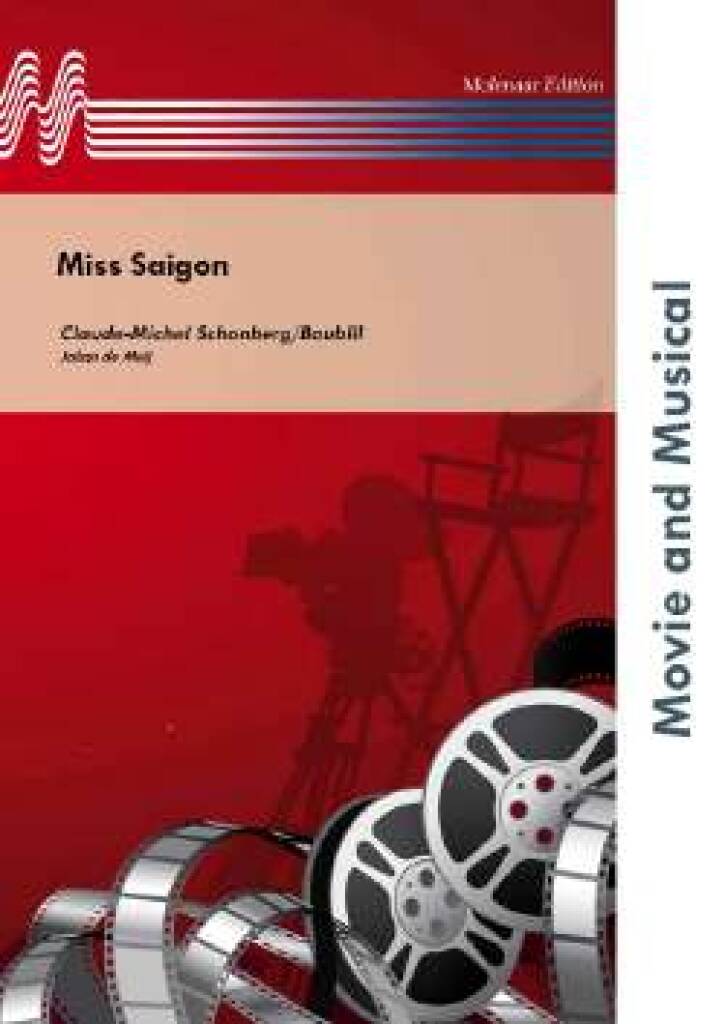
Miss Saigon - Alain Boublil
Miss Saigon is a thrilling musical by the duo Boublil and Schnberg, that is also responsable for Les Miserables. It is a modern version of Madame Butterfly. The plot tells the sentimental story of a G.I. Chris who falls in love with a beautiful native girl Kim during the Vietnam War. When he realizes that she is pregnant he has to go back home in the States where his wife is waiting for him. In order to allow the father to educate the child, the young woman commits suicide. With his usual orchestration skill, Johan de Meij made a fine sympho-nic portrait, containing some of the most beautiful songs of the musical. You can hear successively: 'Overture - Saigon, April 1975', 'The Movie in my Mind', 'The Morning of the Dragon', 'Please' and 'I still believe'.Download the sound of the helicopter:Helicopter - 01Helicopter - 02Helicopter - 03Helicopter - 04Helicopter - 05
Estimated dispatch 7-14 working days
-
 £52.70
 -
 £116.40
Three Pictures for Band - Oliver Waespi
This composition consists of three sound pictures. When writing this work Oliver Waespi did not have any concrete image such as a scenery or a specific form in mind, but rather some typical visual movements. Hence the successive titles of the different parts: Procession, Dialogue and Waves. Numerous associations mutually link those parts as far as motifs and harmony are concerned. The motif of the ascending and descending fourth plays an important role in many a theme. There are many fourth chords by means of which Waespi tries to put a harmonic and unifying stamp on the compostition as a whole. Moreover there are similar or identical, though varied, motifs in the successive parts.The first part, Cortge (Procession), describes the dignified majestic procession by means of simple precise rhythms. At first the music is scarcely audible, as if coming from a distance; it gradually comes nearer until it reaches its climax in large chords, before fading away again. At each quarter note one could imagine a step. The second part, Dialogue, consists of broad outlines of dialogues between the different orchestral groups. Some instruments are asking questions, others are giving answers. After a rather sad passage, the music turns into a climax followed by a second passage that brings comfort and leads to a quiet ending. In the third part, there is a sudden movement coming up in the shape of waves. The principle of the wave, successively swelling and decreasing, dominates the entire musical structure of this part, even in the separate motifs.As far as the instrumentation is concerned there are the following notes: in the brass band version Oliver Waespi has a definite (orchestral) brass band strength in mind. If some parts (e.g. euphonium and flugelhorn) are played by several musicians, the conductor should feel free either to double or to thin those parts, providing the musical contents are not damaged. The same goes for the fanfare band in which the conductor can feel even more free as to the band's orchestral strenght. Anyway, a convincing overall sound is determining and that is to be realised by any kind of wind band.
Estimated dispatch 7-14 working days
-
 £140.00
Car - Marcel Peeters
In this nice five-part suite, Marcel Peeters (Antwerp, 1926) draws a musical portrait of the 20th century. By means of five legendary car types, each of them referring to a specific period, suggested by the contrasting styles, we make a trip back in the history of the previous century. We successively drive a 'Ford '26', a 'Chevy '52', a 'M.G. '63', a 'Volkswagen '47' and a 'Ferrari 2000'. All aboard for this musical historical expedition throughout the 20th century!
Estimated dispatch 7-14 working days
-
 £38.20
 -
 £38.20
 View Music