Results
-
 £101.20
Aa - The Path of a Small River - Guillaume Détrez
The Aa is a French coastal river in northern France, in the Hauts-de-France region, flowing into the North Sea. The river is partially canalised and flows through the towns of Saint-Omer and Gravelines. An exciting, programmatic work with many diverse timbres.
Estimated dispatch 7-14 working days
-
 £38.20
Vimy Ridge - T. Bidgood
The British composer Thomas Bidgood (1870-1925) was a gifted music teacher who conducted his own professional orchestra, several theatre orchestras and wind bands. He composed a lot of light orchestral music and some fifteen marches, mong which 'Sons of the Brave' and Vimy Ridge'. The title of this march refers to a ridge situated between the town of Arras and the Flemish plain in the North of France. This ridge has been assaulted numerous times since the Roman conquest. Bidgood wrote this march after the Battle of Arras in April 1917 when the Canadians conquered Vimy Ridge which was one of the strongest fortified positions of the Hindenburg Line.
Estimated dispatch 7-14 working days
-
 £113.30
Moderate Dances - Angelo Sormani
This piece is a tribute to dance music, especially passionate, intense and meditative dance music. "Moderate Dances" is divided into three movements: a "Tango", a "Slow Waltz" and a "Bossa Nova". Each movement and each dance has its own particular characteristics but, when combined, these different rhythmic beats and times give the piece a feeling of completeness and uniformity. The Tango started to flourish in the suburbs of Buenos Aires in around 1880. There is still some doubt as to its origins, which may be Cuban (Habanera) but are probably African. It was most popular in Argentina and Brazil: here the male protagonist was originally the "gaucho" with his inseparable guitar, later to be replaced by the proud, elegant "compadre". By around 1910 the Tango had spread to Italy and France. New clubs opened, where the upper classes could watch and dance the Tango. Here the dance also underwent some rapid transformations. The exaggerated and extravagant gestures and body movements disappeared. Slow, gliding steps replaced the old rotational movements. The women's red ankle-boots and the partners "staring into each other's eyes" accentuated the erotic nature and sensuality of this dance. So much so that, in 1913, the German government banned soldiers from dancing the Tango. Those who broke the law were immediately discharged from the army. From a strictly musical perspective, the basic instruments were a flute, a harp (the diatonic harp typically played by the Indians of Paraguay) and a violin, or flute, guitar and violin or even clarinet, guitar and violin. These instruments were easy to transport, ideal for playing at parties, in the streets and in courtyards. The musicians played by ear, frequently improvising: there were no scores, no records, which is the main reason why it is impossible to trace the Tango back to its exact origins. However, the Tango's evolution (and growing popularity) was once again fostered by its fundamental ability to absorb "other" cultures, languages and sounds. And it was the arrival of the "bandoneon" (an accordion-like instrument that was invented in Germany and brought to Rio de la Plata by some immigrant), which replaced the flute, that marked the beginning of the Tango's huge success outside Argentina. A number of talented composers, above all the great Astor Piazzola (1921-1992), transformed the bandoneon from a simple accompanying instrument to a solo instrument that was to become the distinguishing feature of the 20th century Tango. The Slow Waltz originated from the Waltz, the typical dance of the Bavarian and Tyrolese peasants in the 1700s. It was composers like Johann Strauss, father and son, who carried the Waltz to its zenith in the 1800s, creating the sensual and melancholy yet joyful and charming dance we are all familiar with. When the Waltz first became popular in Germany, the members of respectable society were shocked at the closeness of the dancing partners, who had always previously danced apart. The main difference between the Waltz and Slow Waltz is that the latter has a slower, more expressive rhythm: the men wear tails and the women wear ball gowns decorated with beads and feathers and couples dance in graceful rotational movements. "Bossa Nova" is the title of the last movement in the piece. Jobim, the great Brazilian musician, described this musical genre as a combination of modern Jazz and Samba. Bossa Nova means "new wave". This was the name of the artistic and musical movement that evolved in Brazil in the late Fifties and was extremely popular throughout the Sixties. The songs are usually about love or social matters, drawing inspiration from the slums of Rio De Janeiro and the lives of their inhabitants. Bossa Nova, with its original compositions and the artistic talent of its musicians, also became hugely popular in the United States and Europe, and top Jazz musicians (Ella Fitzgerald, Stan Getz, Bob Cooper, Charlie Bird, Sonny Rollins, Dexter Gordon, Dizzy Gillespie) started to include Bossa in their repertoires.
Estimated dispatch 7-14 working days
-
 £71.50
March of the Tin Soldiers - Mark Syslo
March of the Tin Soldiers employs themes from Leon Jessels popular march, Parade of the Tin Soldiers. Originally composed for piano, it was later published for orchestra and gained international acclaim in Russia, France, and finally here in the United States on Broadway. Its probably best known for its use by the Radio City Music Hall Rockettes as part of their Christmas Spectacular in New York City. This well-written and approachable setting makes this popular march accessible for young band holiday programs.
Estimated dispatch 7-14 working days
-
 £49.95
Flame of Independence - Dan Price
Given as a gift to the United States of America from the people of France, The Statue of Liberty is one of the most recognizable icons of the United States world-wide and is also a universal symbol of freedom and...
Estimated dispatch 5-7 days
-
£90.00
Global Variations - Nigel Hess
Around the world in just over eight minutes! Although commissioned for a Youth Band, no concessions are made here for lack of technical ability, particularly in the percussion department. The chimes of Big Ben herald the start of a whistle-stop global journey, calling in turn at France, Spain, South Africa, Egypt, Russia, India, China, Australia, South America, and the USA, with a final detour through Ireland and Scotland before hearing Big Ben once more as we arrive home!
In stock: Estimated delivery 1-3 days
-
 £79.99
Supernova (Concert Band - Score and Parts) - Deleruyelle, Thierry
Supernova is an energetic piece in a pop style that inspires joy and good humour, its rhythm giving it an exceptionally lively and festive character. Its theme is renewal, rebirth and solidarity in the wake of the COVID-19 pandemic. The Confdration Musicale de France commissioned this work as part of the initiative "Concerts solidaires au profit de l'enfance en France et dans le monde" (Concerts in aid of children in France and worldwide).Duration: 4.45
Estimated dispatch 7-14 working days
-
 £248.99
Missa Brevis Wind Band Set (Score & Parts)
Missa Brevis, written for choir and wind band, was commissioned by the Conseil D?partemental pour la Musique et la Culture de Haute-Alsace (Dir.: Philippe Pfisterer) in Guebwiller (France), in celebration of the millennium of Pope Leon IX's birth in ?guisheim (France). The composer conducted the first performance on June 23, 2002. It was performed live for the French television channel France 2. The mass movements Kyrie, Gloria, Credo, Sanctus, Benedictus, and Agnus Dei are very suitable for the Catholic as well as the Protestant liturgy. For this mass, various ways for performing in diverse variable strengths are possible. An instrumental performance is possible if the brass represents the choir parts. In this option, it is desirable for the brass to be positioned separately from the rest of the band (on a gallery, for example), so that the idea of two choirs is approached. In a performance with a large choir, the brass can work very well as a support. In that case, the dynamics of the brass should be adapted somewhat, since these are actually intended for an instrumental performance. You can also leave out the brass entirely for the benefit of the choir. For the accompaniment of smaller choirs, you can opt for a small ensemble from the band. This can also be a quartet, put together as desired. For the performance of this mass, the obvious choice is one of the above options. However, as an alternative, a performance with a combination of these options (vocally/instrumentally) is also possible - not just from an artistic point of view (variation), but also from a practical starting point - for example in the case that the choir has rehearsed only two movements. With a full strength, the conductor can vary the instrumentation to his or her liking. Then the brass can also play a role in the accompaniment (instead of supporting the choir). The following combinations are possible: 1. clarinet choir (from Eb Clarinet to Bass Clarinet) 2. clarinet choir + saxophones 3. brass (flugelhorns, horns, euphoniums, bass section) 4. brass (2 trumpets / 2 trombones) 5. double reeds (optional + flute, optional + string bass) 6. tutti 7. all winds 8. all brass In a performance by brass band and choir, it is usually advisable to leave out option 1 (choir + brass + band). The choir sings self-reliantly, accompanied by a full brass band. In an instrumental performance, you can consider a combined quartet (two cornets and two trombones) + brass band. Choral parts available separately. 0:20:00
Estimated dispatch 7-14 working days
-
 £79.99
Chorale for Peace (Concert Band - Score and Parts) - Deleruyelle, Thierry
Chorale for Peace is a song of hope and peace for humanity. In commissioning this work, the wind band of Le Portel (France) wanted to pay tribute to the victims of 8 September 1943, when around 100 Allied planes dropped more than 5,000 bombs on the town of Boulogne and the surrounding area. In fact, this operation was nothing more than a diversion to make the enemy believe that a landing was imminent in the north of France. This music is slow, an adagio commemorating the human sacrifice of this operation. But more broadly, the composer also wanted to express his support for the peoples who, even today, suffer oppression.This set includes an optional choir part that offers the possibility of making an even deeper impression on the listener.Duration: 6.15
Estimated dispatch 7-14 working days
-
 £279.99
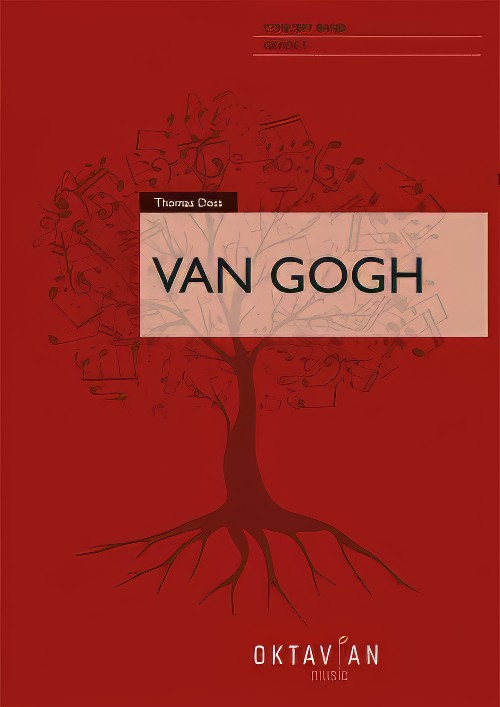
Van Gogh (Concert Band - Score and Parts) - Doss, Thomas
This composition is not a work inspired by the life of the famous painter, but rather an attempt at a pictorial immersion into his world. In addition to Van Gogh's character and tragic life, the technique he employed to create his works, the bright colours of his paintings and his view of nature served as inspiration for this musical work. Point by point, stroke by stroke, Van Gogh brought his own world to life on canvas.On the life of Van Gogh: The Dutch artist Vincent van Gogh was one of the most important pioneers of Modernism, despite being relatively unknown during his own lifetime. As an artist, he chose a life of poverty and seclusion. From today's perspective, his important woks were created from 1880 onwards, when he had already more or less succumbed to madness. While his earlier works could still be classed as contemporary, he matured into a pioneer of Expressionism with his later work indicating an increasing self-awareness. He was just 37 years old when he died but he created over 750 paintings and 1600 drawings in the last ten years of his life.The structure of the work:Start: Brushes and Paints: Van Gogh retired to Arles in southern France where he found his artistic home. The colours and flowering gardens of this landscape awakened in him an unbelievably great creative power.A: A Picture Comes into Being: Van Gogh's psychotic episodes and bouts of depression did not stop him from painting wonderful pictures. Hardly anyone recognised his genius during his lifetime, on the contrary, he often felt misunderstood.C: Paris - Arles: In Paris (from 1886), Van Gogh became inspired by the French art scene. His works found few takers, however. He met and befriended the painter Paul Gauguin, but the lack of success made Van Gogh short tempered, and he began to drink. Eventually, he moved from Paris to Arles in the south of France to establish an artists' collective with Gaugin. Within a few weeks, the two got into such a violent argument that Van Gogh attacked his friend with a knife. The friends parted ways and afterwards Van Gogh cut off his right ear. In 1889 he voluntarily admitted himself into a mental hospital at St. Remy, suffering from hallucinations and fearing that he would lose his mind.G: The Starry Night One of his most famous paintings, created in 1898.H: Death and Brotherly Love Vincent van Gogh accepted an invitation to Auver-sur-Oise in 1890. This was one of his most intensive creative periods. He also went there for treatment, but his mental state hardly improved. After an extended walk, he injured himself fatally with a pistol under mysterious circumstances. Not even to his beloved brother Theo, who had supported him all his life, did he reveal on his deathbed how the accident had occurred.J: Art Market Today, Van Gogh's paintings are among the most expensive paintings on the art market. How ironic, given that he could hardly sell a painting during his lifetime. "I put my heart and soul into my work and lost my mind in the process." (Vincent van Gogh)Duration: 13.15
Estimated dispatch 7-14 working days
 View Music