
Results
-
 £95.00
English Dance Suite - IV. Corranto (Concert Band - Score and Parts) - Gardner, John - Noble, Paul
Arranged for the modern Concert/Wind Band, scored for three trumpets, reasonable doubling of parts where the original musical effect is not altered so that players can have a more responsible and enjoyable experience, more legible parts with less doubling on one staff, etc. The piece is offered either as a complete suite of seven movements, and also as seven individual movements which may be purchased independently. The English Dance Suite was originally composed by John Gardner for Wind Band, and has been re-set for the modern Concert Band instrumentation. Both the original version, edited and type-set by Paul Noble, and this arrangement are first editions now available for purchase to bands around the world. The set of seven Renaissance dances depict John Gardner's love of Scottish music, the Renaissance heritage, and some of his own mischievous approach to music. The first movement, Chacony on a Golden Theme, reminiscent of the Allegro movement of Purcell's Golden Sonata, is much used as a vehicle for variation on a repeated short harmonic progression, often involving a fairly short repetitive bass-line which offered a compositional outline for variation, decoration, figuration and melodic invention. In this it closely resembles the passacaglia. The Alman originated in the 16th century as a duple metere dance of moderate tempo, already considered very old, with a characteristic double-knocking upbeat of one or occasionally three sixteenth notes. It appears to have derived from a German dance but no identifiable dance and no German dance instructions from this era survive. The Hornpipe, usually in 3/2 dance rhythm, is an Irish, Scottish and English dance. It is done in hard shoes, which are used to help keep track of how the dancer keeps in time. There are two variations of the hornpipe dance: fast and slow. Usually, more experienced dancers will do the slow hornpipe but younger dancers will start out with the fast hornpipe and then switch in later years. The Corranto is a 16th-century court dance characterized by short advances and retreats, in quick triple time. The Volta (Italian: the turn or turning) is an anglicised name from the later Renaissance. Its main figure consisted of a turn and lift in a sort of closed position. The Pavan is a slow processional dance common in Europe during the 16th century. The Reel, indigenous to Scotland, consists largely of quaver (eighth note) movement with an accent on the first and third beats of the bar.
Estimated dispatch 7-14 working days
-
 £75.00
English Dance Suite - V. Volta (Concert Band - Score and Parts) - Gardner, John - Noble, Paul
Arranged for the modern Concert/Wind Band, scored for three trumpets, reasonable doubling of parts where the original musical effect is not altered so that players can have a more responsible and enjoyable experience, more legible parts with less doubling on one staff, etc. The piece is offered either as a complete suite of seven movements, and also as seven individual movements which may be purchased independently. The English Dance Suite was originally composed by John Gardner for Wind Band, and has been re-set for the modern Concert Band instrumentation. Both the original version, edited and type-set by Paul Noble, and this arrangement are first editions now available for purchase to bands around the world. The set of seven Renaissance dances depict John Gardner's love of Scottish music, the Renaissance heritage, and some of his own mischievous approach to music. The first movement, Chacony on a Golden Theme, reminiscent of the Allegro movement of Purcell's Golden Sonata, is much used as a vehicle for variation on a repeated short harmonic progression, often involving a fairly short repetitive bass-line which offered a compositional outline for variation, decoration, figuration and melodic invention. In this it closely resembles the passacaglia. The Alman originated in the 16th century as a duple metere dance of moderate tempo, already considered very old, with a characteristic double-knocking upbeat of one or occasionally three sixteenth notes. It appears to have derived from a German dance but no identifiable dance and no German dance instructions from this era survive. The Hornpipe, usually in 3/2 dance rhythm, is an Irish, Scottish and English dance. It is done in hard shoes, which are used to help keep track of how the dancer keeps in time. There are two variations of the hornpipe dance: fast and slow. Usually, more experienced dancers will do the slow hornpipe but younger dancers will start out with the fast hornpipe and then switch in later years. The Corranto is a 16th-century court dance characterized by short advances and retreats, in quick triple time. The Volta (Italian: the turn or turning) is an anglicised name from the later Renaissance. Its main figure consisted of a turn and lift in a sort of closed position. The Pavan is a slow processional dance common in Europe during the 16th century. The Reel, indigenous to Scotland, consists largely of quaver (eighth note) movement with an accent on the first and third beats of the bar.
Estimated dispatch 7-14 working days
-
 £75.00
English Dance Suite - VI. Pavan (Concert Band - Score and Parts) - Gardner, John - Noble, Paul
Arranged for the modern Concert/Wind Band, scored for three trumpets, reasonable doubling of parts where the original musical effect is not altered so that players can have a more responsible and enjoyable experience, more legible parts with less doubling on one staff, etc. The piece is offered either as a complete suite of seven movements, and also as seven individual movements which may be purchased independently. The English Dance Suite was originally composed by John Gardner for Wind Band, and has been re-set for the modern Concert Band instrumentation. Both the original version, edited and type-set by Paul Noble, and this arrangement are first editions now available for purchase to bands around the world. The set of seven Renaissance dances depict John Gardner's love of Scottish music, the Renaissance heritage, and some of his own mischievous approach to music. The first movement, Chacony on a Golden Theme, reminiscent of the Allegro movement of Purcell's Golden Sonata, is much used as a vehicle for variation on a repeated short harmonic progression, often involving a fairly short repetitive bass-line which offered a compositional outline for variation, decoration, figuration and melodic invention. In this it closely resembles the passacaglia. The Alman originated in the 16th century as a duple metere dance of moderate tempo, already considered very old, with a characteristic double-knocking upbeat of one or occasionally three sixteenth notes. It appears to have derived from a German dance but no identifiable dance and no German dance instructions from this era survive. The Hornpipe, usually in 3/2 dance rhythm, is an Irish, Scottish and English dance. It is done in hard shoes, which are used to help keep track of how the dancer keeps in time. There are two variations of the hornpipe dance: fast and slow. Usually, more experienced dancers will do the slow hornpipe but younger dancers will start out with the fast hornpipe and then switch in later years. The Corranto is a 16th-century court dance characterized by short advances and retreats, in quick triple time. The Volta (Italian: the turn or turning) is an anglicised name from the later Renaissance. Its main figure consisted of a turn and lift in a sort of closed position. The Pavan is a slow processional dance common in Europe during the 16th century. The Reel, indigenous to Scotland, consists largely of quaver (eighth note) movement with an accent on the first and third beats of the bar.
Estimated dispatch 7-14 working days
-
 £125.00
English Dance Suite - VII. Reel (Concert Band - Score and Parts) - Gardner, John - Noble, Paul
Arranged for the modern Concert/Wind Band, scored for three trumpets, reasonable doubling of parts where the original musical effect is not altered so that players can have a more responsible and enjoyable experience, more legible parts with less doubling on one staff, etc. The piece is offered either as a complete suite of seven movements, and also as seven individual movements which may be purchased independently. The English Dance Suite was originally composed by John Gardner for Wind Band, and has been re-set for the modern Concert Band instrumentation. Both the original version, edited and type-set by Paul Noble, and this arrangement are first editions now available for purchase to bands around the world. The set of seven Renaissance dances depict John Gardner's love of Scottish music, the Renaissance heritage, and some of his own mischievous approach to music. The first movement, Chacony on a Golden Theme, reminiscent of the Allegro movement of Purcell's Golden Sonata, is much used as a vehicle for variation on a repeated short harmonic progression, often involving a fairly short repetitive bass-line which offered a compositional outline for variation, decoration, figuration and melodic invention. In this it closely resembles the passacaglia. The Alman originated in the 16th century as a duple metere dance of moderate tempo, already considered very old, with a characteristic double-knocking upbeat of one or occasionally three sixteenth notes. It appears to have derived from a German dance but no identifiable dance and no German dance instructions from this era survive. The Hornpipe, usually in 3/2 dance rhythm, is an Irish, Scottish and English dance. It is done in hard shoes, which are used to help keep track of how the dancer keeps in time. There are two variations of the hornpipe dance: fast and slow. Usually, more experienced dancers will do the slow hornpipe but younger dancers will start out with the fast hornpipe and then switch in later years. The Corranto is a 16th-century court dance characterized by short advances and retreats, in quick triple time. The Volta (Italian: the turn or turning) is an anglicised name from the later Renaissance. Its main figure consisted of a turn and lift in a sort of closed position. The Pavan is a slow processional dance common in Europe during the 16th century. The Reel, indigenous to Scotland, consists largely of quaver (eighth note) movement with an accent on the first and third beats of the bar.
Estimated dispatch 7-14 working days
-
 £242.50
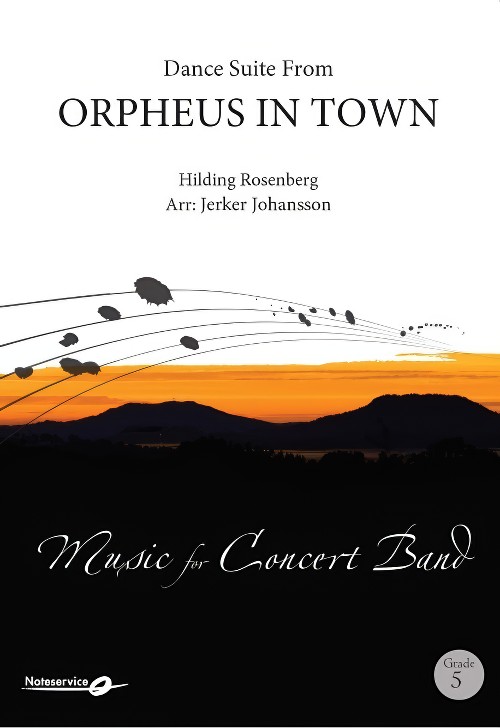
Orpheus in Town, Dance Suite from (Concert Band - Score and Parts) - Rosenberg, Hilding - Johansson, Jerker
Dance Suite in Seven Movements. Op.75. Orpheus In Town. In 1936 the Stockholm Concert Hall was given its most distinguished artistic adornment, Carl Milles' Orpheus fountain. A Greek god lets his voice and the sounds of his lyre float over the rush and bustle of the big city far up in Ultima Thule. Two choreographers at the Stockholm Opera, Julian Algo and Vera Sager, had a brainwave. Why should Orpheus merely be a statue, a symbol of the beauty and inspiring power of music, why not give the myth about him its special Stockholm chapter as well? This is what happened: On the stage we see the columned facade of the Concert Hall and in front of it the statue group with Orpheus and the eight enraptured listeners. Suddenly the figures come to life, jump down from their pedestal and dance into the crowd at the marketplace. Orpheus, who is consumed by longing for Eurydice, begins looking for his beloved, first among other well-known sculptures in town, then in restaurants and nightclubs. At last he thinks he recognises her in a fashionable society woman and brings her to the Concert Hall. However, faced with the threat of having to spend her life in bronze at Orpheus' side, she runs away. She wasn't Eurydice after all. Or was she? For this ballet, which had its first performance at the Stockholm Opera in 1938, Hilding Rosenberg wrote vital and entertaining music in a style which is unusually to the point, and with a bright and strong orchestration. The music in the Dance Suite from Orpheus in Town is taken from the dance scenes at the nightclub: guests and a bartender perform, finally also Orpheus and his entourage. The suite consists of: 1. Rhythm of the Times (2.00); 2. Bartender's Dance (1.30); 3. Girl's Dance (1.00); 4. Dance of the Negress (2.30); 5. Trio Dance (1.30); 6. Tango (2.00); 7. Finale (1.30). Total duration: 14.00.
Estimated dispatch 7-14 working days
-
 £375.00
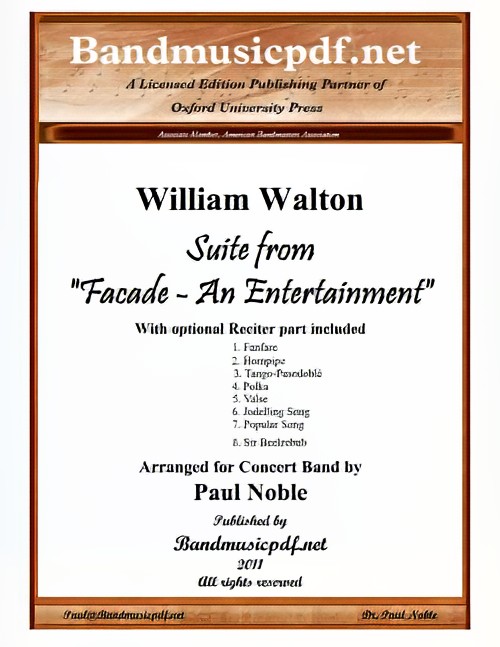
Facade - An Entertainment, Suite from (Concert Band with Optional Narrator - Score and Parts) - Walton, William - Noble, Paul
This Suite from Facade - An Entertainment, composed by William Walton, with poems by Dame Edith Sitwell, presents for the first time a grouping of movements selected and arranged by Paul Noble for Concert Band and optional Reciter. The original composition was written between 1921 and 1928, containing forty-three numbers. They had their origin in a new style of poetry that Edith Sitwell evolved in the early 1920s, poems that her brother Osbert later described as 'experiments in obtaining through the medium of words the rhythm and dance measures such as waltzes, polkas, foxtrots... Some of the resulting poems were sad and serious... Others were mocking and gay... All possessed a quite extraordinary and haunting fascination.' Possibly influenced by the dance references in some of the numbers, Osbert declared that the poems might be further enhanced if spoken to a musical accompaniment. The obvious choice of composer was the young man who lived and worked in an attic room of the Sitwell brothers' house in Carlyle Square W[illiam] T[urner] Walton, as he then styled himself. The now historic first performance of the Facade Entertainment took place in an L-shaped first-floor drawing-room on January 24, 1922. Accompaniments to sixteen poems and two short musical numbers were performed by an ensemble of five players. The performers were obscured from the audience by a decorated front curtain, through which a megaphone protruded for Edith to declaim her poems. This was, as she put it, 'to deprive the work of any personal quality'. The first public performance of Facade was given at the Aeolian Hall on June 12, 1923. By now, fourteen poems had been set, others revised or rejected, and an alto saxophone added to the ensemble. The occasion gave rise to widespread publicity, both pro and contra, and the name of the twenty-one year old W. T. Walton was truly launched. In the ensuing years the Facade has gone through revisions and additions, with full orchestral arrangements of selected movements being made without the Reciter. Former Band Director Robert O'Brien arranged some movements for band, again without Reciter, which are now out of print. So this 'history making' addition is the first opportunity for Concert Bands to present some movements of Facade with poems as originally intended. The luxury of electronic amplification allows the full ensemble to perform without necessarily overshadowing the Reciter. And the arrangements are written with considerable doubling so that the ensemble may play in full, or reduced in size as may be desired for proper balance. And, though not encouraged, the arrangements are written so that the band can perform the music without the Reciter. Program notes are adapted in part from those written by David Lloyd-Jones and published by Oxford University Press in the Study Score of William Walton's Facade Entertainments.
Estimated dispatch 7-14 working days
-
 £89.95
Dance Suite (Concert Band - Score and Parts) - Wiffin, Rob
Dance Suite comprises three dances - Femme Fatale (a tango), Midnight Wish (a rumba) and Wherever I look (a Mambo). The first two movements are fairly straightforward but the mambo is a little more difficult and also requires 4 rather than three trumpets - the fourth part being included in the first trumpet part in the complete suite. The music works best with a string bass or a bass guitar but the bass line is fully cued in the tuba part. Each of the movements is also available separately.Duration: 11.00
Estimated dispatch 7-14 working days
-
 £75.00
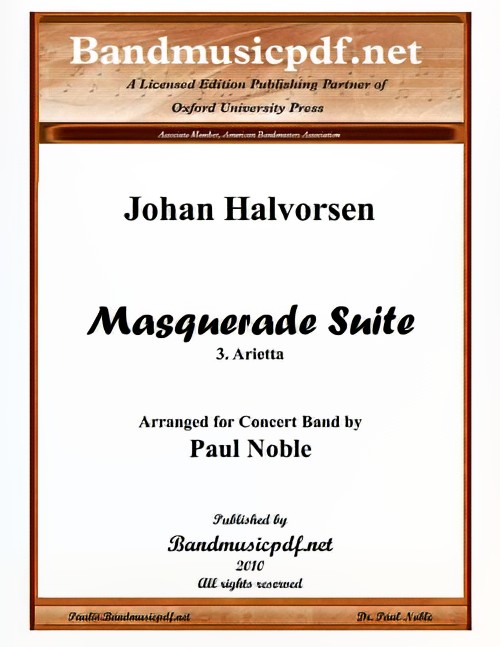
Arietta (from Masquerade Suite) (Concert Band - Score and Parts) - Halvorsen, Johan - Noble, Paul
Masquerade Suite was composed by Johan Halvorsen, one of the best-kept secrets of Norway. Not only was he an accomplished violinist and conductor, but also he was among the most prominent Norwegian composers in the generation following Edvard Grieg. His compositions develop the national Romantic tradition of his friends Grieg and Svendsen, but his was a distinctive style marked by brilliant orchestration inspired by the French Romantic composers. The original version of Masquerade Suite had nine movements. Paul Noble has selected five of the most suitable movements for band transcription and grouped them into this beautiful suite. The U.S. Navy Band in Washington, D.C. gave the premiere performance of this work. The first movement, Holberg Overture, sets the mood, pace, and musical themes for the entire suite, with rousing opening themes, followed by a grand fugue in the development section. This is clearly a piece for accomplished bands, giving all wind players a real workout. Each of the succeeding movements has a distinctive style, making the suite a significant addition to the repertoire of the Concert Band. Especially noteworthy is the Arietta, the easiest of the movements, and can easily stand alone with its haunting flute and oboe melodies and dramatic crescendo, the crisp solos in the Molinasque, and the final movement, which is very much like a circus march, fast, lively and short!
Estimated dispatch 7-14 working days
-
 £75.00
Hanedansen (from Masquerade Suite) (Concert Band - Score and Parts) - Halvorsen, Johan - Noble, Paul
Masquerade Suite was composed by Johan Halvorsen, one of the best-kept secrets of Norway. Not only was he an accomplished violinist and conductor, but also he was among the most prominent Norwegian composers in the generation following Edvard Grieg. His compositions develop the national Romantic tradition of his friends Grieg and Svendsen, but his was a distinctive style marked by brilliant orchestration inspired by the French Romantic composers. The original version of Masquerade Suite had nine movements. Paul Noble has selected five of the most suitable movements for band transcription and grouped them into this beautiful suite. The U.S. Navy Band in Washington, D.C. gave the premiere performance of this work. The first movement, Holberg Overture, sets the mood, pace, and musical themes for the entire suite, with rousing opening themes, followed by a grand fugue in the development section. This is clearly a piece for accomplished bands, giving all wind players a real workout. Each of the succeeding movements has a distinctive style, making the suite a significant addition to the repertoire of the Concert Band. Especially noteworthy is the Arietta, the easiest of the movements, and can easily stand alone with its haunting flute and oboe melodies and dramatic crescendo, the crisp solos in the Molinasque, and the final movement, which is very much like a circus march, fast, lively and short!
Estimated dispatch 7-14 working days
-
 £75.00
Holberg Overture (from Masquerade Suite) (Concert Band - Score and Parts) - Halvorsen, Johan - Noble, Paul
Masquerade Suite was composed by Johan Halvorsen, one of the best-kept secrets of Norway. Not only was he an accomplished violinist and conductor, but also he was among the most prominent Norwegian composers in the generation following Edvard Grieg. His compositions develop the national Romantic tradition of his friends Grieg and Svendsen, but his was a distinctive style marked by brilliant orchestration inspired by the French Romantic composers. The original version of Masquerade Suite had nine movements. Paul Noble has selected five of the most suitable movements for band transcription and grouped them into this beautiful suite. The U.S. Navy Band in Washington, D.C. gave the premiere performance of this work. The first movement, Holberg Overture, sets the mood, pace, and musical themes for the entire suite, with rousing opening themes, followed by a grand fugue in the development section. This is clearly a piece for accomplished bands, giving all wind players a real workout. Each of the succeeding movements has a distinctive style, making the suite a significant addition to the repertoire of the Concert Band. Especially noteworthy is the Arietta, the easiest of the movements, and can easily stand alone with its haunting flute and oboe melodies and dramatic crescendo, the crisp solos in the Molinasque, and the final movement, which is very much like a circus march, fast, lively and short!
Estimated dispatch 7-14 working days
 View Music