
Results
-
 £67.32
Where the River Flows
A suite in 3 parts based on the story of a young boy who was abducted by a Shawnee Indian hunting party in 1771. The first movement, "The New Frontier" is a bold and majestic section containing the patented Swearingen melodic themes which have made his music so popular. "Bring Back My Child" is a solemn section which includes some sorrowful chanting(optional) by members of the band and some very expressive solo spots for the 1st Clarinet and Flute. The third movement, "Great Chief" has a bright and rhythmic character bringing the suite to a dramatic and exciting climax.
Estimated dispatch 7-14 working days
-
 £32.95
Pavane - The Town (Concert Band - Score and Parts) - Wiffin, Rob
The first movement of Aylesbury Dances re-fashioned with a different middle section for the Band of the Household Cavalry. Having performed Wiffin's Aylesbury Dances, the Director of Music of the Band of the Household Cavalry requested a revised version of the first movement of the suite which would be suited to being played on horseback!Duration: 2.30
Estimated dispatch 7-14 working days
-
 £156.00
A Midsummer Night's Dream (Concert Band - Score and Parts) - Mendelssohn, Felix - De Meij, Johan
Suite from the Incidental Music. Felix Mendelssohn Bartholdy (1809 - 1847) composed the music for William Shakespeare's play A Midsummer Night's Dream at two different times. In 1826, at the age of 16, he wrote a concert overture (Op. 21). Sixteen years later, in 1842, he composed the incidental music (opus 61) for King Frederick William IV of Prussia, in which he incorporated the existing overture. The overture premiered in Stettin (then in Prussia, now Szczecin, Poland) on February 20, 1827, conducted by Carl Loewe. Mendelssohn had to travel 80 miles through a raging snowstorm to get to the concert, which became his first public appearance. The first British performance of the overture was conducted by Mendelssohn himself on June 24, 1829, at the Argyll Rooms in London. After the concert, Thomas Attwood was given the score of the overture for safekeeping, but left it in a taxi and was never found. Mendelssohn later rewrote the overture entirely from memory.Duration: 14.45
Estimated dispatch 7-14 working days
-
 £79.95
Timepiece (Concert Band - Score and Parts) - Wiffin, Rob
Timepiece is a challenging work full of driving rhythms and relentless energy. It started life as the first movement of The Sands of Time, a commissioned work for clarinet choir. Because of the time limits of the commission, Wiffin could not develop the material as much as he had wanted to. He rescored it for wind band and included it as the first movement of a suite, but it did not sit well there because of its difficulty. Now re-worked and extended, the driving rhythms and many changes of time that give the piece its name are now balanced by a quieter, tranquil central section in 3/4. It is not easy, but most of the difficulty lies in the reading of the music rather than in any particular technical problems. It is recorded on on the RAF CD, Music in the Air.Duration: 6.15
Estimated dispatch 7-14 working days
-
 £53.95
Wings (Concert Band - Score and Parts) - Gassi, Vince
The men and women of the Royal Canadian Air Force are the inspiration behind this original composition by Vince Gassi. The first work in his Armed Forces Suite, it takes off with a bright, spirited theme first heard in the flutes. The rest of the ensemble soon joins in the maneuvers and offers a fuller tactical report. Clarinets take over with dignity, providing a lyrical contrast, and are supported by a stately accompaniment. It isn't long before we start to feel the "spirit of adventure" building to a contrasting section conveying images of stealth and intrigue. Covert operations lead finally to a restatement of the opening theme by the brass with flute and clarinet obligato. Interlace with fragments from the covert section and we are carried to a soaring conclusion. If you are looking for a spirited concert opener or closer, look no further!Duration: 3:15
Estimated dispatch 7-14 working days
-
 £44.95
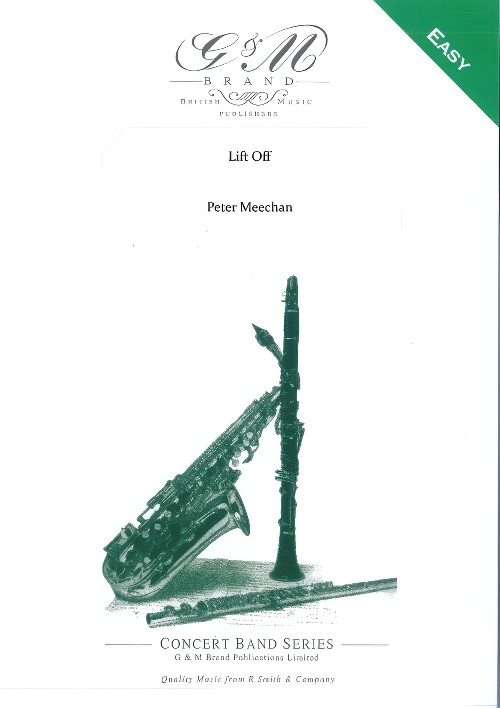
Lift Off (Concert Band - Score and Parts) - Meechan, Peter
Lift Off! is a short suite of descriptive pieces, all inspired by a short flight from Manchester, England to Brussels. In the first movement we hear the engine start, and after the plane has moved into position, it takes off. The second movement depicts the beautiful view of the clouds from above. It all seems timeless and you don't even feel as if you are moving. The last movement starts nervously (I'm not a great flier!), as the plane begins its descent from the sky. However, as we land safely back on earth, the piece ends in a flurry of excitement and triumph, returning to a theme heard in the first movement.
Estimated dispatch 7-14 working days
-
£8.95
Lift Off (Concert Band - Score Only) - Meechan, Peter
Lift Off! is a short suite of descriptive pieces, all inspired by a short flight from Manchester, England to Brussels. In the first movement we hear the engine start, and after the plane has moved into position, it takes off. The second movement depicts the beautiful view of the clouds from above. It all seems timeless and you don't even feel as if you are moving. The last movement starts nervously (I'm not a great flier!), as the plane begins its descent from the sky. However, as we land safely back on earth, the piece ends in a flurry of excitement and triumph, returning to a theme heard in the first movement.
Estimated dispatch 7-14 working days
-
 £124.95
SWORD AND THE CROWN, The (Prestige Concert Band - Score and Parts) - Gregson, Edward
In 1988 I was commissioned by the Royal Shakespeare Company to write the music for The Plantagenets trilogy, directed by Adrian Noble in Stratford-upon-Avon. These plays take us from the death of Henry V to the death of Richard III. Later, in 1991, I wrote the music for Henry IV parts 1 and 2, again in Stratford. All of these plays are concerned with the struggle for power (the crown) through the use of force (the sword) and they portray one of the most turbulent periods in the history of the British monarchy.This work quickly became established in the mainstream repertoire and has received performances worldwide as well as five commercial recordings and many broadcasts. In 2002 I was approached by the Parc and Dare Band regarding their summer festival and commissioned to do a version for brass band. This was given its first performance in Treorchy Hall by the combined bands of Black Dyke and Parc and Dare conducted by Nicholas Childs.When the Royal Air Force Music Services commissioned me to write a work especially for their British tour in 1991 I immediately thought of turning to this music and transforming some of it into a three-movement suite for symphonic band.The first movement opens with a brief fanfare for two antiphonal trumpets (off-stage), but this only acts as a preface to a Requiem aeternam (the death of Henry V) before changing mood to the English army on the march to France; this subsides into a French victory march, but the English army music returns in counterpoint. Finally, a brief reminder of the Requiem music leads to the triumphal music for Richard Plantagenet, Duke of York, father of Edward IV and Richard III (the opening fanfare transformed).The second movement takes music from the Welsh Court in Henry IV (part 1) which is tranquil in mood; distant fanfares foreboding battles to come are heard, but the folktune is heard three times in different variations and the movement ends as it began with alto flute and gentle percussion.The final movement starts with two sets of antiphonally placed timpani, drums and tam-tam, portraying the 'war machine' and savagery of battle. Trumpet fanfares and horn calls herald an heroic battle theme which, by the end of the movement, transforms itself into a triumphant hymn for Henry IV's defeat of the rebellious forces.- Edward GregsonPerformance time 13'54"Recorded on QPRM117D FESTIVAL OF MUSIC 1991, Massed Bands of the Royal Air ForceRecorded on QPRM120D THE SWORD AND THE CROWN, Central Band of the Royal Air Force'Finale' recorded on QPRM142D FESTIVAL OF MUSIC 2002, Massed Bands of the Royal Air Force)
Estimated dispatch 7-14 working days
-
 £87.95
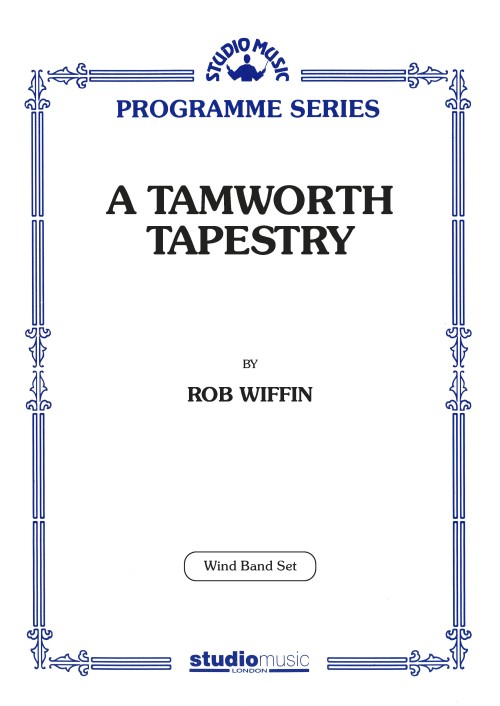
A Tamworth Tapestry (Concert Band - Score and Parts) - Wiffin, Rob
A Tamworth Tapestry was commissioned by the Tamworth Wind Band who gave the first performance in Fazeley, Tamworth, on 27 Apr 2024. In composing it I drew on aspects of Tamworth starting with a short malicious outburst to depict the warlike history of the town's Norman castle. From there the music moves into a slow-flowing minor key movement entitled River Tame. The Celtic derivation of the word Tame means dark and slow-moving. The suite ends with a saltarello - Tomsaete. The Tomsaete were an Anglo-Saxon tribe who lived in the valley of the River Tame and remained around Tamworth throughout the duration of the Kingdom of Mercia. There is also a play on words with the band's conductor - Tom Sears. I combined the saltarello with some allusions to various other Tamworth references including Kingsbury Water Park, Drayton Manor Theme Park, Tamworth Pigs and even a reference to the Robin Reliant!Duration: 6.15
Estimated dispatch 7-14 working days
-
£17.95
A Tamworth Tapestry (Concert Band - Score only) - Wiffin, Rob
A Tamworth Tapestry was commissioned by the Tamworth Wind Band who gave the first performance in Fazeley, Tamworth, on 27 Apr 2024. In composing it I drew on aspects of Tamworth starting with a short malicious outburst to depict the warlike history of the town's Norman castle. From there the music moves into a slow-flowing minor key movement entitled River Tame. The Celtic derivation of the word Tame means dark and slow-moving. The suite ends with a saltarello - Tomsaete. The Tomsaete were an Anglo-Saxon tribe who lived in the valley of the River Tame and remained around Tamworth throughout the duration of the Kingdom of Mercia. There is also a play on words with the band's conductor - Tom Sears. I combined the saltarello with some allusions to various other Tamworth references including Kingsbury Water Park, Drayton Manor Theme Park, Tamworth Pigs and even a reference to the Robin Reliant!Duration: 6.15
Estimated dispatch 7-14 working days
 View Music