
Results
-
 £76.80
Splashing Sounds - Manfred Schneider
Manfred Schneider (1953), musician with the German Army Band Heeresmusikkorps 300 in Koblenz, got a good reputation with wind bands in Europe with his overture 'Upside Down', 'Song of Freedom', 'Rock and Go' and 'Rock Symphony' .'Splashing Sounds' is a lively modern quick march, quite complying with its title.
Estimated dispatch 7-14 working days
-
 £61.00
Trumpets in the Night - Terry Kenny
Trumpets in the Night' is designed to give the audience something to see. Soloists should be positioned at a distance from the band. Preferably behind or in the audience, or at some height, say in the balcony. Directors will surely think of all manners of ingenious ideas! (You could tell how it was played in the shopping centre coming down the escalator.)
Estimated dispatch 7-14 working days
-
 £214.80
Skies - Oliver Waespi
Program notes by Oliver Waespi on his composition Skies:Skies is the plural of Sky. We may wonder are there several skies? Is the sky we all long for not the same for everybody? While travelling on foot and "in the open air" I have observed the firmament often in quite different shapes, so that I can say I have indeed experienced the sky in different ways. Years ago I already wanted to portray "my sky" in music; I finally have been able to realise this long-cherished dream.This composition deals with the sky, more precisely with my sensual and emotional experience of the sky in all its aspects. Two point of views are combined in this composition: one showing the sky as it presents itself to me, the other showing the sky as I observe it. The music was bom simultaneously by intemal and extemal inspiration: it describes nature but also the emotional and spiritual experience of nature. To me, the experience of nature is not abstract, but it is connected with concrete ages, places or people from my neighbourhood. This is why I have combined several parts of this composition with certain landscapes.The sky presents itself in different landscapes in the most varied ways: for the sensual experience, there is no sky as such. The indications of places spread all over the score, are primarily clues for myself; they represent certain atmospheres, which I have experienced especially in England and Scotland. They can however also be useful to the musicians and the audience, providing they know those landscapes and the celestial atmospheres linked to them.The music is independent from the atmospheres described in the subtitles, as those are rather connected to a tragic nature, and so the music is not based on any program. Musically spoken, the composition has a symphonic structure, which means that the complete musical material is derived from three contrasting main themes. In the first part, the description of a noctumal sky ("Night") two themes are developed in an organic way; the first, rather "dusky", is to be found with the horns, the second, "in bright daylight", with the oboe and flute, the third, "more quiet" , with the brass instruments. In the next part, we have clouds and rain over the Isle of Skye (one of the Hebrides islands in Scotland) and here several elements of the first theme are still more developed. Then we get an increasingly dark mood, which is released, in heavy chords. Then suddenly, the sun breaks through and the music gets a majestic character. We have a new shape of the initial theme, first with the French horns and then with the trombones. The music gets a quicker tempo and flows into a quick movement describing the winds and waves at sea ("Wind and Waves"). Three themes are gathering and some variations are developed. The music gets more and more energetic and, after a climax, calms down again. Then we have a kind of "summer pastoral" which suggests summer at the South coast of Cornwall ("South Coast of Penwith Peninsuia in Summer"). This is certainly not the hotte st summer in Europe, but still it is beautiful in this country that is blessed with so much rain. In the "pastoral" , the sea is already sketched in broad outlines in the French horn solo. The magnificence of an aftemoon at the seaside is developed at the end of the composition ("Noon at Treen Cliff', a rock protruding in the sea next to Porthcumo at the South Coast of Cornwall); here the music gets stronger and stronger and after a majestic climax it vanishes completely.
Estimated dispatch 7-14 working days
-
 £159.60
Mais Alto e mais Longe - Afonso Alves
This beautiful overture by the Portuguese composer Afonso Alvares starts with a broad andante that soon turns into a partly rhythmical partly singing allegro evoking the world of thrilling adventures in grandiose settings. The atmosphere calms down and becomes more lyrical in the spinned out adagio that describes inner feelings and yet refers from time to time to the suggested adventures. Repetition of several themes leads to an impressive climax.
Estimated dispatch 7-14 working days
-
 £87.00
Movenze di Festa - Lorenzo Della Fonte
Mid-August's 'great celebration' is the most eagerly awaited event on the Sassari (Sardinia, Italy) calendar. On this day the 'Candelieri' (candles), better described as large and very heavy wax columns - are brought down into the town, decorated with coloured ribbons, flowers and garlands.
Estimated dispatch 7-14 working days
-
 £51.60
Sakura Variations - Kees Vlak
The blooming of the cherry trees each spring is a great event in Japan. In the evening friends meet under the pink and white cherry blossoms for a picnic. It is a striking sight, especially in big cities. Vendors sell Japanese food, entertainers andclowns perform, and the typically cautious Japanese seem to be more relaxed during the cherry blossom, or "Sakura". Kees Vlak captured this atmosphere with his "Sakura Variation"; its theme employs a subtle drum rhythm. The first variation is titled"clowns" and opens with three bass drum strikes. The theme appears in 3/4 time and is repeated several times with surprising changes. An impetuous tempo with dissonant elements suggests a clown's mischievous behaviour. The second variation in a minormode sounds very sad and dramatic. Is this the sadness when thinking of the end of the cherry blossom, as all the petals "snow" down from the trees? The cherry trees will bloom again next year, so the finale celebrates a joyful "Sakura".
Estimated dispatch 7-14 working days
-
 £202.99
Gloriosa - Symphonic Poem for Band Movement 1 - Yasuhide Ito
A new acquisition by Bravo Music, this fresh printing of the 1990 masterwork by Yasuhide Ito features a newly engraved score, improved parts, good availability and value. This stirring and powerful homage to early Christianity in Japan profoundly and eloquently states the case of cross-cultural conflict and resolution.I. OratioThe Gregorian chant "Gloriosa" begins with the words, "O gloriosa Domina excelsa super sidera que te creavit provide lactasti sacro ubere." The first movement Oratio opens with bells sounding the hymn's initial phrases. The movement as a whole evokes the fervent prayers and suffering of the Crypto-Christians.II. CantusIII. Dies FestusCommissioned in 1989 and premiered in 1990 by the Sasebo Band of the Maritime Self-Defense Force of Kyushu, southern Japan.Gloriosa is inspired by the songs of the Kakure-Kirishitan (Crypto-Christians) of Kyushu who continued to practice their faith surreptitiously after the ban of Christianity, which had been introduced to that southern region in the mid-16th century by Roman Catholic missionary Francisco Xavier. The worship brought with it a variety of western music.Though Christianity was proscribed in 1612 by authority of the Tokugawa Shogunate in Edo (today Tokyo), Kakure-Kirishitan continued advocating sermons and disguised songs. Melodies and lyrics such as Gregorian chant were obliged to be "Japanized". For example, the Latin word "Gloriosa" was changed to "Gururiyoza." This adaptation of liturgy for survival inspired Ito to write this piece in order to reveal and solve this unique cultural mystery.The composer explains:"Nagasaki district in Kyushu region continued to accept foreign culture even during the seclusion period, as Japan's only window to the outer world. After the proscription of Christianity, the faith was preserved and handed down in secret in the Nagasaki and Shimabara areas of Kyushu region. My interest was piqued by the way in which the Latin words of Gregorian chants were gradually `Japanized' during the 200 years of hidden practice of the Christian faith. That music forms the basis of Gloriosa."Gloriosa, fusing Gregorian chant and Japanese folk music, displays the most sophisticated counterpoint yet found in any Japanese composition for wind orchestra.
Estimated dispatch 7-14 working days
-
£209.99
Gloriosa - Symphonic Poem for Band Mvt 2 & 3 - Yasuhide Ito
A new acquisition by Bravo Music, this fresh printing of the 1990 masterwork by Yasuhide Ito features a newly engraved score, improved parts, good availability and value. This stirring and powerful homage to early Christianity in Japan profoundly and eloquently states the case of cross-cultural conflict and resolution.I. OratioThe Gregorian chant "Gloriosa" begins with the words, "O gloriosa Domina excelsa super sidera que te creavit provide lactasti sacro ubere." The first movement Oratio opens with bells sounding the hymn's initial phrases. The movement as a whole evokes the fervent prayers and suffering of the Crypto-Christians.II. CantusIII. Dies FestusCommissioned in 1989 and premiered in 1990 by the Sasebo Band of the Maritime Self-Defense Force of Kyushu, southern Japan.Gloriosa is inspired by the songs of the Kakure-Kirishitan (Crypto-Christians) of Kyushu who continued to practice their faith surreptitiously after the ban of Christianity, which had been introduced to that southern region in the mid-16th century by Roman Catholic missionary Francisco Xavier. The worship brought with it a variety of western music.Though Christianity was proscribed in 1612 by authority of the Tokugawa Shogunate in Edo (today Tokyo), Kakure-Kirishitan continued advocating sermons and disguised songs. Melodies and lyrics such as Gregorian chant were obliged to be "Japanized". For example, the Latin word "Gloriosa" was changed to "Gururiyoza." This adaptation of liturgy for survival inspired Ito to write this piece in order to reveal and solve this unique cultural mystery.The composer explains:"Nagasaki district in Kyushu region continued to accept foreign culture even during the seclusion period, as Japan's only window to the outer world. After the proscription of Christianity, the faith was preserved and handed down in secret in the Nagasaki and Shimabara areas of Kyushu region. My interest was piqued by the way in which the Latin words of Gregorian chants were gradually `Japanized' during the 200 years of hidden practice of the Christian faith. That music forms the basis of Gloriosa."Gloriosa, fusing Gregorian chant and Japanese folk music, displays the most sophisticated counterpoint yet found in any Japanese composition for wind orchestra.
Estimated dispatch 7-14 working days
-
 £71.50
Scorpius - Sean O'Loughlin
This thing is sharp! Written at a fast, but accessible time signature, young musicians will feel as though they are laying down a track for a major movie label! Composer Sean O'Loughlin puts his film-scoring experience to good use in this phenomenal new work for the developing band.
Estimated dispatch 7-14 working days
-
 £144.99
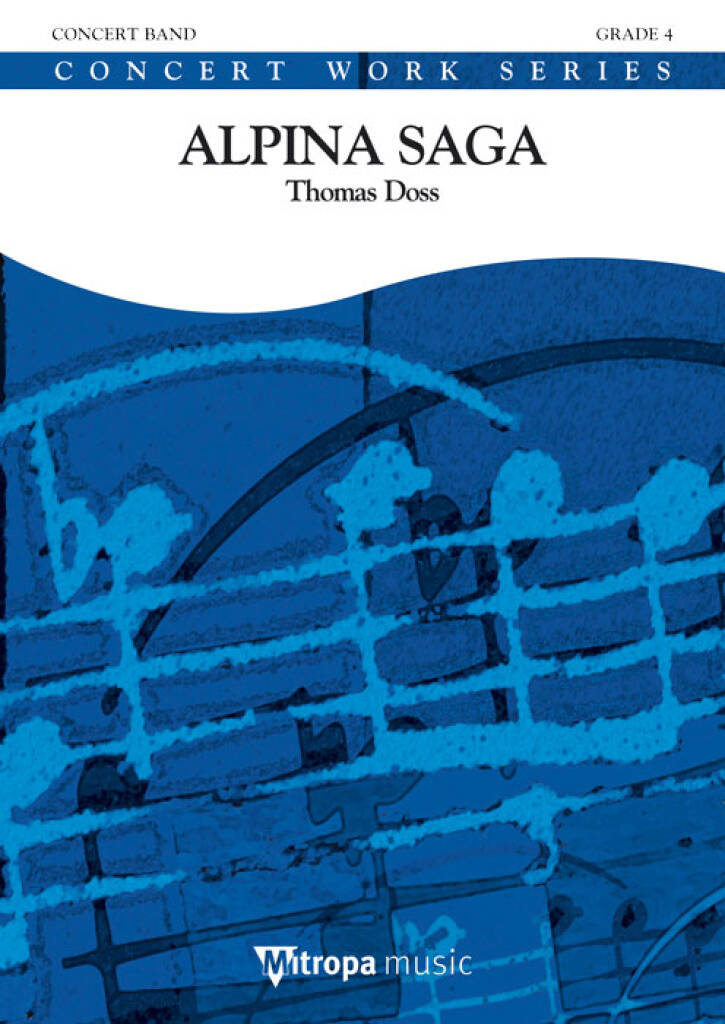
Alpina Saga - Thomas Doss
The enticing sounds of a fanfare come drifting down the mountainside into the valley. A hiker pauses and looks upward to admire the beauty of the mountain. However prudence is in order, for this splendour can be deceiving and many a hiker has taken this way - never to return.
Estimated dispatch 7-14 working days
 View Music