
Results
-
 £214.95
Dance Movements (Prestige Concert Band - Score and Parts) - Sparke, Philip
Dance Movements was commissioned by the United States Air Force Band and first performed by them in February 1996. A tour-de-force for a large band, the work is in four continuous movements which have dance rhythms and moods as their basis. The second movement features the woodwinds and the third is for brass.Winner of the prestigious "Sudler Award" for new music for wind band 1997.Performance time 20'30"Recorded on QPRM129D VENETIAN SPELLS, Central Band of the Royal Air Force - 'Molto Ritmico'Recorded on QPRM130D FIESTA!, Central Band of the Royal Air Force
Estimated dispatch 7-14 working days
-
£49.95
Dance Movements (Prestige Concert Band - Score only) - Sparke, Philip
Score only.Dance Movements was commissioned by the United States Air Force Band and first performed by them in February 1996. A tour-de-force for a large band, the work is in four continuous movements which have dance rhythms and moods as their basis. The second movement features the woodwinds and the third is for brass. Winner of the prestigious "Sudler Award" for new music for wind band 1997.Performance time 20'30"Recorded on QPRM129D VENETIAN SPELLS, Central Band of the Royal Air Force - 'Molto Ritmico'Recorded on QPRM130D FIESTA!, Central Band of the Royal Air Force
Estimated dispatch 7-14 working days
-
 £214.80
Dance Suite - Joseph Horovitz
This work follows a tradition established at the end of the seventeenth century: the creation of a musical structure by using a succession of dance movements, composed in such a way that a satisfying cumulative effect is produced. This method can be traced, starting from the works of Corelli, through the so-called Mannheim school to Mozart, and on to Brahms and beyond. Indeed, most classical symphonies owe their origin to this tradition.Each of the three movements of Dance Suite contains themes and motifs which are based on clearly identifiable dance patterns, more or less traditional and tonal in harmonic language.The first movement is a mixture af march- and gavotte elements, but these occur as variants of a single main theme. The tempo is brisk and the strongly accentuated four-beat measures creates a feeling of motoric drive. This is often counteracted by unexpected syncopation and surprising modulations. Horovitz dispenses with a second subject in favour of a very elaborate development, which makes the final quotation of the theme into a sort of recapitulation.In contrast, the second movement is a gentle, gracefully undulating dance, using two steady beats in every measure. Here there are two themes, the first more rhythmic, the second more lyrical. The second theme always uses the first as accompaniment, rather as a singer might use a guitar. Both themes undergo several modulations before returning to the home key. A Spanish flavour pervades the rhythmic and melodic elements of this movement.The finale is a fast rondo (in 6/8) whose main theme is best described as a tarantella. This alternates several times with a more solid, rustic theme (in 2/4). However, the main theme is recalled in varying guises, including a parody Latin-American version. The orchestration becomes mor elaborate and exciting as the movement proceeds, and the whole work ends with a coda recalling the main rond-theme with an enthusiastic flourish.Joseph Horovitz wrote about Dance Suite: "Most of the melodies and rhythms in the Dance Suite have been in my thoughts for many years, ever since my eraly career as conductor of ballet, and later as composer of some sixteen ballet scores. Some of these ideas were sketched on manuscript paper, others remained in my head and even in my dreams. The composition of this work gave me the chance to search among these half-subconscious sources and to offer my discoveries to the wind-orchestra repertoire."
Estimated dispatch 7-14 working days
-
£214.95
Dance Movements - Philip Sparke
Estimated dispatch 7-14 working days
-
 £123.00
Three Dance Miniatures - Philip Sparke
Three Dance Miniatures was commissioned by Toyoshi and Keiko Namikawa to celebrate the 50th Anniversary of the founding of their Tokyo-based music dealership, Teine Corporation. Composer Philip Sparke has been a friend of the firm's owners for many years and was delighted to be asked to write this celebratory work for them. The piece is in three movements, which are played without a break.
Estimated dispatch 7-14 working days
-
£102.50
Ghost Dance - Quincy C. Hilliard
This powerful piece is based on the final decade of the nineteenth century and the plight of the Lakota (Sioux) Nation. Movements: Incantation Dance of the Ghosts The Massacre. (16:30)
Estimated dispatch 7-14 working days
-
 £144.99
Dance Party - Ron Gilmore
In three contrasting movements Ron Gilmore takes you to the dancefloor. Part 1 (Warming up) ensures that the muscles loose. In part 2 (Chilling out) it's time to unwind with a beautiful trumpet solo. In the last part (Back to the dancefloor), this composition is completed on aswinging. Guaranteed success for both orchestra and audience with this spectacular Dance Party!
Estimated dispatch 7-14 working days
-
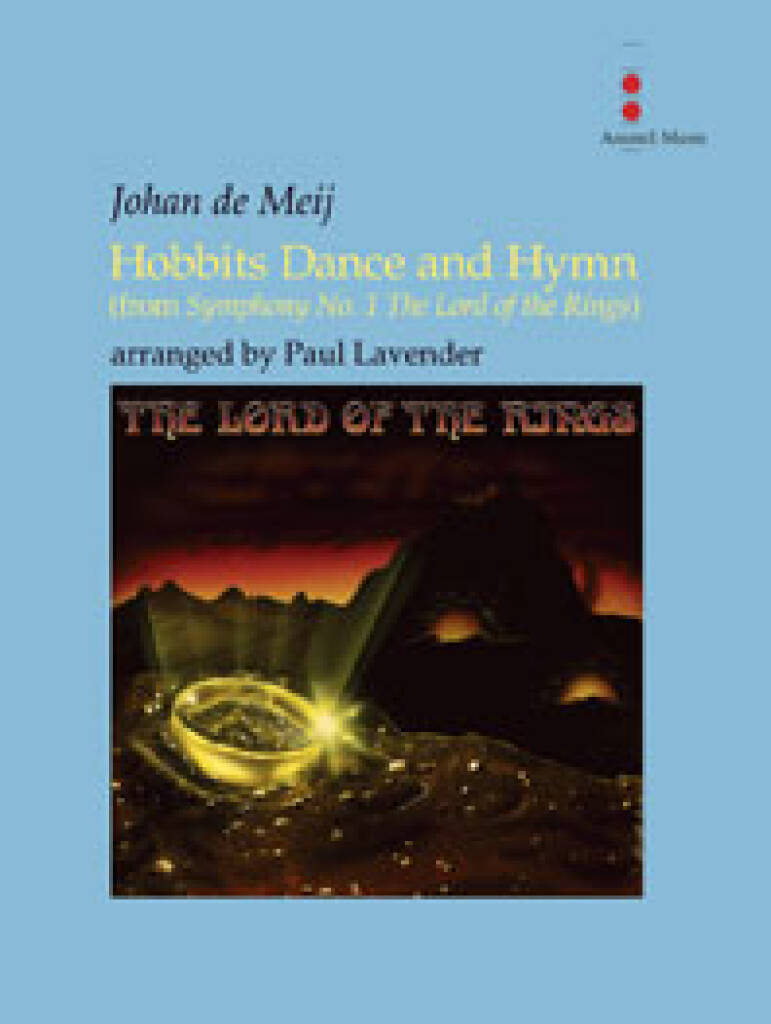 £89.99
Hobbits Dance & Hymn - Johan de Meij
The famous trilogy The Lord of the Rings by English writer J. R. R. Tolkien, published in 1955, has brought enjoyment to several generations of readers. Johan de Meij himself took the inspiration for his first symphony for Concert Band, The Lord of the Rings, from this great series. This easy arrangement of two movements from the symphony, Hobbits Dance & Hymn, has been carefully carried out by Paul Lavender. An ideal work for all junior bands who wish to play the music of the Concert Band master, Johan de Meij.
Estimated dispatch 7-14 working days
-
£99.99
Jazz Suite No. 2 - Dance II - Dimitri Shostakovich
In 1938 Shostakovich composed his Second Jazz Suite at the request of the recently founded State Orchestra for Jazz conducted by Victor Knushevitsky. This suite was originally scored for a complete symphony orchestra to which four saxophones, an accordion and a guitar had been added. The Jazz Suite no. 1 in three movements, composed in 1934, had been written for a smaller ensemble. The title 'Jazz Suite' is rather misleading, as the composer definitely uses the style of light music. Back in 1928, the twenty-two-year-old Shostakovich had already composed some light music. A bet among friends to make an orchestration of the popular song 'Tea for Two' in less then one hour time, causedhim to compose 'Tahiti Trot'. Shostakovich easily won the bet as he completed the original and witty arrangement within only forty minutes!
Estimated dispatch 7-14 working days
-
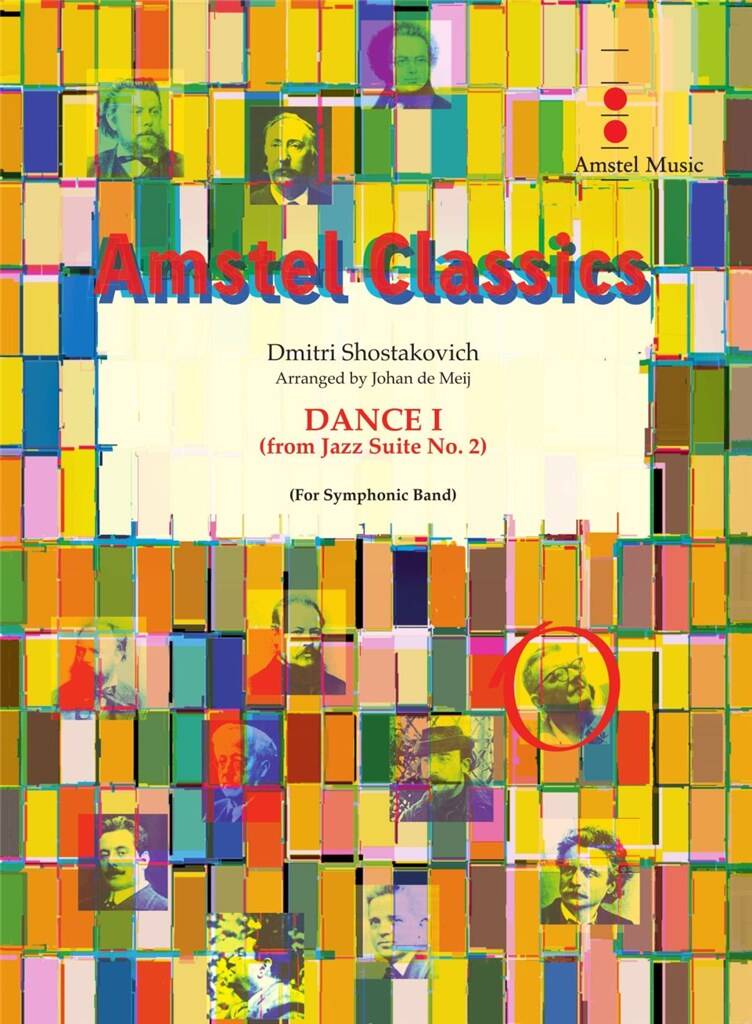 £102.99
Jazz Suite No. 2 - Dance I - Dimitri Shostakovich
In 1938 Shostakovich composed his Second Jazz Suite at the request of the recently founded State Orchestra for Jazz conducted by Victor Knushevitsky. This suite was originally scored for a complete symphony orchestra to which four saxophones, an accordion and a guitar had been added. The Jazz Suite no. 1 in three movements, composed in 1934, had been written for a smaller ensemble. The title 'Jazz Suite' is rather misleading, as the composer definitely uses the style of light music. Back in 1928, the twenty-two-year-old Shostakovich had already composed some light music. A bet among friends to make an orchestration of the popular song 'Tea for Two' in less then one hour time, causedhim to compose 'Tahiti Trot'. Shostakovich easily won the bet as he completed the original and witty arrangement within only forty minutes!
Estimated dispatch 7-14 working days
 View Music