
Results
-
 £109.99
Verdi's Triumphs - Giuseppe Verdi
This piece, as the title might suggest, brings together Verdi's greatest operatic triumphs. Amongst his best hits are Nabucco from 1842, which signified a turn-around after the flop of a previous opera, as well as Rigoletto, which in 1851 propelled him to international fame. Verdi's Triumphs features: Triumphmarch and Su! Del nilo al sacro lido from Aida, the Prisoners' Freedom Choir from Nabucco and La donna mobile from Rigoletto.
Estimated dispatch 7-14 working days
-
 £89.99
Christmas on the Rocks
Christmas on the Rocks collects together four world famous English Christmas carols in an instrumental pop arrangement. Optionally, the audience or a choir can also sing along. If so, the conductor gives the cues. The following Christmascarols are included in this work: God Rest You Merry, Gentlemen - Joy to the World - Away in a Manger (one verse flute solo), and Deck the Halls.
Estimated dispatch 7-14 working days
-
 £84.99
Os Justi - Anton Bruckner
Anton Bruckner is probably best known today as a symphonist however he was also a significant composer of religious works, motets and masses, and the composer of the great Te Deum. These choral works portray equally as much of Anton Bruckner's power as his symphonies. With his unique gift for unlocking the secret and beauty of choir singing he was a true master in this genre. This arrangement for concert band by Thomas Doss retains the character and homogeneity of the original choral work and is a stunning addition to the concert band repertoire.
Estimated dispatch 7-14 working days
-
 £84.99
Toccata - Claudio Monteverdi
Claudio Monteverdi composed this toccata as an instrumental introduction for the opera L'Orfeo (1607). According to the composer, this introduction should be played three times before the rising of the curtain. This is actually the first overture in the history of opera.)The story of Orfeo, who enchanted nature with his music, is tragic, as he loses his beloved Eurydice and decides to retrieve her from the underworld. On their return journey, one glance back at her is fatal: he loses her for the second time.)This arrangement for wind band is very suitable as a concert opener. The toccata is played three times just like the original. The first time it is played by a quintetconsisting of two trumpets and three trombones.)Various ways of performing this toccata are possible. The tension builds up more intensely if the quintet starts off stage. Eventually, these five players join the band, after which the tutti version follows two times. You can also have the brass play from the gallery during the second or third time for a double choir effect.
Estimated dispatch 7-14 working days
-
 £53.50
Four Pictures - Árpád Balázs
The teachers under whom rpd Balzs (b.1937) studied composition - Ferenc Farkas, Aram Khachaturian and Goffredo Petrassi - each independently formed the opinion that with his lyrical gift rpd Balzs's true creative field would be that of choral music and wind ensembles. Their early predictions are borne out by the roughly two hundred and fifty works for choir and almost twenty for wind orchestra that the composer has since produced. It is interesting that in the suite entitled Ngy kp (Four pictures) the stylistic features of these two related musical fields are united. In it the wind instruments sing! It was not by chance that the expansive second movement was given the title Cantilena, while the slightly livelier but just as lyrical third movement was entitled Arietta. The opening movement of the work is a stridently jolly, energetic Indul (March), but not one of the rigidly military kind: the 6/8 rhythm contributes to its light-hearted character. This music is avowedly akin to the ballet music of Prokofiev. This choice series of four character pieces is crowned by Jtk (Play) in which conveying the effect of the mixture of lines moving in parallel and then colliding with each other may be more technically demanding, but is well worth the effort! (Hungaroton HCD 31353)
Estimated dispatch 7-14 working days
-
 £118.00
Ameno - Eric Levisalles
Ameno, from Era's first album released in 1997 which sold over two million copies. The sounds are "New Age" often embellished with an imaginary of musical language which is close to Latin, while retaining a medieval atmosphere that earned Era theirinternational success. The electric guitar solos are offered on various wind instruments. Ameno is available for concert band (ref. 117836) or concert band and choir (ref. 118145).
Estimated dispatch 7-14 working days
-
 £84.99
Remembrance Day - Jacob de Haan
Remembrance Day (Totengedenken) is a chorale-like piece in memory of those who have died in service. Jacob de Haan composed this work for a concert by the symphonic wind orchestra Symphonic Winds, which he conducted in Germany on Volkstrauertag (national remembrance day). The composition is based on a text from Totengedenken (Commemoration of Those Who Have Died). This narrative text is provided in four languages, and is intended to be spoken (using a microphone) ad libitum during the performance. Choir parts are also available to complement the performance.
Estimated dispatch 7-14 working days
-
 £104.99
Canzone di Francesco - Thomas Doss
This beautiful and intense slow composition including lots of melodic and musical sequences is dedicated to Saint Francis-a figure whose life story has always impressed the composer. He had previously honoured Francis of Assisi in several works including a composition for strings, an oratorio, a mass and a Laudate for choir and concert band. Canzone di Francesco will create a moment of meditation and reflection during your concert, but is also very suitable as a warm up piece offering various possibilities to work on intonation, phrasing and sound building.
Estimated dispatch 7-14 working days
-
 £84.99
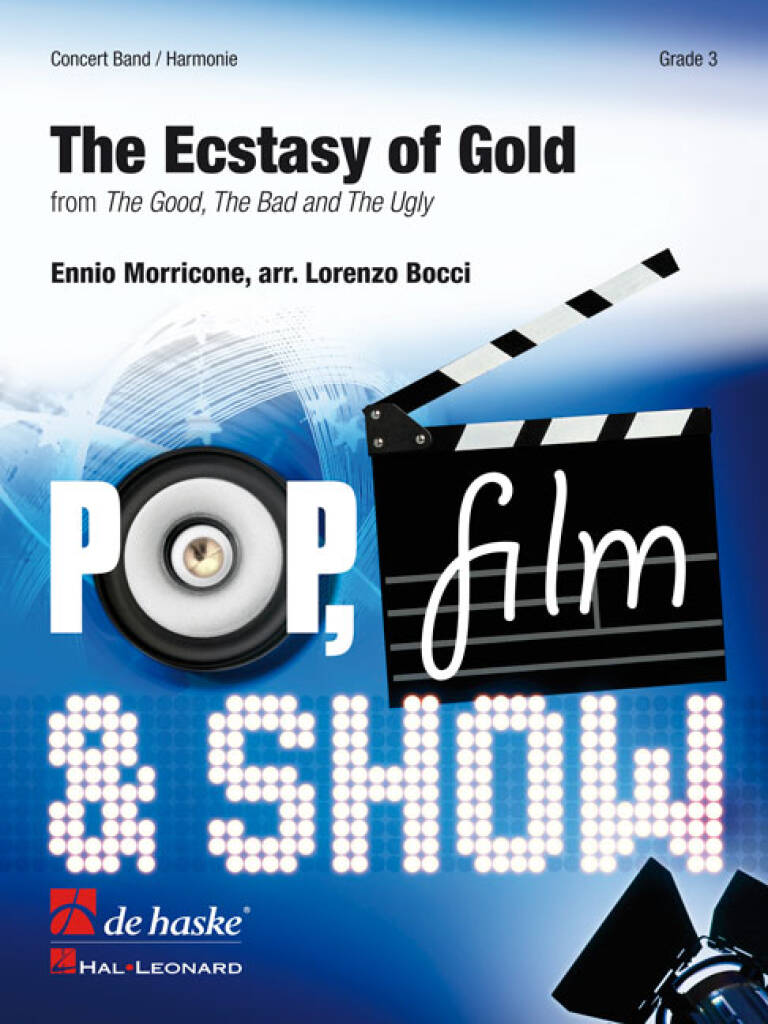
The Ecstasy of Gold - Ennio Morricone
The Ecstasy of Gold is the famous theme from the movie The Good, The Bad and The Ugly that leads up to and is heard during the movie's climax, the showdown! The complete soundtrack to The Good, the Bad and the Ugly was released in 1966 and sold millions of copies. Since 1983, heavy-metal band Metallica have been opening concerts with Morricone's dramatic and exciting song, The Ecstasy of Gold. Lorenzo Bocci has created an equally exciting arrangement for concert band. Optional parts for electric guitar, piano, soprano (vocal), and choir are not listed in the score but are also available.
Estimated dispatch 7-14 working days
-
 £72.99
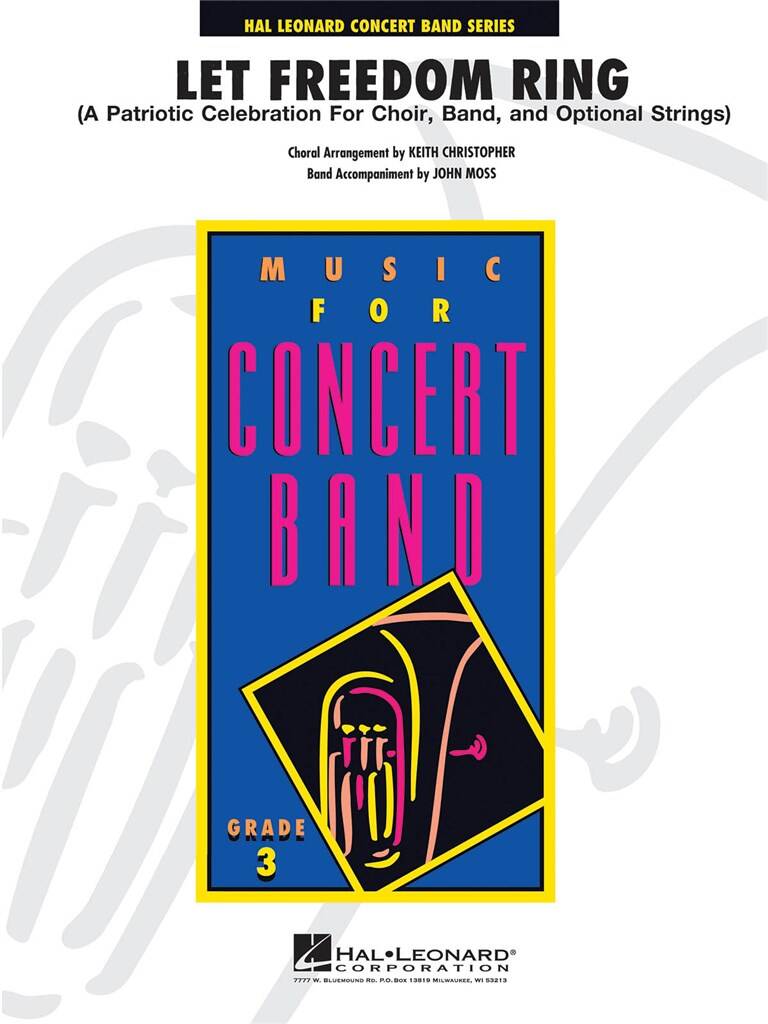
Let Freedom Ring (Medley)
This inspiring 6-minute medley for choir, band, and optional strings is an ideal patriotic feature for school, church, or community performances. Includes: This Land is Your Land, Let Freedom Ring, God Bless the U.S.A., and America the Beautiful. Note that this can be paired with the Christopher/Moss arrangement of 'God Bless America' (#08740036=SATB) for a spectacular concert finale. Available: SATB, SAB, 2-Part, ShowTrax Cassette, Concert Band (Grade 3) and String Pak.
Estimated dispatch 7-14 working days
 View Music
 Listen to MP3