
Results
-
 £64.24
Caprice (Euphonium Solo with Concert Band) Andrew Batterham
VIEW SCORE PDF Caprice was written for Matthew van Emmerik, to showcase his virtuosity in an engaging piece of concert music. The work is in theme and variation form, with the primary material being the theme from the last of Paganini's Ventiquattro Capricci per violino solo, a collection of 24 caprices for solo violin. This theme has been the inspiration for similar works by many composers since it was first published, including Liszt, Brahms, Rachmaninov, Benny Goodman and Andrew Lloyd Webber. In this work, the famous theme is treated to a more contemporary approach. The first variation, Capricious, relies on motor rhythms and jagged dialogues between the soloist and the band. It is couched in an organic scale reminiscent of the Phrygian mode. The second variation, Sad, is in direct contrast, acting as a traditional ballad and allowing the soloist to explore the expressive side of the instrument. The third variation, Energetic, is a micro set of variations in itself, designed to display the soloist's innovative technique and stamina. Each section is more challenging than the last, until the work concludes with a whirlwind dance at breakneck speed. Like all of Batterham's recent work, the musical language of Caprice draws upon classical, jazz, funk and ska elements to create a unique sound where anything can happen, and probably will. This arrangement was made possible through Matt's instigation and generosity. To view a video of Matthew van Emmerik performing the version with brass band please visit www.youtube.com/watch?v=D0hsvux_a5o To view a video of Fletcher Mitchell performing the version with piano please visit www.youtube.com/watch?v=NOZ6KRldDVo Sheet music available from : UK: www.wind-band-music.co.uk USA: www.solidbrassmusic.com Instrumentation: Euphonium Soloist Piccolo Flute 1-2 Oboe Bassoon Clarinet in Eb Clarinet in Bb 1-3 Bass Clarinet in Bb Alto Saxophone 1-2 Tenor Saxophone Baritone Saxophone Trumpet in Bb 1-3 Horn in F 1-4 Trombone 1-2 Bass Trombone Euphonium Tuba String Bass Percussion 1-3
In stock: Estimated dispatch 1-3 days
-
 £37.78
Fantasa Espaola - Wind Band (Andrew E. Lawson)
VIEW SCORE PDF This celebratory Latin-flavored item by award-winning American composer Andrew E. Lawson will be an exciting addition to your band's concert programme. The composer writes: 'The Phrygian mode is one of my favorite modes in music. In Fantasa Espaola you will hear a slightly altered form of the traditional mode, using a lowered second and raised third. It is the fifth mode of the harmonic minor scale and can be heard in music from all over the world. Fantasa Espaola, translated as Spanish Fantasy, is inspired by traditional Spanish music and culture, but with a twist of my own.' PDF download includes score and full set of parts. Sheet music available from : UK: www.wind-band-music.co.uk USA: www.solidbrassmusic.com Difficulty Level: Medium Advanced Instrumentation: Piccolo Flute 1-2 Oboe Bassoon 1 Clarinet in Bb 1-3 Bass Clarinet in Bb Alto Saxophone 1-2 Tenor Saxophone Baritone Saxophone Trumpet in Bb 1-3 Horn in F 1-4 Trombone 1-3 Bass Trombone Euphonium Tuba Timpani Percussion 1-5
In stock: Estimated dispatch 1-3 days
-
£95.00
The Gilded Theatre - Kenneth Hesketh
The Gilded Theatre was commissioned by the National Youth Wind Orchestra of Great Britain on the occasion of its fortieth anniversary. They gave the first performance on 10th August 2008, at St. John's Smith Square, London conducted by James Gourlay.The Gilded Theatre can, in some ways, be seen as a continuation of dramatic forms as presented in a previous piece by Hesketh, Diaghilev Dances. Unlike the Dances, however the music in The Gilded Theatre is conceived as one continuous span and stretches of music are also subtitled and refer to stock characters or scenarios redolent of the commedia dell'arte or 17th Century French Theatre.The subtitles are Rideau, Les Idiots Ou Les Amants, Le Combat Commence, Desespoir, L'apparition, Folie, La Mort, Rideau. The music narative progresses through dramatic, comedic, romantic and aggressive moods supporting the idea of the abstract play to which the the above subtitles refer. Throughout the piece the composer has sought to challenge the players both technically and emotionally, and it is the players themselves who are in fact the protagonists in the piece.
In stock: Estimated delivery 1-3 days
-
 £90.00
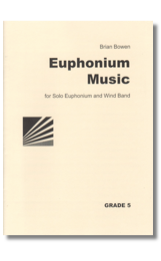
Euphonium Music - Brian Bowen
Something of a classic in its brass band and piano versions! We are delighted, at last, to make this work available ith wind band accompaniment by the composer. Written in 1978, the work is constructed in three movements and is virtually a concerto for euphonium and band. The first movement begins with an unaccompanied motto theme, which uses all twelve notes of the scale but with a tonal feel. The slow second movement is based on an original song melody by the composer - 'The Eyes of God' - and affords lyrical and richly expressive playing that is typically euphonium. Movement three follows without a break - a capricious movement which ends triumphantly. Now available in versions for piano, brass band, wind band, and orchestra, Euphonium Music can be seen as a major contribution to the literature for the instrument. Duration: 15 minutes USA Grade 5 An orchestral version is available on hire.
Estimated dispatch 7-14 working days
-
 £248.99
Missa Brevis Wind Band Set (Score & Parts)
Missa Brevis, written for choir and wind band, was commissioned by the Conseil D?partemental pour la Musique et la Culture de Haute-Alsace (Dir.: Philippe Pfisterer) in Guebwiller (France), in celebration of the millennium of Pope Leon IX's birth in ?guisheim (France). The composer conducted the first performance on June 23, 2002. It was performed live for the French television channel France 2. The mass movements Kyrie, Gloria, Credo, Sanctus, Benedictus, and Agnus Dei are very suitable for the Catholic as well as the Protestant liturgy. For this mass, various ways for performing in diverse variable strengths are possible. An instrumental performance is possible if the brass represents the choir parts. In this option, it is desirable for the brass to be positioned separately from the rest of the band (on a gallery, for example), so that the idea of two choirs is approached. In a performance with a large choir, the brass can work very well as a support. In that case, the dynamics of the brass should be adapted somewhat, since these are actually intended for an instrumental performance. You can also leave out the brass entirely for the benefit of the choir. For the accompaniment of smaller choirs, you can opt for a small ensemble from the band. This can also be a quartet, put together as desired. For the performance of this mass, the obvious choice is one of the above options. However, as an alternative, a performance with a combination of these options (vocally/instrumentally) is also possible - not just from an artistic point of view (variation), but also from a practical starting point - for example in the case that the choir has rehearsed only two movements. With a full strength, the conductor can vary the instrumentation to his or her liking. Then the brass can also play a role in the accompaniment (instead of supporting the choir). The following combinations are possible: 1. clarinet choir (from Eb Clarinet to Bass Clarinet) 2. clarinet choir + saxophones 3. brass (flugelhorns, horns, euphoniums, bass section) 4. brass (2 trumpets / 2 trombones) 5. double reeds (optional + flute, optional + string bass) 6. tutti 7. all winds 8. all brass In a performance by brass band and choir, it is usually advisable to leave out option 1 (choir + brass + band). The choir sings self-reliantly, accompanied by a full brass band. In an instrumental performance, you can consider a combined quartet (two cornets and two trombones) + brass band. Choral parts available separately. 0:20:00
Estimated dispatch 7-14 working days
-
£84.99
Animal Kingdom Wind Band Set (Score & Parts)
In this composition William Vean takes you on a journey through the fascinating and exciting world of animals. Apart from it being a composition filled with "special effects", Animal Kingdom contains many educational elements, such as playing in swing (triplets feeling), chromatics, flutter tonguing, gypsy tuning, varying keys, and, of course, dynamics and articulation. The melodic lines occur in all four voices, as well as in all percussion parts, providing each musician with the opportunity to play a solo or to accompany. Highly recommended for your youth band! William Vean is an educational composer. He knows how to musically shape the special elements from our daily lives. His music is therefore very expressive, containing creative solutions to possible problems. Special ways of playing make his music particularly interesting for the winds, but the percussion section is also featured in his special effects. The world of the animals always plays on ones imagination. In Animal Kingdom, William Vean has portrayed a number of animals in a special manner: Kevin Kangaroo - The jumping character of this animal can be heard in different voices. The swing style also emphasizes the characteristic movements of the kangaroo. Playing in swing style can be practised by using scales. Eddy Elephant - For some of his smaller fellow fauna friends this can be quite an ordeal, but for Eduard (Eddy for friends and intimates) it is his daily walk. Baldrick Bat - Baldrick the Bat is a mysterious character. This can be heard in the fast moving valves and keys, accompanied by special effects in the percussion section. Curtis Camel - Curtis the Camel trudges across the desert, feeling bored. The idea that the horizon will never change does not affect him anymore. He has accepted his fate. The distinctive tones from the gypsy scale provide the suitable oriental sounds. Betty Butterfly - Butterfly Betty elegantly, and without worries, flutters from flower to flower in the garden. Her motto: Carpe Diem (Seize the Day). Betty is a one-day butterfly. Marvin Monkey - A "swing" monkey stirs up the feelings. Even members of the orchestra will look like real monkeys. How about your audience? Each part has its own difficulties and challenges. Important in the first part is playing "in swing" (triplets feeling). This can be practised using scales. In the second part ensemble playing and balance are important. In Baldrick additional information on the effects that have to be played might be useful. "New" sounds are, of course, welcome. Curtis the Camel introduces the gypsy scale. Additional explanation of the use of the scale might be useful. Key changes are interesting in this part. A slight accent on the first beat of the bar will add to the charm of this part. Marvin the Monkey brings back the swing rhythm that was introduced in the first part, alternated by a "straight" part with attention to chromatics and articulation. A story teller will definitely be an asset when performing this composition. 07:30
Estimated dispatch 7-14 working days
-
 £47.50
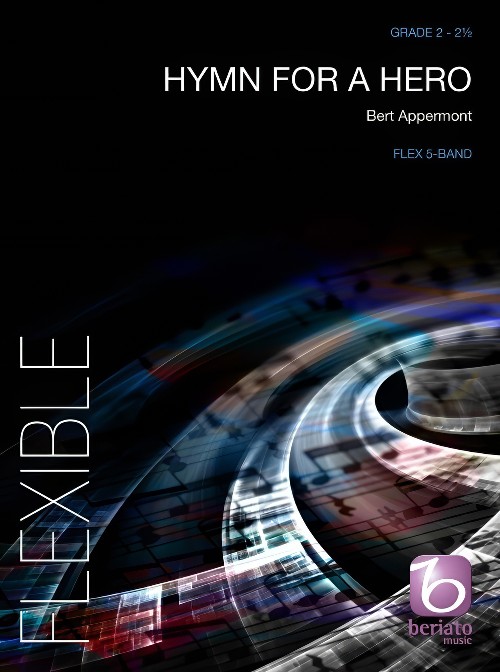
Hymn for a Hero (Flexible Ensemble - Score and Parts) - Appermont, Bert
This composition was inspired by the life of the German cavalry general Hans Michael Elias von Obentraut (1574-1625). The heroism of the illustrious general is expressed in a majestic hymn. Hymn for a Hero can serve as a separate work but, if desired, it can also be integrated in the four-movement composition A Hero's Tale. Concretely, this means that this flex version, following the opening fanfare, can be played along with the first movement (bars 9-52). Thus, a youth or beginner band can make music and perform together with a band of adults or advanced players.Duration: 2.45
Estimated dispatch 7-14 working days
-
 £125.30
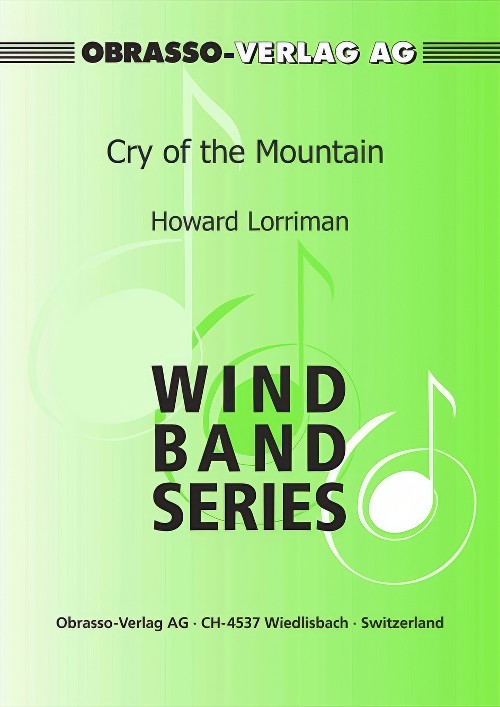
Cry of the Mountain (Concert Band - Score and Parts) - Lorriman, Howard
This work is dedicated to Manfred Obrecht, conductor and musical editor. Manfred asked the composer to write a piece that captures the changing colours and mood of a mountain when viewed from a relatively close distance. The work is in four sections:Awakening - early morning and the mountain is covered in cloud, eventually the sun bursts through and reveals the mountain in all its glory.Snow, Ice and Glaciers - between the rocky out-crops ther are layers of snow; slippery ice patches and icicles adorn the overhangs. In the larger crevices and valleys glaciers are formed.Vistas and Distant Peaks - when viewed from other high points one can see the mountain in full outline against the vast landscape.Avalanche - despite its beauty, a mountain can be a dangerous place and the accumulated snow may not be stable, it can easily tumble out of control. The slight twist of major tonalities at the very end reflects the way a sudden change in light can alter the whole perspective.
Estimated dispatch 7-14 working days
-
£332.99
Cantica de Sancto Benedicto Wind Band Set (Score & Parts)
Cantica de Sancto Benedicto is a three-movement work for mixed choir, soprano solo, concert band and organ ad libitum - on Latin lyrics that relate to the life of Saint Benedict. It was commissioned by the city of Norcia in Italy, where Benedict was born. The holy Benedict (480-547) is considered the founder of monastic life within the Roman Catholic Church. His enormous influence is especially owing to his monastic rule, the Regula Benedicti.Jacob de Haan has named the movements of Cantica de Sancto Benedicto after the Holy Trinity: the Father (Gloria Patri), the Son (Gloria Filio) and the Holy Spirit (Gloria Spiritui Sancto). The lyrics of thehymn Gemma Caelestis, (which, like the other texts, were originally used in Gregorian chant) are voiced by the choir. To this purpose, Jacob de Haan composed new, choral-like, homophone music. The sequence Laeta Quies is rendered by the soprano; the verses (divided over the three movements) are alternated with those of Gemma Caelestis. The work closes with an impressive grand finale, in which texts are used from the proprium of the mass in honor of the saint's day of the holy Benedict (11 July). Notes to the conductor: For this cantata, there are various possibilities for the performance. The first involves a performance in which the choir and soprano parts are only accompanied by organ. Such a performance has several advantages: since the band never sounds together with the choir and the soprano, no balance problems occur, and even a performance with a large concert band and a small cantata choir is conceivable. A special layout is also possible - with which you can set up a three-dimensional performance in a church. For example, the choir can sing in the chancel, accompanied by the choir organ; the soprano can stand on the gallery, accompanied by the main organ; and the band can be seated in another part of the church. The choir could also sing from a gallery. With layouts like this, working with two conductors is advisable. Choral parts available separately. 0:28:30
Estimated dispatch 7-14 working days
-
 £115.00
FRENCH IMPRESSIONS (Concert Band) - Woolfenden, Guy
This work is inspired by four paintings by the French painter Georges Seurat, but does not attempt to recreate his pointillist technique in musical terms. The first movement, Parade, contrasts the strange gas-lit world of La Parade de Cirque: Invitation to the Sideshow, which features a sinister-looking trombone player and his ghostly acolytes, with the cool detached stance of that great masterpiece A Bathing Place: Asni?res. The second movement, Can Can, recreates the world of two other paintings: Le Cirque and Le Chahut, which depicts a curiously stylised Can Can in full swing, accompanied by a pit orchestra. The phrase "faire du chahut" means to make a racket!
Estimated dispatch 7-14 working days
 Listen to MP3
 View Music