
Results
-
 £143.00
Psyche et Eros (Concert Band - Score and Parts) - Franck, Cesar - Cesarini, Franco
Cesar Franck, composer, pianist, organist and music teacher, completed Cupid and Psyche, his sixth and last symphonic poem in 1887. It was first performed in Paris in 1888 and was a complete success, but the piece later fell completely into oblivion, and it was only thanks to some meticulous research that it has returned to concert halls. The intricate love affair between Psyche and Cupid is an original story of the Metamorphoses, written in the 2nd century AD by Apuleius. The tale is about overcoming obstacles in love and their final union. The symphonic poem is divided into three parts and calls for a choir. The movement that is the subject of this arrangement, Psyche et Eros, is positioned at the end of the second part. Franco Cesarini's version for wind orchestra carefully illustrates the nuances of the instrumental colours, and represents a real test aimed at demonstrating the musicality and interpretative skills of orchestras and their conductors. Duration: 10.30
Estimated dispatch 7-14 working days
-
 £58.50
Dark Adventure (Flexible Ensemble - Score and Parts) - Ford, Ralph
This version of Dark Adventure by Ralph Ford is part of our Belwin FLEX offerings and is designed with maximum flexibility for use by any mix of instruments---wind, strings, and percussion, including like- or mixed-ensembles with as few as 5 players. The suggested instrumentation and a customizable Teacher Map will help you plan out how to best assign parts to suit your ensemble's needs. The 5-part instrumentation will support balanced instrumentation of the lower voices. It also comes with supplemental parts for maximum flexibility. With the purchase of this piece, permission is granted to photocopy the parts as needed for your ensemble. A percussion accompaniment track is also available as a free download. String parts have been carefully edited with extra fingerings and appropriate bowings to support students in mixed ensembles playing in less familiar keys. A musical adventure through mysticism and magic. This unique setting offers a wide variety of dynamics, textures, and styles while remaining playable. The momentum is quickly established, and your students are part of the journey. This is a super piece that will capture the imagination of students and listeners alike. Duration: 3.30
Estimated dispatch 7-14 working days
-
 £58.50
Andalucia (Flexible Ensemble - Score and Parts) - Lopez, Victor
This version of Andaluc?a by Victor Lopez is part of our Belwin FLEX offerings and is designed with maximum flexibility for use by any mix of instruments---wind, strings, and percussion, including like- or mixed-ensembles with as few as 4 players. The suggested instrumentation and a customizable Teacher Map will help you plan out how to best assign parts to suit your ensemble's needs. The 4-part instrumentation will support balanced instrumentation of the lower voices. It also comes with supplemental parts for maximum flexibility. With the purchase of this piece, permission is granted to photocopy the parts as needed for your ensemble. A percussion accompaniment track is also available as a free download. String parts have been carefully edited with extra fingerings and appropriate bowings to support students in mixed ensembles playing in less familiar keys. Andalucia has always been a very musical land, and the Moors that occupied Andaluc?a for nearly 800 years have contributed greatly to its unique music and exotic dances. Victor Lopez has utilized Andalucia as his inspiration to provide us with an original composition that blends both the flamenco and traditional march styles. Full of fire and energy! Duration: 2.00
Estimated dispatch 7-14 working days
-
 £191.30
Nepotism (Movement II from Symphony No.1, The Borgias) (Concert Band - Score and Parts) - Schwarz, Otto M.
A sinister legend hangs over the Borgia family, a legend of corruption, abuse of power, orgies, sex and murder. These rumours proliferated especially during the papacy of Alexander VI, a descendant of the family, who was even called the Antichrist. On his death, contemporary witnesses reported that the devil himself prowled around the death chamber and a black dog run along the corridors of the Vatican as his emissary. One might say that this Borgia pope, who ruled together with his family with the greatest brutality, became demonised. Unscrupulousness, poison-toting, incest and other malice are to this day the hallmarks of this pontiffNepotism: Rodrigo Borgia was elected Pope on 11 August 1492. From the very start, the new pope was prepared to use any means to eliminate his opponents, either through the infamous Borgia poison or by excommunication and execution. His son Cesare, who wanted little to do with the church, was appointed cardinal against his will. Alessandro Farnese, broth of Giulia Farnese, the Pope's mistress, also became a cardinal. Numerous Spaniards were brought into the country and were appointed to ecclesiastical posts. This infuriated the opponents of Alexander VI. The Dominican Girolamo Savonarola from Florence demanded the removal of the Pope. He was tortured and banned. Giuliano della Rovere wanted to convene councils to depose the Pope, which Alexander managed to prevent through artful political manoeuvrings. Through great brutality, brilliant political skill and power games, this pope was able to achieve his goal of leaving for his children a great legacy. Alexander VI constantly changed his allies and always acted unscrupulously to improve his financial situation and expand his sphere of influence. At the centre of the second movement of this work is the medieval hymn Dies Irae (Day of Wrath), which acts as a warning in the background condemning the Pope's actions.Duration: 9.15
Estimated dispatch 7-14 working days
-
 £191.30
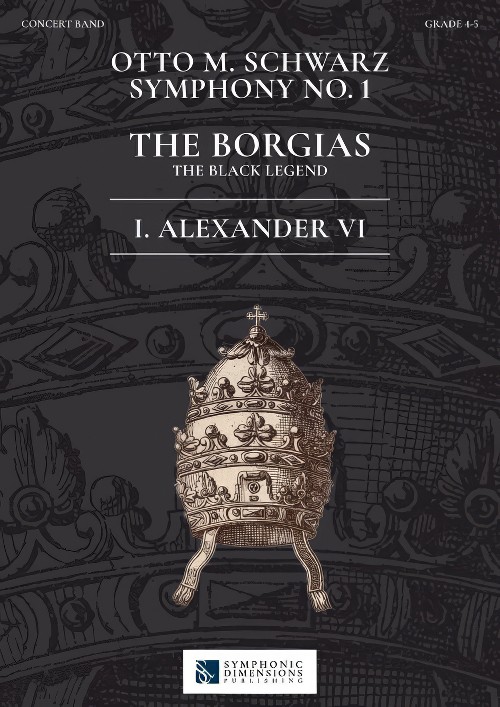
Alexander VI (Movement I from Symphony No.1, The Borgias) (Concert Band - Score and Parts) - Schwarz, Otto M.
The Borgia family is the subject of a so-called black legend, a pejorative term that has been used since the Middle Ages to refer to Spain and Spaniards. The Borgias' black legend is one of corruption, abuse of power, orgies, sex and murder. These rumours spread especially during the reign of Pope Alexander VI, a member of the family. Alexander was even referred to as the Antichrist. According to eyewitnesses, when he died Satan prowled the death chamber and a black dog, an envoy of the Devil, ran up and down the aisles of the Vatican. The brutal rule of Pope Alexander and his family led to a kind of demonization of the Borgia family. But it is precisely the lack of scruples, the brewing of poisons, the incest and various cruelties that continue to hold a certain fascination for us.Alexander VI: Rodrigo Borgia was born in 1431 near Valencia. He studied law in Bologna and, through his uncle Pope Calixtus III, he rose through the church hierarchy. As vice-chancellor of the Holy Roman Catholic church, he became one of the richest men in Europe. As a cardinal he fathered four children who he later legitimised when he became pope. His election to the papacy was funded by the sale of offices, extortion and bribes of all kinds. Through an alliance with Ascanio Sforza he was elected pope on August 11 1492 and named himself from then on Alexander VI, an allusion to Alexander the Great.Duration: 9.30
Estimated dispatch 7-14 working days
-
 £99.99
Hidden Light (Loyalty Among Friends) (Concert Band - Score and Parts) - Houben, Kevin
Hidden Light (Loyalty Among Friends), was composed on the occasion of the 75 year membership of Mr Leo Knoben at the Royal Brass Band 'Eendracht Waubach'(NL). From pride and admiration for this exceptional jubilee , but also out of gratitude for his many years of commitment as musician and member of the board, the association chose to have a memorable work written. That assignment resulted in the wonderful choral Hidden Light, for which composer Kevin Houben based himself on the following emotions and oppositions: small vs majestic, submissive vs royal and simplicity vs glory. The work starts in a very modest, dark atmosphere, after which the composition develops into a grand and lofty sound with broad melodies, exploring the full richness and colors of the 'symphonic' wind band. The interesting variety in orchestration - the small, intimate setting at the beginning and the following broad, majestic tutti passages - makes the work very varied, grateful to perform and to listen to. With Hidden Light Kevin Houben has again created an expressive and powerful composition that is highly reflective in nature. This emotional work is a tribute to an exceptional man who has been there for 'his' orchestra all his life, with a warm heart for 'his' musicians. Each musician will recognise the connection and the passion for music in this piece. Duration: 5.30
Estimated dispatch 7-14 working days
-
 £119.99
Quarantine (One Village United) (Concert Band - Score and Parts) - Doss, Thomas
Like a dark veil, an ominous sense of foreboding takes hold across the world. A looming danger, one previously unknown to mankind, slowly approaches, bringing our daily lives to a grinding halt. A perilous virus gives us no choice other than to stay in our homes, leaving us unable to work in our offices or even visit family and friends. Something that has only been talked about in history books is coming to pass: a pandemic! The invisible danger expands more and more, and we feel paralysed by fear and fright. The distance between us and our fellow human beings increases. At the same time, we start to better understand something crucial: we have time again! People help each other out. Neighbourly assistance and support within one's own family becomes more apparent. We stand by each other. Suddenly we have the time for things that we did not have before. Time for reflection... A new era commences. Finally, hope reappears. We leave our houses, but nothing is quite the same anymore. With renewed strength, people begin to perceive the future in a positive and optimistic way once again. With greater attention and awareness of the here and now, we feel that, despite it all, we can be happy. Duration: 8.00
Estimated dispatch 7-14 working days
-
 £134.99
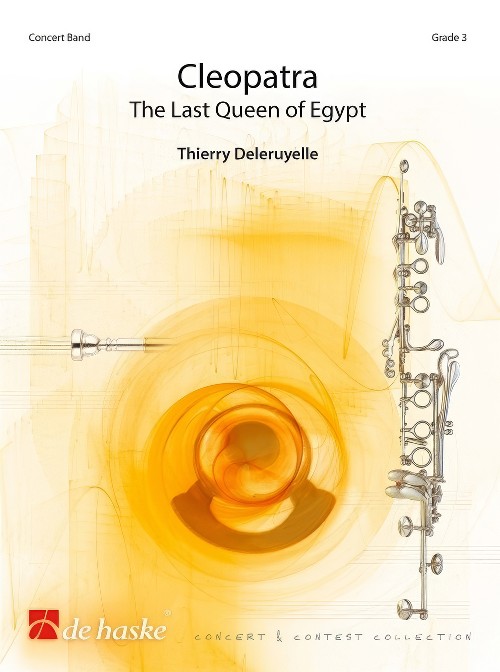
Cleopatra (Concert Band - Score and Parts) - Deleruyelle, Thierry
The Last Queen of Egypt. Queen Cleopatra ruled Egypt for over 20 years. She is one of antiquity's best-known women, in particular because of her relationships with Julius Caesar and, above all, Mark-Anthony, but also because the cause of her death remains a mystery. The work is split into three parts and performed without breaks. The first section begins with a bright introduction representing Mark-Anthony. Dynamic in nature and reminiscent of military music, this characterises the Roman general. But soon after, another theme emerges, softer and more melodic, symbolising Cleopatra's femininity. The two characters then combine on a faster tempo. The middle section of the work depicts the love that Mark-Anthony and Cleopatra feel for each other. This passionate relationship lasted ten years and produced three children. This is expressed by a warm and intense theme, just like the beauty of the Egyptian queen. The third and last section opens in a determined and military mood. Mark-Anthony and Cleopatra were often apart, the Roman general was often away on a campaign. They met up in Alexandria to celebrate their triumph. But, as the targets of the jealousy and ambition of Octavius, Julius Caesar's son, the lovers are trapped and await the inevitable conquest of Egypt by the Romans. When Mark-Anthony heard the false news that Cleopatra had committed suicide, he ended his own life. The Queen of Egypt, for her part, was imprisoned shortly afterwards. The two lovers remain one of History's most famous couples. This piece was commissioned by the Wind Orchestra of the town of Antony, near Paris, directed by Philippe Rossignol, to mark its 90th anniversary. Duration: 10.00
Estimated dispatch 7-14 working days
-
 £141.99
Pulcinella (Euphonium Solo with Concert Band - Score and Parts) - Sparke, Philip
Pulcinella was commissioned by the Taiwanese euphonium player Tzu-Hsiang Lin. Lin is a renowned soloist and teacher and a Besson Euphonium Artist. He teaches euphonium at Taipei National University of the Arts, National Taiwan University of Arts, Shih Chien University and National Kaohsiung Normal University. Lin gave the premiere of Pulcinella in both its concert band and brass band versions in January 2021. Pulcinella continues Sparke's series of euphonium solos named after characters of the Italian commedia dell'arte and opens with a long and expressive minor melody for the soloist over a brooding accompaniment. This is taken up briefly by the full band and is extended by the soloist after a change of key. A cadenza, accompanied by fragments of the main melody leads to a complete change of mood, tempo and tonality, introducing a Vivo section starting with a perky syncopated tune for the soloist. The band then uses elements of this new tune to introduce a change of key, where the soloist introduces a more lyrical second subject over a pulsing accompaniment. The band then takes this up and changes key to reintroduce the original Vivo melody, which leads to a short and acrobatic coda to bring the work to a spectacular close. Duration: 6.45
Estimated dispatch 7-14 working days
-
 £175.00
60 Warm-Up Chorales (Concert Band - Score and Parts) - Cesarini, Franco
During his experience as a band conductor and teacher of wind orchestra conducting at university, Franco Cesarini has dealt with the topic of warm-ups very frequently. Throughout these long years of conducting he has had the opportunity to try many existing methods, evaluating their advantages and disadvantages. After a long time, he has decided to compile a collection of chorales for warm-ups, which are organised according to the criteria that he considers most effective. While working on his60 Warm-up Chorales for Concert Band, Franco Cesarini has always borne in mind that amateur musicians play for pleasure. He feels that it is extremely important that they have satisfaction at every moment of the rehearsal and not to start the rehearsal with needless "punishing" exercises. Nobody is really motivated to start playing with scales, long notes, or tricky rhythmical exercises. There is often a distinguished absentee in band rehearsals, namely music itself! Although this publication does not foresee a specific tempo for the chorales, they should often be performed rather slowly but without dragging. Dynamics are not indicated, so that the conductor has the opportunity to draw the attention of the musicians to his gestures and to make them react according to his indications. Timpani and bell parts have been added with the aim of not leaving the percussionists completely inactive during the warm-up phase, but can also be omitted. The chorales are written in four parts (SATB) and are also playable in smaller groups. The four voices can be played in different combinations of woodwinds or brass quartets or in mixed combinations. The collection includes ten chorales for the following keys: D flat major, A flat major, E flat major, B flat major, F major and C major. With his 60 Warm-up Chorales Franco Cesarini would like to convey the message to play the chorales in a musical way, thus raising the musicians' awareness of phrasing, the right interpretation of cadences, rubato and agogic. Above all, never do anything without putting the musical aspect in the foreground. 60 Warm-up Chorales for Concert Band: A perfect collection to warm-up and improve tuning of a concert band!
Estimated dispatch 7-14 working days
 View Music