
Results
-
 £71.50
Vision - Peter Sciaino
Here is musical work that exudes a powerful message of positive thinking and confidence. The introduction presents an uplifting and warm harmonic setting, creating the positive atmosphere that is critical to accomplishing any endeavor. The bold melody that follows is supported by stately rhythms that convey an air of confidence and pride. As the piece closes, the listener is left with an uplifting feeling of hope, teamwork, and optimism.
Estimated dispatch 7-14 working days
-
 £82.50
The Quest for Victory - Mark Lortz
An exuberant tribute piece that exhibits an unyielding energy and a vibrant spirit. After an impressive opening fanfare, the piece quickly transitions to a musically lyric section of contrasting repose. The energy returns with angular and strident brass and percussion statements over woodwind ostinatos. A soaring climax ensues as the opening fanfare returns for a spectacular finish.
Estimated dispatch 7-14 working days
-
 £104.50
The Road to Castlemaine - Barry E. Kopetz
A collection of Australian folk songs that depict the sights and sounds of the beautiful landscape with an Aussie twist and tongue-in-cheek tuneful way. The first movement includes The Wonderful Crocodile and The Old Jig-Jog, folk songs full of energy and dance-like qualities. River Fraser provides the melodic content for the second movement, a slow and impassioned lament. The third movement uses three popular tunes that range in style from joyful dancing as in an Irish reel, to a poignant and haunting flavor, to a brave and dramatic march that dies away bit by bit prior to an explosive ending of energy and good humor.
Estimated dispatch 7-14 working days
-
 £116.40
Cordoba - Isaac Albéniz
CORDOBAThis piece is an extract from the five part piano work 'Cantos de Espaa' (Songs from Spain) opus 232 which consists of 'Preludio' (Asturias), 'Oriental', 'Bajo la Palmera' (Cuba), 'Cordba' and 'Seguidillas' (Castilla); some of these parts are also to be found in the 'Suite Espaola'. 'Cordoba', the last part but one, seems to announce the grandeur and serenity of the composer's last works; it is as if he was preparing to retire from the hectic dynamic world. The introduction has a subdued, almost liturgical character, whereas the next dance sounds rather very solemn. Cordba is as an island in the restless stream. It is an Andalusian dance with a majestic character similar to that of the city which inspired the work. This very harmonious composition is one of Albniz's finest.
Estimated dispatch 7-14 working days
-
 £214.80
Skies - Oliver Waespi
Program notes by Oliver Waespi on his composition Skies:Skies is the plural of Sky. We may wonder are there several skies? Is the sky we all long for not the same for everybody? While travelling on foot and "in the open air" I have observed the firmament often in quite different shapes, so that I can say I have indeed experienced the sky in different ways. Years ago I already wanted to portray "my sky" in music; I finally have been able to realise this long-cherished dream.This composition deals with the sky, more precisely with my sensual and emotional experience of the sky in all its aspects. Two point of views are combined in this composition: one showing the sky as it presents itself to me, the other showing the sky as I observe it. The music was bom simultaneously by intemal and extemal inspiration: it describes nature but also the emotional and spiritual experience of nature. To me, the experience of nature is not abstract, but it is connected with concrete ages, places or people from my neighbourhood. This is why I have combined several parts of this composition with certain landscapes.The sky presents itself in different landscapes in the most varied ways: for the sensual experience, there is no sky as such. The indications of places spread all over the score, are primarily clues for myself; they represent certain atmospheres, which I have experienced especially in England and Scotland. They can however also be useful to the musicians and the audience, providing they know those landscapes and the celestial atmospheres linked to them.The music is independent from the atmospheres described in the subtitles, as those are rather connected to a tragic nature, and so the music is not based on any program. Musically spoken, the composition has a symphonic structure, which means that the complete musical material is derived from three contrasting main themes. In the first part, the description of a noctumal sky ("Night") two themes are developed in an organic way; the first, rather "dusky", is to be found with the horns, the second, "in bright daylight", with the oboe and flute, the third, "more quiet" , with the brass instruments. In the next part, we have clouds and rain over the Isle of Skye (one of the Hebrides islands in Scotland) and here several elements of the first theme are still more developed. Then we get an increasingly dark mood, which is released, in heavy chords. Then suddenly, the sun breaks through and the music gets a majestic character. We have a new shape of the initial theme, first with the French horns and then with the trombones. The music gets a quicker tempo and flows into a quick movement describing the winds and waves at sea ("Wind and Waves"). Three themes are gathering and some variations are developed. The music gets more and more energetic and, after a climax, calms down again. Then we have a kind of "summer pastoral" which suggests summer at the South coast of Cornwall ("South Coast of Penwith Peninsuia in Summer"). This is certainly not the hotte st summer in Europe, but still it is beautiful in this country that is blessed with so much rain. In the "pastoral" , the sea is already sketched in broad outlines in the French horn solo. The magnificence of an aftemoon at the seaside is developed at the end of the composition ("Noon at Treen Cliff', a rock protruding in the sea next to Porthcumo at the South Coast of Cornwall); here the music gets stronger and stronger and after a majestic climax it vanishes completely.
Estimated dispatch 7-14 working days
-
 £83.50
The Procession of the Nobles - Nikolai Rimsky-Korsakov
The Procession of the Nobles is the best-known piece that survived an ambitious project which was never completed due to lack of money. No less than five composers, several orchestras, choirs and ballet schools were to participate in what should become an enormousshow-piece of comprehensive theatre. The project failed because of lack of sponsors and internal conflicts, but it provided this magnificent composition. Mlada tells the story of Princess Voislava who kills her friend Princess Mlada because she is in love with Mlada's fianc Prince Jaromir. Mlada's spirit - personified by a female dancer - succeeds in convincing Jaromir in a dream of Voislava's cruel act. Jaromir revenges himself. Morena, goddess of the underworld, invoked by Voislava to chase Mlada's spirit, avenges the dying princess. An infernal storm brings death and destruction. In the final chorus of the opera the spirits of the deceased pay a tribute to the souls of the lovers Jaromir and Mlada united in death.
Estimated dispatch 7-14 working days
-
 £65.10
Fly With Me - Patrick Millstone
Here you have an ideal warm-up for your next contest or an intimate intermezzo for your next concert. Patrick Millstone succeeded in composing an impressive and nice sounding easy to play choral that will be appreciated by your musicians and also please your audience!
Estimated dispatch 7-14 working days
-
 £140.80
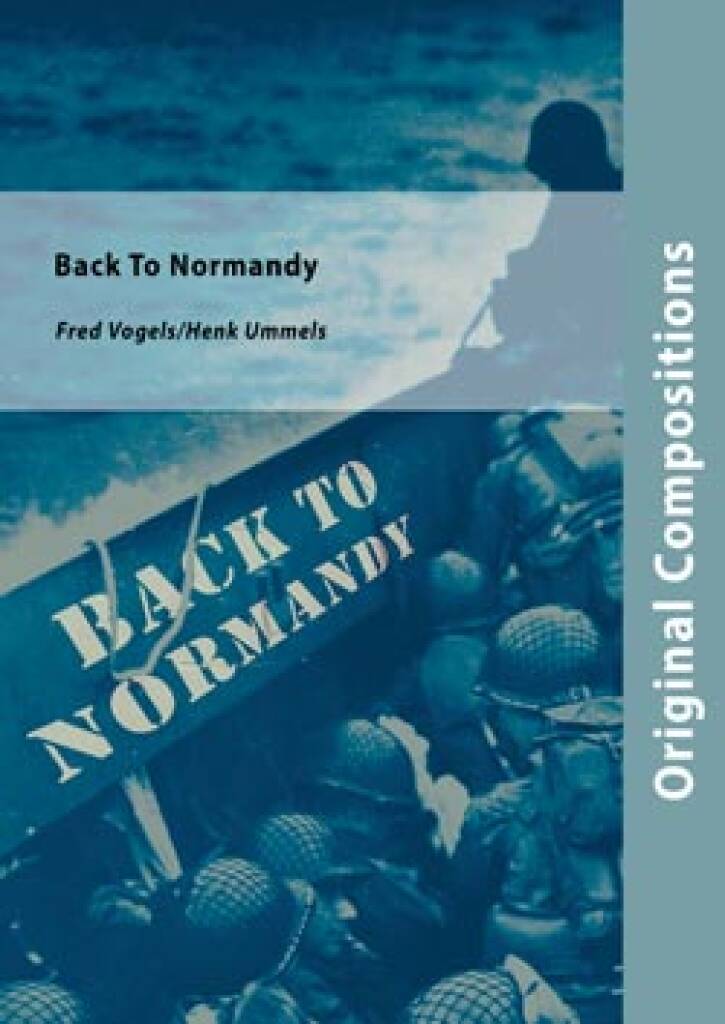
Back to Normandy - Fred Vogels
Back to Normandy is a composition for concert band on the occasion of D-Day. On D-Day (June 6, 1944) the liberation of Western Europe started at the beach of Normandy. A long campaign through Europe followed before the liberation was complete. Back to Normandy describes the first hours of the landing with the shelling of the German positions as a (musical) peak. As an introduction you will see and hear de preperations for the biggest campaign ever. Very special and unique is the fact that the music of Back to Normandy can be performed synchronously with a movie with original footage, specially made for this composition. This will without a doubt be an extra experience for the audience. So far performances like this were exclusively for professional orchestras (like George Fenton, Earth). This piece is specially suitable for concert bands that want to offer their audience something special and also want to honour the liberators. The movie to practise for the concert is on Youtube (meassures and metronome are visible/audiblematen). On the Back to Normandy forum you can get more information or have an exchange of views about this project or D-Day in general. You can download the complete movie here (1, 7 GB). Interaction with the composer is certainly appreciated.
Estimated dispatch 7-14 working days
-
£67.50
Capriccio - V. Erdmann
This piece and is characterized by rhythmically terse motifs in contrast to tonally delicate sections. The composer's distinctive language, rich in dissonances, is combined through precise formal sequences in a varied, sparkling style. It is an ideal piece for competitions at an advanced level and it is also fine concert music. Veit Erdmann-Abele mainly works as an editor for Sddeutsche Rundfunk [South German Radio] in Stuttgart. He is also active as a composer.
Estimated dispatch 7-14 working days
-
 £77.90
La matita di leonardo - Luciano Feliciani
2019 coincided with the 500-year anniversary of the death of Leonardo Da Vinci, one of the greatest men of genius in history, a universal genius who was a scientist, philosopher, architect, painter, musician, engineer, anatomist, botanist, designer, and planner. This composition entitled La Matita di Leonardo (Leonardo's Pencil), represents an ideal journey into the mind of the Tuscan genius: in the first part of the piece, percussion instruments underline the ticking of the passage of time that anticipates the birth of the idea, while short thematic cells in various instruments alternate, drawing the rhythmic melodic line. On this background, we hear the main theme entrusted to the dark tones of trombone and euphonium. The music proceeds with a growing pace and an adventurous character to represent the genesis of Leonardo's machines, which are in fact the result of the drawings of his pencil. In the second, more animated part, a new theme is introduced, varied, and elaborated, thus giving life to a vigorous movement meant to describe the drawings that come to life, leaving the pages of Leonardo's codes. In the coda the two themes overlap, transporting the listener towards a resolute and rhythmically energetic conclusion in an enthralling and engaging finale.
Estimated dispatch 7-14 working days
 View Music