
Results
-
£72.70
Always On My Mind - Elvis Presley
Estimated dispatch 7-14 working days
-
£70.99
Always On My Mind
Estimated dispatch 10-14 working days
-
 £82.50
My Heart Always Wanders - Jason K. Nitsch
This hauntingly beautiful folk tune has all of the drama that you'd want out of a lyrical ballad. Jason's fresh harmonic palette works perfectly with this melody and provides ample opportunities to work on expressiveness and sensitivity while also stretching the dynamic range of your musicians.
Estimated dispatch 7-14 working days
-
 £48.95
Glen Crossing (Concert Band - Score and Parts) - Stalter, Todd
This delightful piece is the perfect opener for developing bands. Of the piece, the composer writes, "My dog loves to take walk with our son, and she is always very excited to experience anything and everything on their journeys together. Glen Crossing contains melodies that revealed themselves to me on my walks with Hershey, and hopefully it portrays the fun and joy that 'Hershey and her boy' have every day, rollicking through the neighbourhood."Duration: 2.00
Estimated dispatch 7-14 working days
-
 £435.40
Goldberg 2012 - Svein H. Giske
The first time I heard Bach's Goldberg Variations was in the movie Silence of the lambs, in the early 1990s. I noticed the beautiful background music in one of the scenes, but at that time I didn't know what it was. A few years later, when I was studiying at the Grieg Academy, I got to know the entire piece. For me, this is a piece of music which I can listen to countless times. I think it sounds as fresh today as it did more than 15 years ago and it never ceases to inspire me. Both Bach's composition and Glenn Gould's famous 1955 recording (which was the first one I heard) still makes a great impression on me. Before Gould recorded it at age 22, it wasn't a highly ranked piece amongst pianists and Bach was by many viewed as a bit old-fashioned. The young Canadian turned all this around. He managed to portray Bach in a reformed way, producing fine nuances in phrasing and making the many layers in Bach's music more transparent than anyone before him. Thus he plunged both himself and Bach (back) onto the international music scene. When The Norwegian Band Federation (NMF) asked me to write the test piece for NM in 2012, it was only natural for me to use the Goldberg Variations as a starting point and inspiration for my work. Since I was a teenager at NMF's summer courses in the mid eighties I've always listened to many different styles of music. Growing up in Sunnmre with the Brazz Brothers as teachers and mentors, jazz-, pop/rock- and folk music were early on a natural part of my musical background. I also have my classical education from the Grieg Academy on trumpet. As the title of my piece implies, I've wanted to bring Bach to the present and put his music into various modern musical landscapes. I think you can bring about a special kind of energy when music from different genres are mixed and I've tried to do this by mixing Bach with artists and musical styles from the present. In Goldberg 2012, the music is often constructed by several layers, which in a way are living parallel musical lives. They are seemingly moving or floating freely, almost unaware of each other, but bound together by the same basic pulse. The rythms, however, are often notated on a different rythmic subdivision level than the usual 8th- or 16th note levels. By doing this, I hope to achieve transparent sounds that rythmically are perceived as more free and detached from each other. In large sections of the piece, pop/jazz is fusioned with elements from Bach. I guess you could have this little scene as a synopsis for the piece: picture a group of musicians meeting: some are classical performers, some are jazz. They start to improvise together, each in their own voice or musical dialect and I'm sort of in the middle, trying to write down what they are playing. This is what I feel much of Goldberg 2012 is about. The foundation of the piece, in addition to Bach and references from pop/jazz music, lies also in my own material. This material, basically two chords, is heard in it's purest form in the 1st movement. I use these chords to create scales, new chords and different motifs which contribute to blend together the different moods of the piece. It has not been my intention to copy Bach's form (theme and 30 variations), but rather to use the bits and pieces that I like the most as an inspiration for my own variations. The 1st movement, Aria 2, is for my 3rd son, Olav, who was born on the 21st of April 2011, and the 5th movement, From long ago, is dedicated to the memory of my father, Svein J. Giske, who passed away on the 6th of June 2011. -Svein H. Giske, January 2012-
Estimated dispatch 7-14 working days
-
 £214.80
Dance Suite - Joseph Horovitz
This work follows a tradition established at the end of the seventeenth century: the creation of a musical structure by using a succession of dance movements, composed in such a way that a satisfying cumulative effect is produced. This method can be traced, starting from the works of Corelli, through the so-called Mannheim school to Mozart, and on to Brahms and beyond. Indeed, most classical symphonies owe their origin to this tradition.Each of the three movements of Dance Suite contains themes and motifs which are based on clearly identifiable dance patterns, more or less traditional and tonal in harmonic language.The first movement is a mixture af march- and gavotte elements, but these occur as variants of a single main theme. The tempo is brisk and the strongly accentuated four-beat measures creates a feeling of motoric drive. This is often counteracted by unexpected syncopation and surprising modulations. Horovitz dispenses with a second subject in favour of a very elaborate development, which makes the final quotation of the theme into a sort of recapitulation.In contrast, the second movement is a gentle, gracefully undulating dance, using two steady beats in every measure. Here there are two themes, the first more rhythmic, the second more lyrical. The second theme always uses the first as accompaniment, rather as a singer might use a guitar. Both themes undergo several modulations before returning to the home key. A Spanish flavour pervades the rhythmic and melodic elements of this movement.The finale is a fast rondo (in 6/8) whose main theme is best described as a tarantella. This alternates several times with a more solid, rustic theme (in 2/4). However, the main theme is recalled in varying guises, including a parody Latin-American version. The orchestration becomes mor elaborate and exciting as the movement proceeds, and the whole work ends with a coda recalling the main rond-theme with an enthusiastic flourish.Joseph Horovitz wrote about Dance Suite: "Most of the melodies and rhythms in the Dance Suite have been in my thoughts for many years, ever since my eraly career as conductor of ballet, and later as composer of some sixteen ballet scores. Some of these ideas were sketched on manuscript paper, others remained in my head and even in my dreams. The composition of this work gave me the chance to search among these half-subconscious sources and to offer my discoveries to the wind-orchestra repertoire."
Estimated dispatch 7-14 working days
-
 £149.40
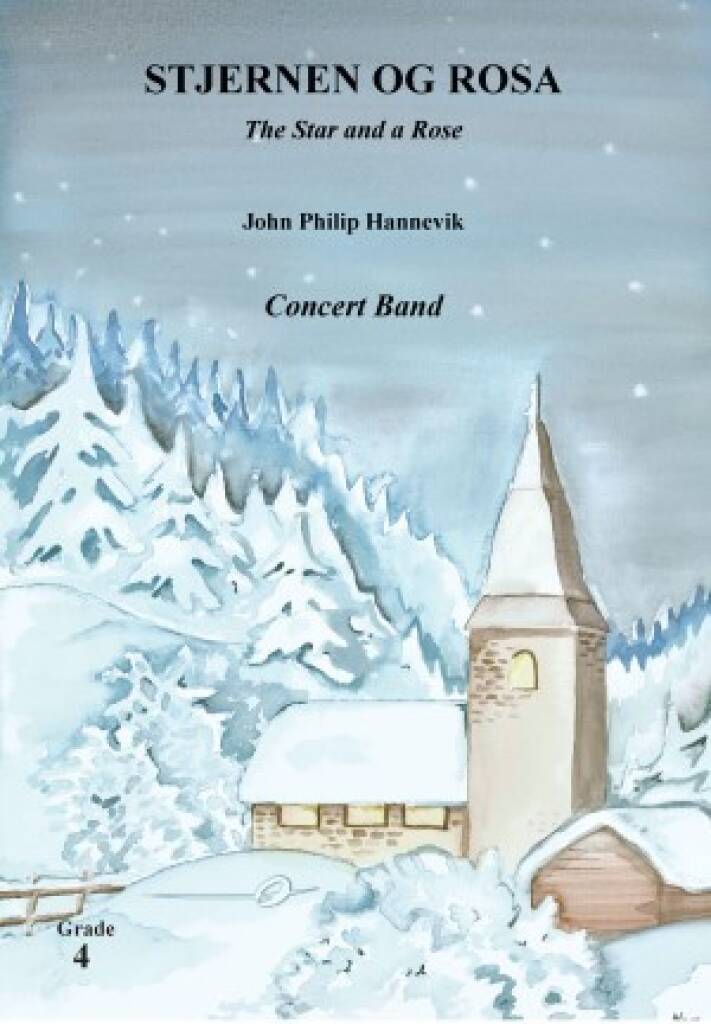
Stjernen og Rosa - John Philip Hannevik
The Star and a Rose is a big-scale Christmas piece for band, featuring four seasonal chorales.The first is a Gregorian-like chant Hodie Christus natus est.In this section of the piece, a soloist can be placed away from the band, maybe on a gallery. The soloist can be a tenor instrument, maybe trombone, or you can feature a vocal soloist.After this, the music leads us on to the old German Christmas chorale Lo, how a rose e'er blooming. This song is given a fairly rhythmical treatment, but make sure that the melody is presented in a cantabile style.An interlude follows, before the piece presents one of the most used and loved Scandinavian Christmas chorales, Mitt hjerte alltid vanker (My Heart will always wander), composed by the Danish bishop Hans Adolph Brorson around 1732. This song is building towards a climax, before the solo horn brings it all down to the Stable view described in the lyrics.Then comes a transition that brings us in to the final section of the piece, which presents the international Christmas Carol Adeste Fideles. As many will notice, I have borrowed a section from David Wilcocks majestic harmonization towards the end.The title of the piece has its background form the lyrics in My heart will always wander, where the text speaks about the stars in the sky. But also in the latin text for Adeste Fideles:Stella duce, Magi, Christum adorantesThe Rose is of course from the lyrics in the chorale Lo, how a Rose.
Estimated dispatch 7-14 working days
-
 £126.00
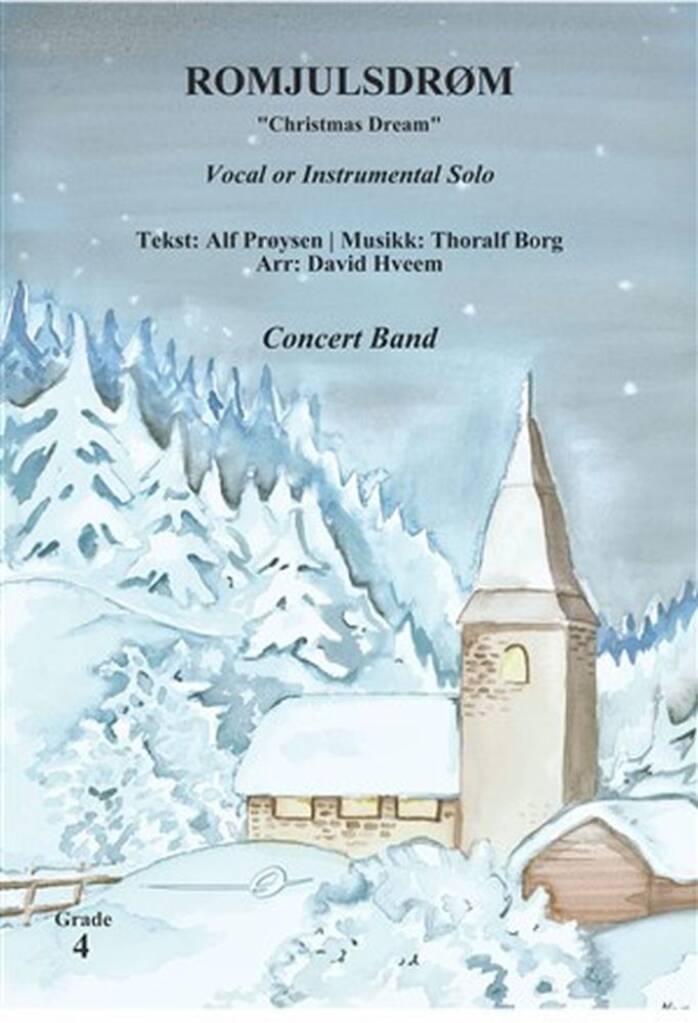
Romjulsdrm - Thoralf Borg
The poem Romjulsdrm ("Christmas Dream") was first published in Arbeiderbladet on January 3rd 1959, and became known when Thoralf Borg set a melody to it in 1968. Up until this, Alf Prysen had used a melody quite similar to the song Lijan uti dalen, when he sang the song in the TV program Ei vise vil jeg synge in 1964. At the same time that Borg's melody was written, the last four lines of text were also added to the poem, and the song took on the form we know today.The form and structure of this arrangement originates from a version for big band and vocals commissioned by stre Toten Storband, written in 2018 for one of their traditional midnight concerts on the day before Christmas. In an attempt to give the arrangement a nice calm and the text a lot of room, as is often the case in songs like this, it ended up in a relatively narrative style where the variation in tempo and the shifts between swing and straight eighth notes are particularly central.The song is about family, friendship and the quiet days of the Christmas holidays, which hopefully is something most people can recognise. The arrangement for the aforementioned midnight concert was ordered because my sister was to be the soloist for the concert, and since my father also played lead trombone - as he has done in this big band for as long as I can remember - it was natural to add a small trombone solo as well. It's always special to write and arrange music for people I know and appreciate, but it's extra special when it's also for two of my great role models.- David Stre Hveem -
Estimated dispatch 7-14 working days
-
 £108.40
Three Brass Cats - Chris Hazell
This is what Chris Hazell, the composer, had to say about 'Three Brass Cats': 'Some years ago I had four cats in the house - all were strays and decided that I was a soft touch when it came to free board and lodgings, so instead of moving on, they all decided to stay. Sadly they have all now gone to the great cattery in the sky. However, at the time they were around I was asked to write some pieces for a brass group (The Philip Jones Brass Ensemble). What should I write about? Well, I've always liked writing about the people and places around me (they appear in a lot of my music) so I thought.. I know, my cats. These days I don't have any cats as I travel around a lot with my work, but it's nice to think that they're still with me in the music.'
Estimated dispatch 7-14 working days
-
£107.70
Triqui-Traqui - Paul Desenne
Commissioned by Gustavo Dudamel for his 2017 New Year's concert with the Vienna Philharmonic, my Caribbean reinterpretation of Strauss' famous Tritsch-Tratsch Polka was deemed tooosefor the occasion, yet the maestro recorded it that year, not in Vienna but in Caracas, with the fabulous performers of his orchestra, the Orquesta Sinfnica Simn Bolvar, and published it on the web as his musical New Year's greetings card. The gesture was meaningful, and bold. I'm convinced that Johann Strauss, a man immersed in the fashions of his city and his time, would have loved the idea; a musical collage which carries in its banter a very strong aesthetic statement. The lightest and most frivolous things seem to always carry the deepest messages, let us not forget. ... ... Today, this version of my transformed Tritsch- Tratsch Polka forSymphonic Band created by Steve Boehm, will certainly tickle the Viennese in each and every one of us, and we will be very happy!"
Estimated dispatch 7-14 working days
 View Music