
Results
-
 £140.80
Decennium - Eric Swiggers
'Decennium' was composed in 2003 as a commission by the municipality of Berheze for its tenth anniversary. The composition describes the history of this town in the Province of Brabant, consisting of 6 different villages: Heesch, Heeswijk, Dinther, Nistelrode, Loosbroek and Vorstenbosch. The composition starts with a slow introduction, Adagio Misterioso, suggesting the atmosphere in long-ago days when the area consisted mainly of swamps, meres and low woods. (The word 'Bern' is a synonym of 'Born' meaning source or water, whereas 'Hese' is derived from 'Haisjo' meaning brushwood ). Above the dark sounds we hear far away trumpet signals announcing the Middle Ages. After a piercing crescendo, we hear the full sound of festive trumpets. A medieval dance, as was to be heard in the Heeswijk castle, follows. This dance gets a more and more stirring character and finally turns into a merry popular dance ending with a burst of laughter reproduced by descending scales with the muted trombones and trumpets. A slow transition with a quotation from a Gregorian plainsong (Domine Deus) and church bell ringing, referring to the Abbey of Berne, brings us to a romantic Larghetto. This part describes the quiet rural life in a beautiful natural surrounding. The last dying note contrasts with the threatening ostinato, referring to the rise of the industrialization, which provoked quite some resistance with the local people. Once more we hear the 'Domine Deus' but much more powerful this time. When the resistance calms down, the work concludes with an Alla Marcia. The first notes of the main theme could be heard all through the composition and now we hear the complete main theme again. The new town is born. A festive conclusion refers both to the tenth anniversary and the optimism and confidence as to the future.
Estimated dispatch 7-14 working days
-
 £154.99
Achnaton Wind Band Set (Score & Parts)
The Egyptian pharaoh Amenhotep IV, better known as Achnaton, was the second son and successor of Amenhotep III. He reigned the New Kingdom from 1353 until 1336 BC. Achnatons lack of interest in the economic well-being of Egypt ushered in a revolutionary period in Egyptian history. His harsh reign induced much suffering under the population. During this period when it was customary for a pharaoh to have many wives, he had taken his cousin Nefertete to reign as queen at his side. An elegant and very beautiful woman, she used her influence to ease the turmoil caused by Achnaton. Combined with her grace, her presence at public functions led to a greater popularity among her subjects than the pharaoh enjoyed himself. Being mostly preoccupied with religious questions, he declared that all the other gods did not exist. There was only one god, the Aten, and it was the sun itself. It was now necessary to change his name: 'Amenhotep' meaning 'the god Amun is satisfied', because he didnt want to be associated with Amun or any of the other deities. He renamed himself 'Achnaton' which means 'servant of the Aten' -- a much more appropriate title! In the sixth year of his reign Achnaton also moved the capital to a brand new city called Achet-Aton ('the Horizon of the Aten') which was where Tel el-Amarna stands today. He did this to further isolate himself from the 'old' religion, since the previous capital Thebes was the centre of worship of Amun. This new religion created an up rise among the population and high priests. In spite of Nefertetes influence, the falling economy and religious conflict resulted in the decline of the Egyptian empire. Hoping to forget it ever happened, people later tried to eradicate all traces of Achnaton and his successors rule by smashing their statues, mutilating their mummies, and ruining their relief carvings. From that moment on he was remembered as the 'heretic king'. This composition was partially funded by the 'Prins Bernhard Cultuurfonds'. 09:00
Estimated dispatch 7-14 working days
-
 £62.95
Celtic Lullaby (Concert Band - Score and Parts) - Nobes, Geoffrey
Celtic Lullaby was composed after a recent visit to the beautiful Isle of Arran off the west coast of Scotland. The beauty of the island, its mountains and glens, the lovely seascape around Holy Isle and the gentle rise and fall of the hills are all hopefully reflected in the music; the final few bars bring to mind one of Arran's radiant sunsets as night gently falls over the western sea.Duration: 4.00
Estimated dispatch 7-14 working days
-
 £52.00
Milton, the Melting Snowman (Concert Band - Score and Parts) - Orcino, Leonard A.
Who doesn't like a sunny day in the midst of winter? Who is that statuesque figure all decked out in his winter finery? Who stands proud, guarding the family home? Why it's "Milton the Melting Snowman!" But alas, as the day progresses and temps rise a transformation begins. Listen, as the music evokes Milton's dismay, "I'm melting!" The musical adventure pays tribute to this gallant guardian, soon to be a fond memory until next year. Set your mind free wander with this whimsical winter musical offering as the band pays tribute to this pillar of packed snow.Duration: 2.15
Estimated dispatch 7-14 working days
-
 £53.95
Baile Sereno (Concert Band - Score and Parts) - Bough, Thomas
Beginning as a stately Latin dance which builds into a vibrant celebration, all performers get involved and set the mood by combining foot taps and clapping to produce a memorable start to this piece. Carefully notated percussion parts contribute authentic sounds and provide students an opportunity to play congas, bongos, and timbales using traditional notation. Performers and audiences alike will enjoy the multicultural content and the emotional rise and fall of this engaging composition.Duration: 3.00
Estimated dispatch 7-14 working days
-
 £375.00
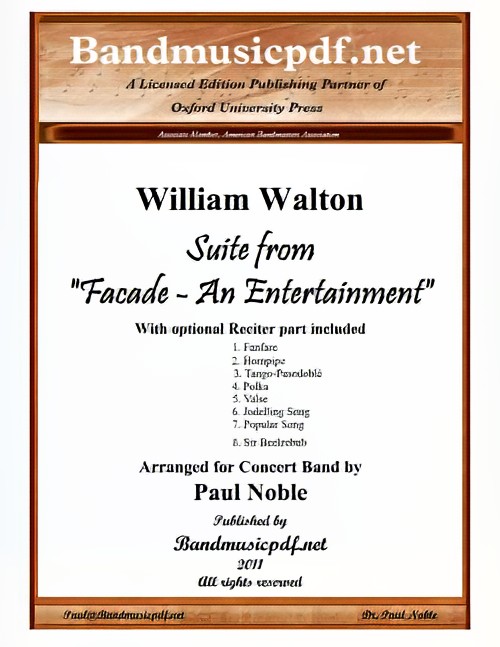
Facade - An Entertainment, Suite from (Concert Band with Optional Narrator - Score and Parts) - Walton, William - Noble, Paul
This Suite from Facade - An Entertainment, composed by William Walton, with poems by Dame Edith Sitwell, presents for the first time a grouping of movements selected and arranged by Paul Noble for Concert Band and optional Reciter. The original composition was written between 1921 and 1928, containing forty-three numbers. They had their origin in a new style of poetry that Edith Sitwell evolved in the early 1920s, poems that her brother Osbert later described as 'experiments in obtaining through the medium of words the rhythm and dance measures such as waltzes, polkas, foxtrots... Some of the resulting poems were sad and serious... Others were mocking and gay... All possessed a quite extraordinary and haunting fascination.' Possibly influenced by the dance references in some of the numbers, Osbert declared that the poems might be further enhanced if spoken to a musical accompaniment. The obvious choice of composer was the young man who lived and worked in an attic room of the Sitwell brothers' house in Carlyle Square W[illiam] T[urner] Walton, as he then styled himself. The now historic first performance of the Facade Entertainment took place in an L-shaped first-floor drawing-room on January 24, 1922. Accompaniments to sixteen poems and two short musical numbers were performed by an ensemble of five players. The performers were obscured from the audience by a decorated front curtain, through which a megaphone protruded for Edith to declaim her poems. This was, as she put it, 'to deprive the work of any personal quality'. The first public performance of Facade was given at the Aeolian Hall on June 12, 1923. By now, fourteen poems had been set, others revised or rejected, and an alto saxophone added to the ensemble. The occasion gave rise to widespread publicity, both pro and contra, and the name of the twenty-one year old W. T. Walton was truly launched. In the ensuing years the Facade has gone through revisions and additions, with full orchestral arrangements of selected movements being made without the Reciter. Former Band Director Robert O'Brien arranged some movements for band, again without Reciter, which are now out of print. So this 'history making' addition is the first opportunity for Concert Bands to present some movements of Facade with poems as originally intended. The luxury of electronic amplification allows the full ensemble to perform without necessarily overshadowing the Reciter. And the arrangements are written with considerable doubling so that the ensemble may play in full, or reduced in size as may be desired for proper balance. And, though not encouraged, the arrangements are written so that the band can perform the music without the Reciter. Program notes are adapted in part from those written by David Lloyd-Jones and published by Oxford University Press in the Study Score of William Walton's Facade Entertainments.
Estimated dispatch 7-14 working days
-
 £73.50
The Spirit of Orpheus (Concert Band - Score and Parts) - Smith, Robert W.
Commissioned by the Phi Mu Alpha Sinfonia Foundation, this brilliant composition by Robert W. Smith follows in a long line of high-energy, vibrantly-descriptive and excitingly-scored works. Set as a tribute to musicians past and present, all of the Smith trademarks are present in this tune, guaranteeing your musicians will thoroughly enjoy rehearsals and audiences will rise to their feet applauding at the conclusion. A truly important musical statement!Duration: 7.30
Estimated dispatch 7-14 working days
-
 £72.99
NATURE'S WAY (BandQuest) - Schuller, Gunther
From the composer: "Nature's Way for intermediate level band was commissioned by BandQuest, a project initiated by the American Composers Forum. Their mission is for major composers of national reputation to write works of high quality that take into consideration the (still comparatively limited) levels of musical development--both technical and conceptual--typical of such ensembles. I eagerly accepted the commission and the challenges implied thereby--that is, to reign in my creative imagination to some extent and limit the technical/conceptual demands to a more moderate level than is to be found in my previous compositions for band. Nonetheless, since the process of rehearsing, studying and performing a work created specifically for the school student market is--and must be, in my view--primarily educational, it was very clear to me that my work would (and should) challenge the players at least to their top levels, and even a little beyond that. Thus Nature's Way in no way represents a compromise of my personal style, nor my long held concepts of form, continuity, texture, and instrumentation. I have known for a long time that young, inquisitive minds are eager to learn from new experiences, from previously never encountered challenges, that is to say, to be pushed--gently--to rise above their present levels of achievement. That's what education is all about."
Estimated dispatch 7-14 working days
 View Music