
Results
-
 £75.00
English Dance Suite - V. Volta (Concert Band - Score and Parts) - Gardner, John - Noble, Paul
Arranged for the modern Concert/Wind Band, scored for three trumpets, reasonable doubling of parts where the original musical effect is not altered so that players can have a more responsible and enjoyable experience, more legible parts with less doubling on one staff, etc. The piece is offered either as a complete suite of seven movements, and also as seven individual movements which may be purchased independently. The English Dance Suite was originally composed by John Gardner for Wind Band, and has been re-set for the modern Concert Band instrumentation. Both the original version, edited and type-set by Paul Noble, and this arrangement are first editions now available for purchase to bands around the world. The set of seven Renaissance dances depict John Gardner's love of Scottish music, the Renaissance heritage, and some of his own mischievous approach to music. The first movement, Chacony on a Golden Theme, reminiscent of the Allegro movement of Purcell's Golden Sonata, is much used as a vehicle for variation on a repeated short harmonic progression, often involving a fairly short repetitive bass-line which offered a compositional outline for variation, decoration, figuration and melodic invention. In this it closely resembles the passacaglia. The Alman originated in the 16th century as a duple metere dance of moderate tempo, already considered very old, with a characteristic double-knocking upbeat of one or occasionally three sixteenth notes. It appears to have derived from a German dance but no identifiable dance and no German dance instructions from this era survive. The Hornpipe, usually in 3/2 dance rhythm, is an Irish, Scottish and English dance. It is done in hard shoes, which are used to help keep track of how the dancer keeps in time. There are two variations of the hornpipe dance: fast and slow. Usually, more experienced dancers will do the slow hornpipe but younger dancers will start out with the fast hornpipe and then switch in later years. The Corranto is a 16th-century court dance characterized by short advances and retreats, in quick triple time. The Volta (Italian: the turn or turning) is an anglicised name from the later Renaissance. Its main figure consisted of a turn and lift in a sort of closed position. The Pavan is a slow processional dance common in Europe during the 16th century. The Reel, indigenous to Scotland, consists largely of quaver (eighth note) movement with an accent on the first and third beats of the bar.
Estimated dispatch 7-14 working days
-
 £75.00
English Dance Suite - VI. Pavan (Concert Band - Score and Parts) - Gardner, John - Noble, Paul
Arranged for the modern Concert/Wind Band, scored for three trumpets, reasonable doubling of parts where the original musical effect is not altered so that players can have a more responsible and enjoyable experience, more legible parts with less doubling on one staff, etc. The piece is offered either as a complete suite of seven movements, and also as seven individual movements which may be purchased independently. The English Dance Suite was originally composed by John Gardner for Wind Band, and has been re-set for the modern Concert Band instrumentation. Both the original version, edited and type-set by Paul Noble, and this arrangement are first editions now available for purchase to bands around the world. The set of seven Renaissance dances depict John Gardner's love of Scottish music, the Renaissance heritage, and some of his own mischievous approach to music. The first movement, Chacony on a Golden Theme, reminiscent of the Allegro movement of Purcell's Golden Sonata, is much used as a vehicle for variation on a repeated short harmonic progression, often involving a fairly short repetitive bass-line which offered a compositional outline for variation, decoration, figuration and melodic invention. In this it closely resembles the passacaglia. The Alman originated in the 16th century as a duple metere dance of moderate tempo, already considered very old, with a characteristic double-knocking upbeat of one or occasionally three sixteenth notes. It appears to have derived from a German dance but no identifiable dance and no German dance instructions from this era survive. The Hornpipe, usually in 3/2 dance rhythm, is an Irish, Scottish and English dance. It is done in hard shoes, which are used to help keep track of how the dancer keeps in time. There are two variations of the hornpipe dance: fast and slow. Usually, more experienced dancers will do the slow hornpipe but younger dancers will start out with the fast hornpipe and then switch in later years. The Corranto is a 16th-century court dance characterized by short advances and retreats, in quick triple time. The Volta (Italian: the turn or turning) is an anglicised name from the later Renaissance. Its main figure consisted of a turn and lift in a sort of closed position. The Pavan is a slow processional dance common in Europe during the 16th century. The Reel, indigenous to Scotland, consists largely of quaver (eighth note) movement with an accent on the first and third beats of the bar.
Estimated dispatch 7-14 working days
-
 £125.00
English Dance Suite - VII. Reel (Concert Band - Score and Parts) - Gardner, John - Noble, Paul
Arranged for the modern Concert/Wind Band, scored for three trumpets, reasonable doubling of parts where the original musical effect is not altered so that players can have a more responsible and enjoyable experience, more legible parts with less doubling on one staff, etc. The piece is offered either as a complete suite of seven movements, and also as seven individual movements which may be purchased independently. The English Dance Suite was originally composed by John Gardner for Wind Band, and has been re-set for the modern Concert Band instrumentation. Both the original version, edited and type-set by Paul Noble, and this arrangement are first editions now available for purchase to bands around the world. The set of seven Renaissance dances depict John Gardner's love of Scottish music, the Renaissance heritage, and some of his own mischievous approach to music. The first movement, Chacony on a Golden Theme, reminiscent of the Allegro movement of Purcell's Golden Sonata, is much used as a vehicle for variation on a repeated short harmonic progression, often involving a fairly short repetitive bass-line which offered a compositional outline for variation, decoration, figuration and melodic invention. In this it closely resembles the passacaglia. The Alman originated in the 16th century as a duple metere dance of moderate tempo, already considered very old, with a characteristic double-knocking upbeat of one or occasionally three sixteenth notes. It appears to have derived from a German dance but no identifiable dance and no German dance instructions from this era survive. The Hornpipe, usually in 3/2 dance rhythm, is an Irish, Scottish and English dance. It is done in hard shoes, which are used to help keep track of how the dancer keeps in time. There are two variations of the hornpipe dance: fast and slow. Usually, more experienced dancers will do the slow hornpipe but younger dancers will start out with the fast hornpipe and then switch in later years. The Corranto is a 16th-century court dance characterized by short advances and retreats, in quick triple time. The Volta (Italian: the turn or turning) is an anglicised name from the later Renaissance. Its main figure consisted of a turn and lift in a sort of closed position. The Pavan is a slow processional dance common in Europe during the 16th century. The Reel, indigenous to Scotland, consists largely of quaver (eighth note) movement with an accent on the first and third beats of the bar.
Estimated dispatch 7-14 working days
-
 £91.99
The Sun Will Rise Again (Concert Band - Score & Parts) - Sparke, Philip
The composer writes:On March 11th 2011 a massive 9.0- magnitude earthquake occurred off the coast of north-eastern Japan. I'm writing these programme notes barely a week later and the death toll caused by the quake and resulting tsunami already exceeds 6000, with thousands of people still unaccounted for. I have many friends associated with many bands throughout Japan and one of these, Yutaka Nishida, suggested I write a piece to raise money to help those affected by the disaster. I was immediately attracted by the idea and have arranged Cantilena (a brass band piece recently commissioned by the Grenland International Brass Festival, Norway) for wind band, giving it a new title to honour my friends in the Land of the Rising Sun. I will be donating royalties from this piece to the Japanese Red Cross Society Emergency Relief Fund and am delighted to say that my distributors, De Haske, who will generously also donate all net profits from sales of this piece, have pledged a substantial advance payment to the Red Cross so that what little help this project generates can be immediate. It is my sincere wish that this 'Band Aid' project will allow wind bands around the world support the people of Japan, where bands are a way of life for many, in this difficult time.- Philip SparkeDuration: 4:30
Estimated dispatch 7-14 working days
-
 £94.99
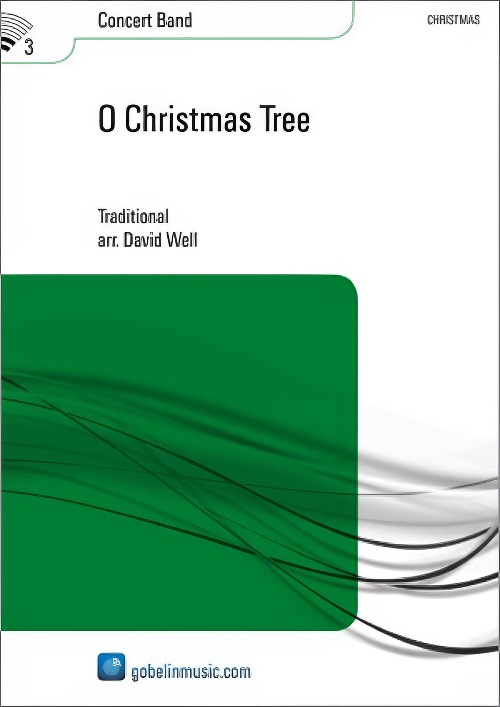
O Christmas Tree (Concert Band - Score and Parts) - Well, David
The tradition of the Christmas tree in Western Europe dates back to a time long before any Christianization had taken place. During the severely cold winter nights, so it was believed, evil spirits tried to 'kill' nature. Needle-leaved trees were the only ones which kept their green colour throughout the year, and therefore became symbols of immortality. These 'living' trees, said to be the work of benign spirits, were brought into people's houses to ward off evil, life-threatening powers. In the 14th century people first started to decorate Christmas trees. It was a pagan custom, originated by the inhabitants of Alsace. This custom was taken over by the Church in the course of the 15th and 16th century. At first the decoration consisted mainly of edibles, such as apples and wafers, but later small presents were added. Legend has it that the reformer Martin Luther was the first person to decorate a Christmas tree with candles. The flickering candle flames were meant to create the image of a starry sky in which Christ's apparition could be recognized. The German organ-player Ernst Anschutz from Leipzig was the first person to notate the song 'O Tannenbaum', the melody being a well-known folk song. Next to 'Stille Nacht' 'O Tannenbaum' is the most famous German Christmas song, now known throughout the world. In the United States of America the melody of 'O Tannenbaum' has even been used in four States (among which the State of Maryland) for their State song. In David Well's arrangement the song is first heard as many of us know it. After this introduction, however, it is transformed into a solid rock version, and the beat has been changed. In the second part the familiar three-four time is back, but here the rhythm is different from the original. After the richly ornamented rock beat the basic theme can be heard once again and the composition is concluded in a festive manner.Duration: 3:15
Estimated dispatch 7-14 working days
-
 £421.99
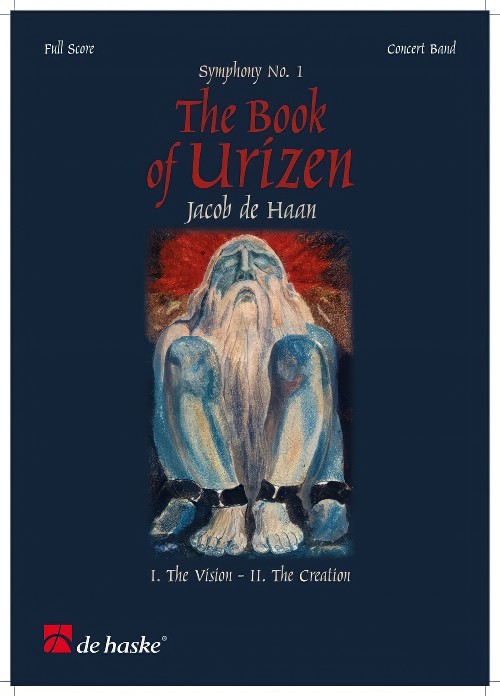
The Book of Urizen (Movements I: The Vision and II: The Creation) (Soprano, Narrator and Concert Band - Score and Parts) - De Haan, Jacob
The Book of Urizen is a work for concert band, solo soprano, and a male narrator in which sound collages of religious expressions are used. The piece is inspired by the compelling visionary poem of the same name (which the poet illustrated himself) by the Englishman William Blake (1757-1827), who occupies a unique position in western literature and the visual arts. He was not just a poet and a writer, but he was also a graphic artist, a painter, an illustrator, a spiritualist, a religious visionary, and a mystic philosopher. For the performance of this work, a professional sound system, including two microphones and a CD player, is needed. The three sound collages are three separate tracks on the enclosed CD and can be played easily at the right moment.The Book of Urizen bears resemblance to Genesis and Exodus, of which the contents form the basis of the Christian, Jewish, and Islamic faith. Blake adhered to the principle that all religions are in fact one, and that deities reside in human beings. In The Book of Urizen this is represented in "The Net of Religion," which is spanned over the earth by Urizen. The sound collages, compiled by Jacob de Haan in the studio, find their origin in Jerusalem, the Holy City, where the afore-mentioned faiths come together.In the first movement of this composition, The Vision, Urizen prepares his vision of the world, and he presents this to the "Eternals." His vision is rejected, and Urizen locks himself up in his own abstract world. When he does emerge again, he is confronted with rage by the gathered Eternals. Urizen flees the wrath of the Eternals, "the flames of eternal fury," and enwombs himself in his own world. When the Eternals see Urizen in his "stony sleep," they wonder if this is death. The blacksmith Los is torn by grief because of the isolation of Urizen. It brings him to rouse his fires, prepare his forge, and to give Urizen's world concrete form.In the second movement, The Creation, Urizen's world, but also man, woman, and child are created. Los is horrified with the appearance of Urizen's body. He mourns and pities Urizen, and from his blood a female form comes into being, with the name Enitharmon. The Eternals, fearful of the female form, decide to erect a tent to obstruct their view to eternity. Enitharmon and Los beget a son, called Orc. Los baptizes him as a child of the "fallen world." Orc is fed at Enitharmon's breast, which makes a girdle of jealousy restrict Los' chest. He takes the child to the top of the mountain and chains him down. The cries of Orc awaken Urizen, who explores his world creating instruments of scientific measurement to do so. Los encircles the face of Enitharmon from the sight of Urizen and Orc. She then populates the earth by giving birth to an enormous race.The Web, the third movement of The Book of Urizen, is available in a separate set.
Estimated dispatch 7-14 working days
-
 £267.99
Between the Two Rivers (Concert Band - Score and Parts) - Sparke, Philip
Between the Two Rivers was commissioned by Fanfare Prins Hendrik, from Aalst in the Netherlands. The title derives from the fact that the town of Aalst lies between two tributaries of the River Dommel. The community is a highly religious one, so the famous Luther chorale, Ein' Feste Burg, was an obvious choice for Philip Sparke to use as the theme for this new work. It takes the form of a theme with four contrasting variations. Variation 1 is a moto perpetuo, variation 2 has a slower march like feel, variation 3 is a sinister slow movement and the final variation is in the form of a lyrical fugue. Between The Two Rivers is sure to become a major work in modern concert band repertoire.Duration: 14:15
Estimated dispatch 7-14 working days
-
 £250.00
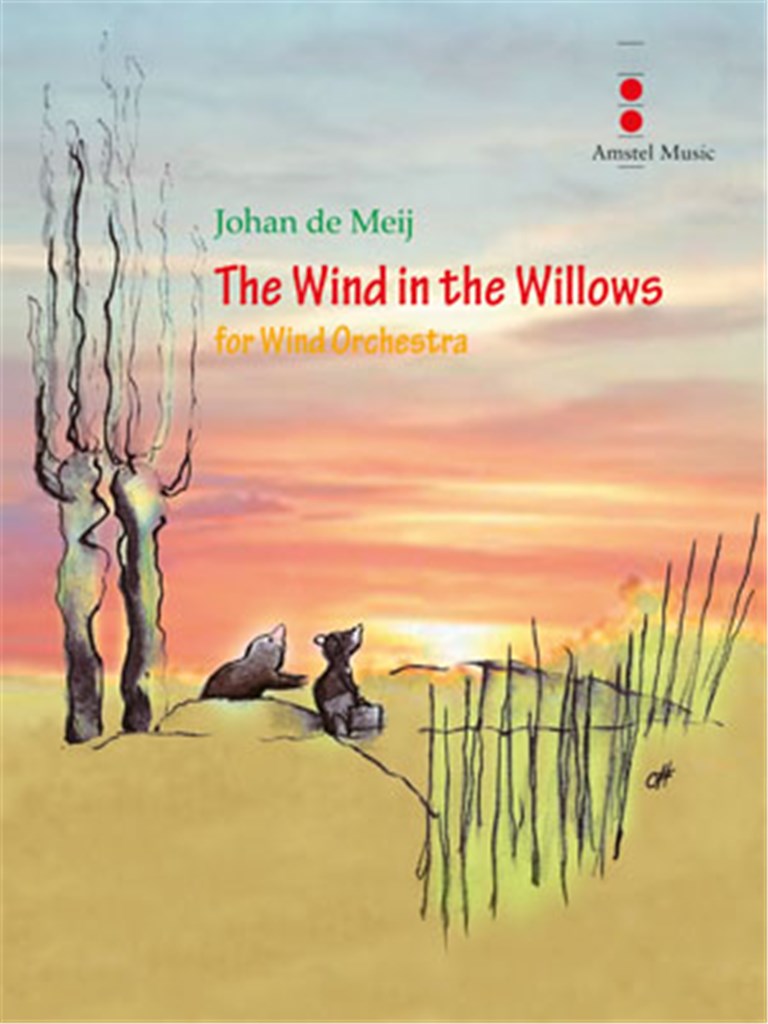
The Wind in the Willows (Concert Band - Score and Parts) - De Meij, Johan
A book for those who keep the spirit of youth alive in them; of life, sunshine, running water, woodlands, dusty roads, winter firesides, said author Kenneth Grahame (1859-1932) about his children's book The Wind in the Willows. Initially, he wrote the stories about Ratty, Mole, Badger and Toad to read to his visually handicapped son Alistair, but after the publication in book form in 1908, it became a worldwide success. It was later also turned into a film and a television series. What appealed ti the composer most is the friendly, very cosy atmosphere that Grahame has managed to create with his optimistic narrative style full of high spirits, an atmosphere that reminds thecomposer of his own carefree youth. It was therefore a great pleasure to set this book to music! The four movements successively describe: I) The River- The river, which flows through the habitat of the animals like a lifeline, regularly is the scene of pleasant boat trips and picnics. The animals lead their untroubled lives here. The four-tone main motif [A-C-D-C] is extensively presented by the brass section, and returns in the following movements as a countermelody. II) Ratty and Mole -The bright, energetic Rat and the melancholy doubter Mole are inseparable friends and have many adventures. Their opposite characters are illustrated by separate musical themes. III) Mister Toad - The wilful, haughty Mister Toad is indeed a unique case: time after time, he runs into tricky situations, and with his indomitable passion for fast, preferably stolen, cars he causes quite a lot of damage... IV) The Return of Ulysses - After Toad Hall, the majestic residence of Mister Toad, is recovered from the weasels and stoats of the Wild Wood, who had captured the estate in a cowardly way, our friends get ready for a banquet. They celebrate the victory with a triumphant parade, and so both the book and the music conclude with a happy ending. Duration: 17.00
Estimated dispatch 7-14 working days
-
 £189.99
Godzilla Eats Las Vegas (Concert Band - Score and Parts) - Whitacre, Eric
Note from Composer:It took me seven years to get my bachelor's degree from the University of Nevada, Las Vegas. By the time I graduated I was ready to eat Las Vegas.Tom Leslie asked me to write another piece for the group as I was leaving, and I thought it would be a blast to do something completely ridiculous. The players are called upon to scream in terror, dress like Elvises (Elvi), and play in about thirty different styles from mambo to cheesy lounge music. The audience follows a script that I wrote simulating a campy, over the top Godzilla movie (is there any other kind?).I wrote the bulk of the piece while in my first year at Juilliard, and no kidding, I used to act out the script every morning devouring animal crackers, wreaking havoc all over the breakfast table. The script was originally twice as long, and had an entire subplot devoted to a young scientist and his love interest. As I started to finish the piece, however, it didn't seem that funny and that story (along with an extended Elvis tribute) ended up on the cutting room floor.The idea that this piece is being played all over the world in such serious concert venues is the single funniest thing I have ever heard. It has been played on the steps of the Capitol by the United States Marine Band, by the Scottish National Wind Symphony (they play in kilts, so help me God), and I have a video of a Japanese audience visibly confused and shaken by the whole experience. Can you imagine? I'm laughing my head off even as I write this!Godzilla Eats Las Vegas! was commissioned by the University of Nevada Las Vegas, Thomas G. Leslie, conductor, and received its premiere November 28th, 1996.The performers are encouraged to go crazy: wear showgirl costumes, Elvis costumes, act out scenes on stage, use video and lighting - anything to get a laugh.
Estimated dispatch 7-14 working days
-
 £94.99
Conzensus (Concert Band - Score and Parts) - Van der Roost, Jan
This stately concert opener was originally written by Jan Van der Roost for a special event in which six respected wind orchestras (two Belgian and four Dutch) of different composition (two symphonic bands, two fanfare bands and two brass bands) were featured during six concerts. Each evening brought forth a performance by a symphonic band, a fanfare, and brass band, so that the audience could experience all three types of ensembles. This was indeed an original concept. The name, ConZEnSus, comes from a combination of the words, 'Concert Cyclus' (concert series) and 'zes' (Dutch for 'six'). This leads to a new word, which refers to 'consensus'. The general tenor of the cycle is thus immediately indicated. The richness of colour of the various ensembles is revealed through an open and friendly atmosphere. During all six concerts (over a span of three years), ConZEnSus functioned as a permanent opening number for each orchestra. Thus the same musical story was portrayed in three different packages.Duration: 2:30
Estimated dispatch 7-14 working days
 View Music