
Results
-
 £72.99
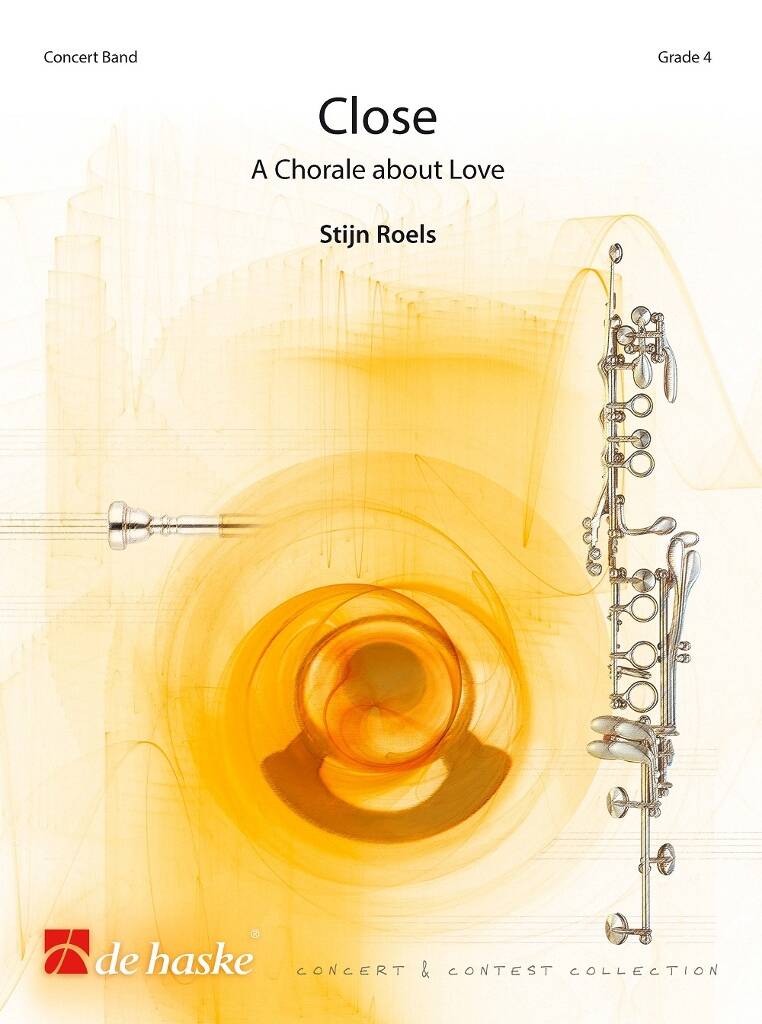
Close - Stijn Roels
Close is a chorale that sings the praises of a universal theme: love. The people who are dear to you are the ones you'd like to keep as close to you as possible, to make sure you can hug them from time to time. This was not always a matter of course during the past COVID period - an absence which many people felt deeply. The desire for the closeness of love is expressed in a beautiful, lyrical melody supported by warm harmonies. After a quiet opening, the music builds up to a grand climax, and it features tender as well as ardent moments. Perfect to dream away, as well as to dwell on the many aspects that belong to love.
Estimated dispatch 7-14 working days
-
 £159.99
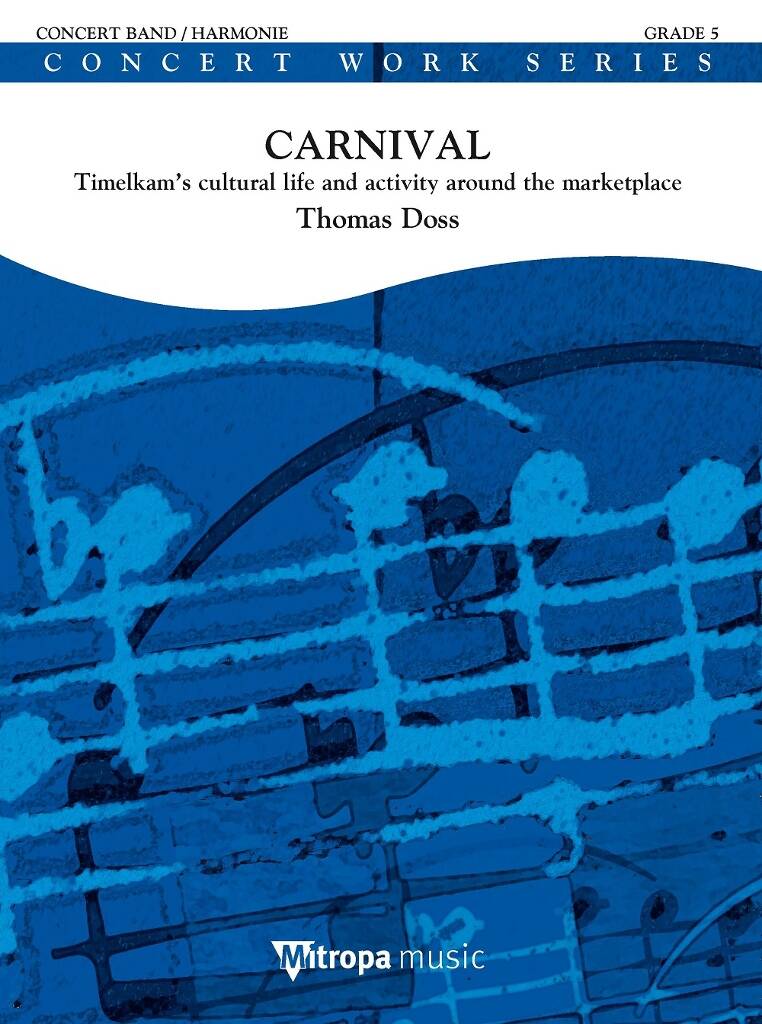
Carnival - Thomas Doss
This work was commissioned by Marktmusik Timelkam to celebrate its 170th anniversary. It describes the cultural life and hustle and bustle of the band's home base, the Austrian town of Timelkam. Carnival pictures a festive procession starting at the marketplace and lasting well into the night. The work features many 'carnivalesque' elements and is a joy for players to perform. There is a lot of merry activity going on in the music; people cheerily chatting in the inn; singing and dancing together and having fun. There is also room for a melancholy mood, accompanied by reminiscences about eternal goodbyes and searching for love. With the added musical representation of children's playing and pranks, a beautiful sunrise as well as a depiction of the churches and societies in town, this composition is not just an account of a carnival parade but a small portrayal of life.
Estimated dispatch 7-14 working days
-
 £159.99
Guardian Angels - Kevin Houben
Guardian Angels gives a musical expression to the legend of Reverend Louis Henri Bhler referring to the use of Psalm 34.North-west Veluwe and in particular Oldebroek (The Netherlands) has a very rich religious tradition which is demonstrated by its monumental churches. They tell the story of a stirring history in which Reverend Bhler played a crucial role. Inspired by his arrival as a pastor in 1870 in the neighbouring Oosterwolde, two big religious communities came into existence with their characteristic churches but this rivalry also resulted in great social unrest.This composition reflects on this striking personality and in particular on the story of the Angel Guard.'One evening Reverend Bhler has given a sermon in Oldebroek and he walks over the Church path through the pastures to Oosterwolde. On this dark and stormy evening Bhler's opponents are waiting for the pastor in ambush. They want to drown him in a watercourse near the Church path but abandon their plan because Bhler is accompanied by two men. The next day it comes to an encounter between Bhler and his opponents. They repent their, fortunately unexecuted , plan. Bhler firmly believes that on the previous night he walked alone over the Church path, and was not accompanied by two men. It was concluded that it must have been the angels who had protected Bhler.'Psalm 34 is central to this composition and this because of its powerful melody but also because the lyrics of verse 4 of the rhymed version fit in well with the special legend of Reverend Bhler:The Lord's angel gathered round himAn invincible heavenly guard,Who tries God's will, around himSo he's well guard(ed)A second melodious and harmonic cell is a musical transformation of the name 'Bhler'. This cell is varied in major and minor third chords and sometimes used as the main idea or apotheosis, but also serves as an accompanying cell or as a bridge between other melodic and rhythmic constructions.The composition was made possible by contributions of: Mr Evert van de Poll, owner of the Van Gelder Groep, Het Prins Bernhard Cultuurfonds Gelderland en Het Feteris Oosterbaan Fonds.
Estimated dispatch 7-14 working days
-
 £171.00
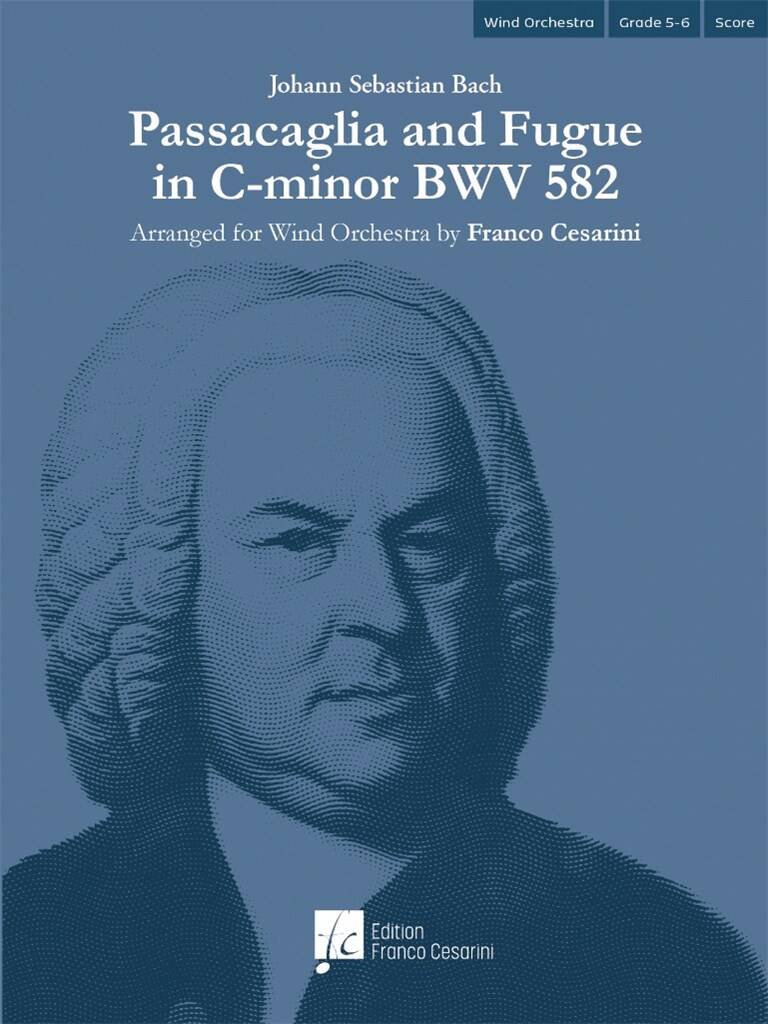
Passacaglia and Fugue in C-minor BWV 582 - Johann Sebastian Bach
The Passacaglia is a set of instrumental variations based on an ostinato bass. Bach's Passacaglia and Fugue in C-minor for organ represents the pinnacle of what had been achieved in this compositional form at that time. In Franco Cesarini's arrangement for large wind orchestra, the particularly careful interpretation of the original piece enables him to exploit all the sound colors at his disposal, and in this sumptuous guise Bach's work also takes on a grandiose dimension, albeit tinged with late-Romanticism. The exposition of the beautiful theme begins in the bass part, immediately creating a solemn and serious atmosphere which is accentuated by the intensely pathetic character of the first variations. Up to the tenth variation it remains confined to the bass, but in subsequent ones it also passes to the soprano and alto register. The integrity of the theme is also embellished with elegant arpeggios, in whose lower and higher extensions the theme can be distinguished. Towards the end it returns to the bass in an impressive thickening of the polyphonic texture that swiftly re-establishes the key of C-minor. The "Thema fugatum" which follows immediately does not constitute a Fugue in its own right, rather it is nothing but the twenty-first and most extensive variation of the Passacaglia. This time Bach uses only the first half of the theme, superimposing a rhythmic countersubject that considerably enlivens the entire development of the composition. The polyphonic discourse becomes increasingly dense, until the building tension peaks in a powerful "Neapolitan sixth" chord, followed by a sudden pause. This culminating moment then leads to the coda and final cadence on a bright C-major chord.
Estimated dispatch 7-14 working days
-
 £119.99
Quarantine - Thomas Doss
Like a dark veil, an ominous sense of foreboding takes hold across the world. A looming danger, one previously unknown to mankind, slowly approaches, bringing our daily lives to a grinding halt. A perilous virus gives us no choice other than to stay in our homes, leaving us unable to work in our offices or even visit family and friends. Something that has only been talked about in history books is coming to pass: a pandemic! The invisible danger expands more and more, and we feel paralysed by fear and fright. The distance between us and our fellow human beings increases. At the same time, we start to better understand something crucial: we have time again! People help each other out. Neighbourly assistance and support within one's own family becomes more apparent. We stand by each other. Suddenly we have the time for things that we did not have before. Time for reflection... A new era commences. Finally, hope reappears. We leave our houses, but nothing is quite the same anymore. With renewed strength, people begin to perceive the future in a positive and optimistic way once again. With greater attention and awareness of the here and now, we feel that, despite it all, we can be happy.Recorded by the Kobe College Wind Orchestra and its conductor Satoshi Yagisawa
Estimated dispatch 7-14 working days
-
 £64.99
If It Were Easy... - Richard L. Saucedo
Composed as a tribute and memorial to a revered educator, If It Were Easy... brings to mind a range of emotions and moods, including the idea that goals worth achieving are not always easy, but require dedication and perseverance.The piece begins quietly then builds gradually to a glorious full band chorale before tapering to a quiet and delicate finish.
Estimated dispatch 7-14 working days
-
 £127.30
Funky Hedde - Torstein Aagaard-Nilsen
A good friend of mine, trombonist and professor Jesper Juul Windahl commissioned me a trombone quartet. I then wrote Four Nordic Folk Pops. The last of the four is a Norwegian tune called Havard Hedde in a funky version. Then I made a brass quintet version for Lofoten Brass Quintet for a their Australia tour. The trombonist in the quintet asked me for a brass band version to be used in an entertainment contest (SIDDIS Brass). Havard Hedde did not succeed in getting married, but I think this version wil make him dance again. Torstein Aagaard-Nilsen
Estimated dispatch 7-14 working days
-
 £76.99
Whispers from Beyond - Rossano Galante
Composed as a tender tribute to a lost friend, this is meant not to be a mournful piece, but rather a joyous remembrance of a life ended too soon. The work features two primary themes that ebb and flow as the music progresses. Soaring melodic lines and rich orchestration help bring character and distinction to this effective and emotional piece. Dur: 4:00
Estimated dispatch 7-14 working days
-
 £66.95
In tantum lux - Todd Stalter
In tantum lux (The only light) was written as a memorial and celebration honoring the life of a music educator and her faith, who taught in a small school her entire career and persevered through the challenges and unique demands that teaching small school bands present. The piece also serves as a celebration of every band student and teacher in small schools everywhere who may not have the resources to have a full ensemble, yet strive every day to experience the joy of making music to the fullest just the same. (4:00)
Estimated dispatch 7-14 working days
-
 £271.60
Cerebral Vortex - Øyvind Moe
Cerebral Vortex was composed for Musikkforeningen Nidarholm for their participation in the 2009 World Music Contest in Kerkrade, The Netherlands. Tthe first performance was given at this contest conducted by Espen Andersen, with the composer in thesaxophone section.The title is meant to describe a from of writer's block caused not by lack of ideas, but rather a lack of ability to channel and form the madness swirling around inside the head of someone with a great desire to express something. In this respect,the piece can be said to be an exercise in keeping focus from the composer's side. A limited amount of material is repeated and treated to create a development that always has a solid anchor point. This is emphasized by the return to the openingtheme towards the end.
Estimated dispatch 7-14 working days
 View Music