
Results
-
£74.99
Oh, My Heart Belongs To Ireland - James Swearingen
It's virtually impossible to visit Ireland without feeling an instant appreciation for the scenic countryside, the endearing charm of its many citizens, and for the deep-rooted history of the country's many crowning achievements. Solo trumpet/cornet (cued for euphonium) packaged with a brief, but optional, vocal solo highlights the beginning and ending of this beautiful piece. The middle section is pure Irish charm with a light and lively theme performed over the drones of bagpipes along with the rudimental sounds of drummers drumming. Simply stunning!
Estimated dispatch 7-14 working days
-
£54.99
Nearer My God To Thee - Charles L. Barnhouse
Band Grade 3Solo Grade 4.5Note: This is a reprint from a vintage publication of 1888. No conductor score is published for this work. The Solo Cornet part serves as a conductor guide.Parts for Eb Horns are included; no F Horn parts are published for this work. If a C Piccolo/C Flute part was not published originally, one has been subsequently added by our editorial staff.
Estimated dispatch 7-14 working days
-
£54.99
Cosette - G. E. Holmes
Note: This is a reprint from a vintage publication of 1929.This piece contains solo parts for Soprano, Alto, and Tenor Saxophone.No conductor score is published for this work. The Solo Cornet part serves as a conductor guide.Parts for Eb Horns are included; no F Horn parts are published for this work.
Estimated dispatch 7-14 working days
-
£72.99
Valse Caprice - Herbert L. Clarke
Herbert L. Clarke was a legendary composer and musician active in the early part of the 20th century, well-known for his solos for cornet, trombone, euphonium and combinations of brass instruments with band accompaniment. What is not as well-known is that Clarke also wrote three works for alto saxophone and band! Helen, Valse Caprice and Lavinia were written between 1918-1922 in Canada for Charles Shaw, saxophonist for the Anglo-Canadian Leather Company Band which Clarke directed at the time. Valse Caprice is a fine example of pure lyric elegance. Written in modified ABA form, the principal theme is followed by a more embellished variation in eighth notes. The contrasting middle section is a pensive meno mosso, which leads into a reprise with cadenza-like figures, building to a rousing conclusion. The historic publication of these three works by Southern Music represents a significant contribution to saxophone solo and band literature that will introduce generations of musicians to some of Herbert Clarke_x001A_s finest hidden gems.
Estimated dispatch 7-14 working days
-
 £211.80
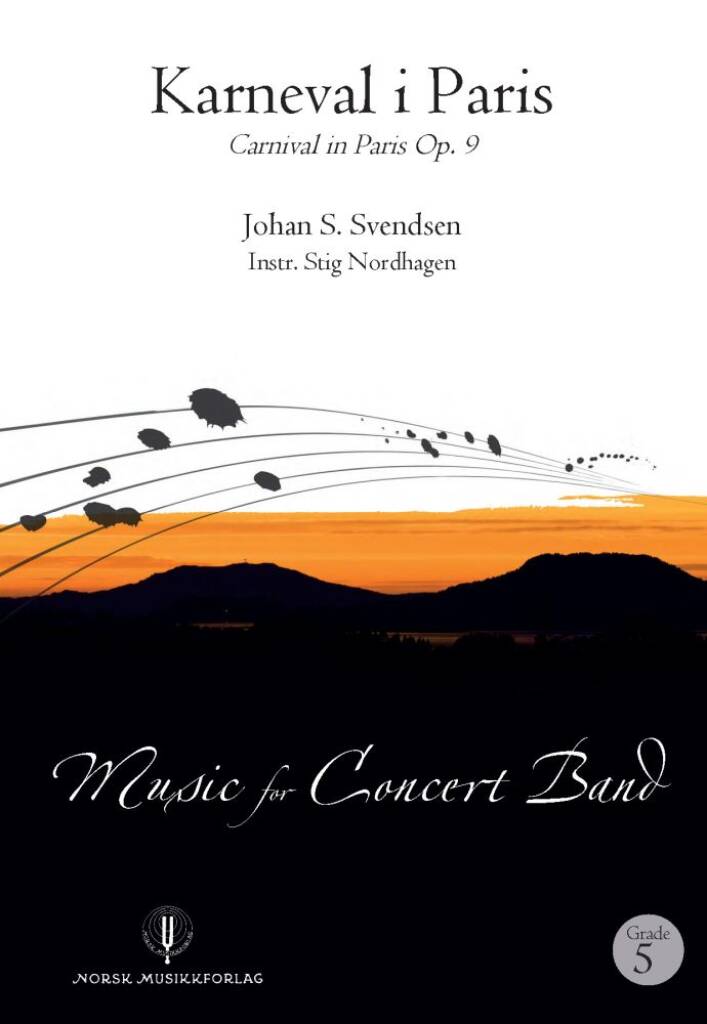
Karneval i Paris - Johan S. Svendsen
Johan Svendsen (1840-1911) composed "Carnival in Paris" in 1872, inspired by the energy and vibrancy of the Parisian carnival celebrations. The piece showcases a variety of moods and orchestral colours, ranging from jubilant and playful sections to more lyrical and elegant passages. It is a lively and colourful work that reflects Svendsen's skill in orchestration and his ability to capture vivid, festive atmospheres in music. In "Carnival in Paris", his Nordic musical roots meet the cosmopolitan influences he encountered while living and working in major European cities. The work has become one of Svendsen's most popular and is frequently performed in concert halls and festivals. About My Transcriptions for Wind Bands Ever since I started playing the clarinet at 8 or 9 years old in the school band "Blveisene" in my hometown of Gjvik, playing transcriptions of orchestral music has been a natural part of the repertoire. In regional bands, Norway's National Youth Band, and during my 10 years in a Military band, I played many such transcriptions. These transcriptions often included handwritten parts, masterfully crafted by colleagues in a time when music notation software didn't exist. Similarly, the scores were often incomplete, typically featuring just a solo clarinet part and condensed score in Bb. The transcriptions also contained parts for instruments like the Eb cornet and multiple tenor horns, but no saxophones, which made them less suitable for modern wind bands. The rise of many skilled Concert Bands and the increasing demands for scores and accessibility made me realize that someone needed to preserve this tradition. The reason I've transcribed these works is to ensure that you can play or conduct a repertoire that I believe has a rightful place in Norwegian Wind Band tradition. These transcriptions are my contribution to preserving some of the unique works in Norwegian music literature. Creating a transcription is a complex task, and I believe the score of "Carnival in Paris" is one of the most intricate I've undertaken. The first part of the process involves entering the entire orchestral score into music notation software. This is time-consuming and requires meticulous work. The next step is to check several editions to see if there are any discrepancies. Mistakes are often found in orchestral material, which can lead to further errors in the transcription. After that, I listen to many different recordings while following along with the score, paying attention to how different conductors emphasize balance and timbre. Gradually, I begin to note down passages I believe will work well for wind bands. One particular challenge in this piece is that the woodwinds and strings operate in the same register. In the original, the tonal difference between the strings and winds helps to clarify the individual musical lines. In the transcription, I've tried to address this by separating the lines, for example through octave adjustments, and highlighting them without compromising other aspects. I've also used some mallet percussion to broaden the tonal palette. There are countless decisions to be made to create a product that will hopefully allow future generations of wind band musicians to play this repertoire. - Stig Nordhagen -
Estimated dispatch 7-14 working days
-
£78.99
Side Partners - Claude T. Smith
The era of old-time concerts in the park comes back to life with "Side Partners." Composed by cornet virtuoso, Herbert L. Clarke, for himself and his long-time friend, Sousa Band trombonist Frank Holton, this delightful piece can be played by two cornets/trumpets, two trombones, two euphoniums, or any combination of these instruments. Feature your two outstanding brass players in this charming work. The accompaniment requires a minimum of rehearsal, and the solo parts are flashy without being overly demanding. An excellent choice also for community bands. Delightful music!
Estimated dispatch 7-14 working days
-
£54.99
Burlington - Charles L. Barnhouse
Note: No conductor score is published for this work. The Solo Cornet part serves as a conductor guide.Due to the era of this work, saxophone and double-reed parts are not published. Parts for Eb Horns are included; no F Horn parts are published for this work. If a C Piccolo/C Flute part was not published originally, one has been subsequently added by our editorial staff.
Estimated dispatch 7-14 working days
-
£54.99
Chautauqua - Charles L. Barnhouse
Note: No conductor score is published for this work. The Solo Cornet part serves as a conductor guide.Due to the era of this work, saxophone and double-reed parts are not published. Parts for Eb Horns are included; no F Horn parts are published for this work. If a C Piccolo/C Flute part was not published originally, one has been subsequently added by our editorial staff.
Estimated dispatch 7-14 working days
-
£54.99
Kanawha - Charles L. Barnhouse
Note: This is a reprint from a vintage publication of 1888. No conductor score is published for this work. The Solo Cornet part serves as a conductor guide.Due to the era of this work, saxophone and double-reed parts are not published. Parts for Eb Horns are included; no F Horn parts are published for this work. If a C Piccolo/C Flute part was not published originally, one has been subsequently added by our editorial staff.
Estimated dispatch 7-14 working days
-
£54.99
Mt. Pleasant - Charles L. Barnhouse
Note: This is a reprint from a vintage publication of 1888. No conductor score is published for this work. The Solo Cornet part serves as a conductor guide.Parts for Eb Horns are included; no F Horn parts are published for this work. If a C Piccolo/C Flute part was not published originally, one has been subsequently added by our editorial staff.
Estimated dispatch 7-14 working days
 View Music