Searching for Brass Band Music? Visit the Brass Band Music Shop
We've found 7 matches for your search

Results

  • £64.95

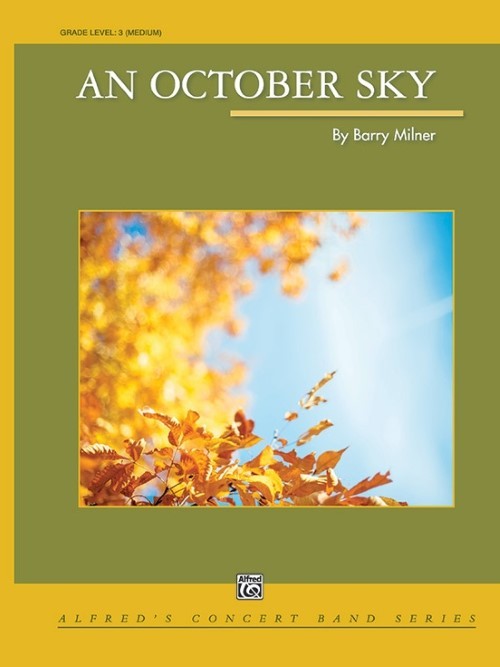
    An October Sky (Concert Band - Score and Parts) - Milner, Barry

    Inspired by an October afternoon when the sun had not yet lost its warmth, this piece is an attempt to recreate that moment---being thankful for all we are given, appreciating the beauty around us, and reflecting upon the importance of family and those we love.

    Estimated dispatch 7-14 working days

     PDF View Music

  • £59.80

    Alte Kameraden - Carl Teike

    It is the greatest tragedy in the life of a young composer if he happens to write his most successful piece at the beginning of his musical career. This holds true for Carl Teike, as the unsurpassed success at the beginning of his musical life was his march "Old Comrades". It is a sparkling piece that may well be labeled to be the German "march of marches". Carl Teike was born on Feb. 05, 1864 in Altdamm. After his parents had moved to Stettin, he had early contacts with military music as a youngster. The enthusiasm for this kind of music never left him throughout his life. He began a musical apprenticeship with City Music Director Bttcher in Wollin and already played in the spa orchestra of Bad Misdroy, which Bttcher conducted. Upon completing his apprenticeship, he enlisted as a volunteer in the band of the (5th Wrttemberg) King Karl Grenadiers No. 123 in Ulm. The musical and military environment there proved to be ideal for the ambitious young musician, who hoped to eventually study band music at the University of Music in Berlin. Above all, his military superior, bandmaster Julius Schreck supported young Teike wherever he could. Unfortunately the time in Ulm took a very unhappy turn, as Schreck's successor was extremely resentful towards Teike, and musical support was replaced by sheer harassment. On account of this, Teike retired from the military towards the end of 1889. Short employments in Ravensburg and Ulm evidently did not suit Teike, who was of northern German descent. This is why he applied for the Royal Police Force in Potsdam. Teike was accepted and entered service in 1895. The royal capital of the Hohenzollerns obviously stirred Teike to write a number of brilliant marches. He even became known abroad as the "musical policeman". Unfortunately he contracted a severe pneumonia while on duty, which eventually forced him to retire from the Royal Police Force in Potsdam. On February 01, 1909 he and his family moved to the prosperous provincial city of Landsberg on the Warthe (which is located east of Berlin in present-day Poland). There, Count Clairon d'Haussonville proved to be an understanding superior who paved the way for modest Carl Teike to continue composing, as his creativity had not suffered from this move. The disease which he had caught in Potsdam evidently was more severe than he was inclined to accept. In spring 1922, his state of health became worse, and in May of that year he passed away. Much too early - as many people felt. Teike's marches constitute an enrichment of the German concert march, as he never composed any street marches. Clear structures, musical ingenuity and a multitude of tone colors distinguish his works and shape them into something really new. It is this type of the march in particular that became the bedrock of the universal appeal of the German march. Even today Teike's marches stand unrivaled for musical quality and content - and they never are aggressive. Toward the end of his tour of duty in Ulm, Teike handed a new march to his superior, which, at the time, did not have a title yet. He in turn told Teike to "put it in a stove and burn it". As we know today, this was a classic misappraisal, as Teike subsequently named his march "Old Comrades" in view of his impending retirement. We do not even need to discuss the acceptance the march has met and still meets all over the world, as "Old Comrades" simply always has been a march of universal appeal. In his new arrangement, Siegfried Rundel did not change the essence of Teike's music, he rather sensitively adapted it to modern musical practice and to the instrumentation of the symphonic band on the basis of his deep respect for the works of Carl Teike.

    Estimated dispatch 7-14 working days
  • £159.99

    Fantasia Per La Vita E La Morte - Bert Appermont

    The mystique surrounding life and death formed the starting point of this composition. I wanted to write a work without a story, mixed up in a kind of musical quest for a new world of sound, original rhythm sequences, melodies filled with suspenseand distinct orchestral tones.The indirect cause was the birth of my first child which took place during this time, followed by the death of a close family member. At such a moment you experience just how close life and death are to each other, anddespite one being the antithesis of the other, they are incredibly similar. Both radical events are passages into new worlds and have great emotional impact. Moreover, the work was commissioned by "New Life", an orchestra that lost one of itsmusician in a plane crash, which also led me to believe that this approach would be appropriate.I would prefer not to comment on which passages in the composition concern life (birth) and which refer to death. It seems to me that it is moreinteresting to question traditional conceptions and leave it open for the listener. If you think that a passage is about birth, and this idea then shifts, it is this that raises fascinating questions, on both a musical and metaphysical level.Music isin an indirect but incredibly persuasive way in which to express the endless striving and seeking of mankind. Music can even touch eternity, as it were, and give us the feeling that we can transcend death. This endless search (and also longing) canbe heard throughout the work; as much in the sound fields and accent shifts in the first part as in the enormous tension curves and compelling themes of the second part. The semi-tone functions in this way as a guide or something to hold on to,running through the whole work and upon which much of the musical material is based. Traces of profound love resound with quiet simplicity in the slow section's melodious solos, after which the work contemplates life and death one last time, musesupon joy and sadness, on the possibilities and limitations of people and on the why of all things.I would like to dedicate this work to my dearest daughter Paulientje, to Meterke and to Johan de Jong of the "New Life" orchestra. May it fare themwell, here or in another dimension...

    Estimated dispatch 7-14 working days
  • £150.00

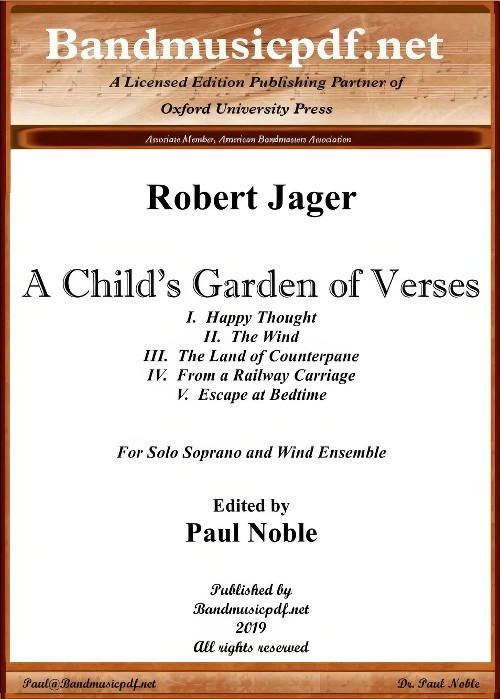
    A Child's Garden of Verses (Soprano Solo with Concert Band - Score and Parts) - Jager, Robert - Noble, Paul

    A Child's Garden of Verses has a very special meaning for me. Bob Jager, a family friend, was visiting in our home, and my wife, Mitzi Noble, a soprano soloist, was singing to his children. Bob's two young children became so enthralled with the music that Bob wanted to capture that moment. So he composed this piece for Mitzi, and dedicated it to his children, Kathleen and Matthew. The text is from Robert Louis Stevenson's poems: I. Happy Thought; II. The Wind; III. The Land of Counterpane; IV. From a Railway Carriage; V. Escape at Bedtime. Bob writes: The ideal performance instrumentation would be one on a part. If a larger group is used the balance should be kept proportional. In a few places the terms Solo or One are used where the sonority is critical, and this should be strictly followed. Above all, the singer should never feel forced by the ensemble. This work was composed in 1972, and was never published. I am pleased that Bob has allowed me now to publish it under Noble Music Publications, so that it may be available for others to perform and enjoy. Mitzi writes: Although we did not have access at the time, the ideal performance would be with a throat mic so that the soloist is free to move around the stage and sing, as though singing and relating to children sitting on the front row.

    Estimated dispatch 7-14 working days
  • £64.95

    Retriever Reveries (Concert Band - Score and Parts) - Wiffin, Rob

    This slightly unusual title reflects the fact that we, the Wiffin family, love Golden Retrievers and have shared our lives with them for the past 25 years or so. As a breed they can look very similar but their characters are, of course, very different. These two contrasting movements, At the Splash with Sim and Barnaby Behaves Badly, highlight just a couple of aspects of life with these faithful and loving companions.

    Estimated dispatch 7-14 working days
  • £12.95

    Retriever Reveries (Concert Band - Score Only) - Wiffin, Rob

    This slightly unusual title reflects the fact that we, the Wiffin family, love Golden Retrievers and have shared our lives with them for the past 25 years or so. As a breed they can look very similar but their characters are, of course, very different. These two contrasting movements, At the Splash with Sim and Barnaby Behaves Badly, highlight just a couple of aspects of life with these faithful and loving companions.

    Estimated dispatch 7-14 working days
  • £115.60

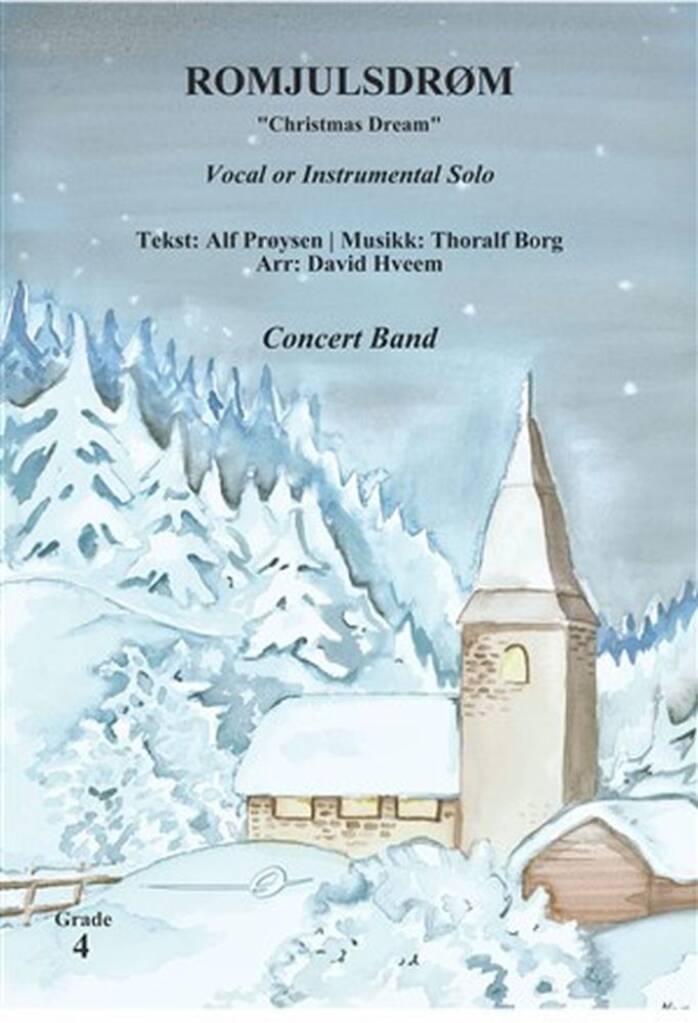
    Romjulsdrm - Thoralf Borg

    The poem Romjulsdrm ("Christmas Dream") was first published in Arbeiderbladet on January 3rd 1959, and became known when Thoralf Borg set a melody to it in 1968. Up until this, Alf Prysen had used a melody quite similar to the song Lijan uti dalen, when he sang the song in the TV program Ei vise vil jeg synge in 1964. At the same time that Borg's melody was written, the last four lines of text were also added to the poem, and the song took on the form we know today.The form and structure of this arrangement originates from a version for big band and vocals commissioned by stre Toten Storband, written in 2018 for one of their traditional midnight concerts on the day before Christmas. In an attempt to give the arrangement a nice calm and the text a lot of room, as is often the case in songs like this, it ended up in a relatively narrative style where the variation in tempo and the shifts between swing and straight eighth notes are particularly central.The song is about family, friendship and the quiet days of the Christmas holidays, which hopefully is something most people can recognise. The arrangement for the aforementioned midnight concert was ordered because my sister was to be the soloist for the concert, and since my father also played lead trombone - as he has done in this big band for as long as I can remember - it was natural to add a small trombone solo as well. It's always special to write and arrange music for people I know and appreciate, but it's extra special when it's also for two of my great role models.- David Stre Hveem -

    Estimated dispatch 7-14 working days

     PDF View Music