
Results
-
 £83.50
The Procession of the Nobles - Nikolai Rimsky-Korsakov
The Procession of the Nobles is the best-known piece that survived an ambitious project which was never completed due to lack of money. No less than five composers, several orchestras, choirs and ballet schools were to participate in what should become an enormousshow-piece of comprehensive theatre. The project failed because of lack of sponsors and internal conflicts, but it provided this magnificent composition. Mlada tells the story of Princess Voislava who kills her friend Princess Mlada because she is in love with Mlada's fianc Prince Jaromir. Mlada's spirit - personified by a female dancer - succeeds in convincing Jaromir in a dream of Voislava's cruel act. Jaromir revenges himself. Morena, goddess of the underworld, invoked by Voislava to chase Mlada's spirit, avenges the dying princess. An infernal storm brings death and destruction. In the final chorus of the opera the spirits of the deceased pay a tribute to the souls of the lovers Jaromir and Mlada united in death.
Estimated dispatch 7-14 working days
-
 £86.80
Wild Horses - Geert Schrijvers
This short, descriptive work was composed to commemorate the 10th anniversary of the dutch wind ensemble 'Vakantieorkest Ad Hoc', on their tour to the south of France. The work is a reference to the accommodation where the orchestra has often stayed. 'Wild Horses' is an rip-roaring composition, which brings forth images of the sometimes harsh and exciting world of the Wild West. This work is also a tribute to one of the most influential film score composers of all time: Ennio Morricone. The trampling of the wild stallions, the expansive wasteland and the exquistie beauty of the prairie at sunset form the main inspiration sources for this spectacular work.
Estimated dispatch 7-14 working days
-
 £130.10
Boudewijn Harmonie (Drijvers) - Boudewijn de Groot
With this medley 'Boudewijn' arranger Gerhart Drijvers pays a tribute to one of the greatest composers of original Dutch songs. Indeed, in collaboration with Lennaert Nijgh, Boudewijn de Groot wrote numerous fine songs for other artists as well as for himself. In this medley you can hear successively the songs 'Strand' (Beach), 'Beneden alle peil' (No level at all), 'Mijnheer de President' (Mister President), 'Tante Julia' (Aunt Julia) and, of course, 'Avond' (Evening). Thanks to these great successes 'Boudewijn' will not only be an extremely popular concert piece for all Dutch speaking audiences, but any audience.
Estimated dispatch 7-14 working days
-
 £78.90
Hangin' On! - Dean Jones
This swinging composition from the popular composer Dean Jones is a tribute to the much loved 'Light Walk' from Barry Gott. This is a delightful interlude during a heavy concert, and perfect for a summer evening's performance.
Estimated dispatch 7-14 working days
-
 £110.40
Elegy to Victims of War - Harrie Janssen
In these turbulent times when the world faces challenges and conflicts, this piece offers a powerful message of reflection, hope and connection. Beautiful melodies and poignant harmonies as we pay tribute to the victims of war and strive for a future of peace and reconciliation. Experience the power of music to unite and inspire us in this time of uncertainty and change.
Estimated dispatch 7-14 working days
-
 £153.99
Homenaje A La Tempranica - Joaquín Rodrigo
This piece is a tribute to the famous Zarzuela 'La Tempranica' by Gernimo Gimnez and perfectly conveys the lively spirit of this popular Spanish operetta form with its increasing international popularity.
Estimated dispatch 7-14 working days
-
 £126.50
Italian impressions - Angelo Sormani
"Italy is truly a magical land that has touched my heart beyond measure." These are the words describing the feelings that accompanied the various visits of the American conductor Wesley Broadnax in our country. Italian Impressions, a composition dedicated to Broadnax, portrays these feelings in three main sections that develop without interruption throughout the piece. The first section, "Magic Land," describes a trip to Rome and is a tribute to the splendor and magic of some of the venues in this city. Rich in historical and cultural significance, these places are moving because of their surprising architecture and artistic genius. The second part, "The Huge Castle," depicts his visit in the Umbrian Region. It is a reflective and suspended immersion in music that describes landscapes characterized by ancient houses, churches, courtyards, and squares. "Assisi," says Wesley, "is the city that glitters in the night sky, comparable to a huge castle!" The third part, "Medieval Ballad," is a reference to the city of Siena and Tuscany more generally. The main theme of this movement recalls medieval atmospheres and is based on the fourteenth-century ballad "Ecco la primavera" by Francesco Landino. The original material is presented, elaborated, and juxtaposed with new thematic motives, which lead to an energetic conclusion of the piece.
Estimated dispatch 7-14 working days
-
 £113.30
Moderate Dances - Angelo Sormani
This piece is a tribute to dance music, especially passionate, intense and meditative dance music. "Moderate Dances" is divided into three movements: a "Tango", a "Slow Waltz" and a "Bossa Nova". Each movement and each dance has its own particular characteristics but, when combined, these different rhythmic beats and times give the piece a feeling of completeness and uniformity. The Tango started to flourish in the suburbs of Buenos Aires in around 1880. There is still some doubt as to its origins, which may be Cuban (Habanera) but are probably African. It was most popular in Argentina and Brazil: here the male protagonist was originally the "gaucho" with his inseparable guitar, later to be replaced by the proud, elegant "compadre". By around 1910 the Tango had spread to Italy and France. New clubs opened, where the upper classes could watch and dance the Tango. Here the dance also underwent some rapid transformations. The exaggerated and extravagant gestures and body movements disappeared. Slow, gliding steps replaced the old rotational movements. The women's red ankle-boots and the partners "staring into each other's eyes" accentuated the erotic nature and sensuality of this dance. So much so that, in 1913, the German government banned soldiers from dancing the Tango. Those who broke the law were immediately discharged from the army. From a strictly musical perspective, the basic instruments were a flute, a harp (the diatonic harp typically played by the Indians of Paraguay) and a violin, or flute, guitar and violin or even clarinet, guitar and violin. These instruments were easy to transport, ideal for playing at parties, in the streets and in courtyards. The musicians played by ear, frequently improvising: there were no scores, no records, which is the main reason why it is impossible to trace the Tango back to its exact origins. However, the Tango's evolution (and growing popularity) was once again fostered by its fundamental ability to absorb "other" cultures, languages and sounds. And it was the arrival of the "bandoneon" (an accordion-like instrument that was invented in Germany and brought to Rio de la Plata by some immigrant), which replaced the flute, that marked the beginning of the Tango's huge success outside Argentina. A number of talented composers, above all the great Astor Piazzola (1921-1992), transformed the bandoneon from a simple accompanying instrument to a solo instrument that was to become the distinguishing feature of the 20th century Tango. The Slow Waltz originated from the Waltz, the typical dance of the Bavarian and Tyrolese peasants in the 1700s. It was composers like Johann Strauss, father and son, who carried the Waltz to its zenith in the 1800s, creating the sensual and melancholy yet joyful and charming dance we are all familiar with. When the Waltz first became popular in Germany, the members of respectable society were shocked at the closeness of the dancing partners, who had always previously danced apart. The main difference between the Waltz and Slow Waltz is that the latter has a slower, more expressive rhythm: the men wear tails and the women wear ball gowns decorated with beads and feathers and couples dance in graceful rotational movements. "Bossa Nova" is the title of the last movement in the piece. Jobim, the great Brazilian musician, described this musical genre as a combination of modern Jazz and Samba. Bossa Nova means "new wave". This was the name of the artistic and musical movement that evolved in Brazil in the late Fifties and was extremely popular throughout the Sixties. The songs are usually about love or social matters, drawing inspiration from the slums of Rio De Janeiro and the lives of their inhabitants. Bossa Nova, with its original compositions and the artistic talent of its musicians, also became hugely popular in the United States and Europe, and top Jazz musicians (Ella Fitzgerald, Stan Getz, Bob Cooper, Charlie Bird, Sonny Rollins, Dexter Gordon, Dizzy Gillespie) started to include Bossa in their repertoires.
Estimated dispatch 7-14 working days
-
 £252.50
Gopak - Eric Ewazen
Gopak is the first movement of a set of Symphonic Dances written for the Hofstra Unibersity Wind Ensemble, directed by Peter Boonshaft, who commissioned and premiered the work in 2009. Gopak is a tribute to my Polish and Ukrainian roots. My father used to dance traditional Ukrainian dances including the Gopak, and some of my earliest musical memories include the joyful, energetic, and rhythmic feel of those wonderful folk dances.Gopak has a strong feeling of two beats, is accented quite heavily, and is energetic from beginning to end. The melodies are completely original, but the lively feel of the music calls to my mind the energy of the Gopak, notes composer Eric Ewazen.
Estimated dispatch 7-14 working days
-
 £196.50
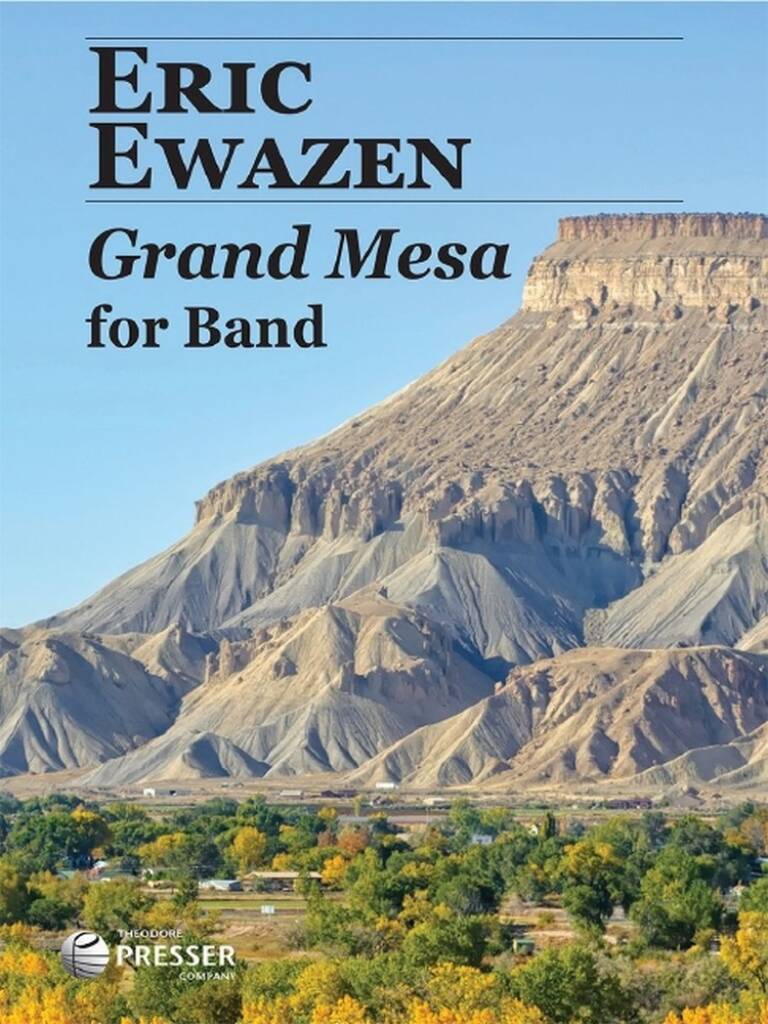
Grand Mesa - Eric Ewazen
The Colorado Mesa University Wind Symphony, under direction of Dr. Calvin Hofer, has hosted the annual and continually growing Best of the West Music Festival. In 2007, Ewazen was guest composer and commissioned for a new concert band work to celebrate Grand Junction and the towering Grand Mesa that rises above the town. Inspired by this grand landscape, I set out to write a work which was rich, resonant, colorful and bold, a tribute to this amazing scenery which I ultimately had the pleasure of seeing and exploring first hand. For intermediate to advanced bands.
Estimated dispatch 7-14 working days
 View Music