
Results
-
 £61.50
Tailspin! - Rob Romeyn
Inspired by a memorable commuter jet trip taken by the composer, "Tailspin!" is an aggressive and hard hitting composition capturing the peril of an airliner in rapid descent. Contemporary harmonies and driving rhythms contribute to the unique and fresh sound of this work. Varied dynamics and textures add to the drama and make this the perfect concert or festival work for young bands. Creative and skillful scoring makes this sound much harder than it actually is. "Tailspin!" Has the excitement and power that students love!
Estimated dispatch 7-14 working days
-
 £56.99
Nighthawk - James Swearingen
A slow, dark, and mysterious theme serves as a prelude to a new section that explodes with rhythmic energy. Instruments scored where they sound their best, layered themes, interesting harmonies, and a variety of percussion parts all combine to create an exciting musical journey from start to finish. The crafting of this piece will help make your students sound advanced for their age. Very Impressive!
Estimated dispatch 7-14 working days
-
£76.99
We Gather Together - Kremser
The famous Dutch hymn "We Gather Together" is scored for small bands with limited instrumentation, but will sound great with bands of all sizes! Dedicated to the Frontline Responders and Essential Workers who keep us safe, this is the perfect "welcome back" piece for both the band and your returning audience. With "Build-A-Band scoring, you get to create unique sounds using the strengths of your instrumentation, and by following the suggested flexible interplay between sections. This beautiful arrangement includes optional vocal parts for performers and/or audience. Piano, bass, guitar and percussion can strengthen your sound as well. Flexible works wonders, and it's perfect for distance learning situations!
Estimated dispatch 7-14 working days
-
 £137.70
Every Breath You Take - Gordon Matthew Sumner
The great hit from 1983 by English band Police has moods and colours that is immediately recognized. In the band arrangement it is much the same, but with the added timbres and carpets of sound typical for wind players. Please pay attention to balance throughout the piece. You may also use this piece To improve the sound, balance and intonation in your band.
Estimated dispatch 7-14 working days
-
 £193.20
CASTRVM - Lionel Beltrán-Cecilia
CASTRVM is a symphonic episode inspired by four of the main civilizations that have coexisted over time in Ulldecona's Castle. With its melodies and sound effects, the composer tries to transport the listener through a trip to four uninterrupted movements, from the beginnings of this small settlement, creating a natural atmosphere recreated by the voice and the singing of birds to take us into the history with the first inhabitants, the Iberians, giving strength to the introduction of the composition, to move on to the time of the Andalusians, which with a melody in the form of a dance marked by percussion will transport us to take a walk in the surroundings of its circular tower. Next, and with strength, we arrive at the medieval and Christian period, marked in the score by the brass instruments, in this fragment we find moments that take us into the church of "Santa Mara de los ngeles", with melodies that evoke resonance and pomposity, continuing until we find the immense square tower, symbol of the fortress and homage, finally used as a prison and arsenal of those times. Then, there is a small slow march that will move us to some measures of strong stridency to finish with the whole section of low brass having its great moment of prominence, down to we reach the last part, Qna, a name that is recited during the musical piece and one of the names given in the past to the area that could be seen from the castle, where the change of location of the new town is recreated leaving the castle site, but always looking at it with respect and admiration as at the beginning of what is now the current Ulldecona, in this part, the composer plays a bit with a very well-known and significant melody for the inhabitants of Ulldecona, the "Jota Vieja", first making a reflex effect of all its melody and then only with the first six notes of this one, which builds a bridge until reaching the march and, later, the grand finale of this symphonic episode. The work was commissioned by Ulldecona Town Council and the Ulldecona Music Band, led by its conductor Joan Nadal i Girona, to commemorate the 800th anniversary of the donation of the Town Charter of Ulldecona "the old" (1222-2022), as part of the PATRIMONIUM 20.22 programme, "La Banda (Sonora) del Castell" (The soundtrack of the Castle).CASTRVM consists of: I.Iberians: stone and ironII.AndalusiansIII.The square tower: fortress and homageIV.Qna
Estimated dispatch 7-14 working days
-
 £103.20
Eternal Harmony - Kevin Houben
In memory of Ralph Lenssen - dedicated to the Royal Wind Orchestra St. Philomena Chevremont on the occasion of its 125th anniversaryEternal Harmony is a restrained yet powerful tribute in which memory, connection, and musical tradition come together. The work was composed in memory of Ralph Lenssen and dedicated to the Royal Wind Orchestra St. Philomena Chevremont, which celebrates an impressive musical legacy with this anniversary.At the heart of the composition lies an intensely lyrical melody that runs like a guiding thread throughout the piece. This musical core is continuously illuminated, deepened, and transformed, giving rise to a rich and layered sound world.Throughout the work, an expressive journey unfolds, filled with subtle and enchanting turns. The wind orchestra is used in all its facets: from intimate, transparent passages to full, sustained soundscapes. This interplay creates a spectrum of contrasts in which musicality, balance, and tone color take center stage.Warm harmonies and organically flowing chord progressions contribute to an atmosphere of serenity and reflection. At the same time, the music builds toward moments of intensity and emotional depth, in which the orchestra reveals its full sonic richness.Eternal Harmony is thus more than a composition: it is a musical remembrance, a quiet dialogue between past and present, and a tribute to both a cherished individual and an orchestra that has embodied music and community for 125 years.
Estimated dispatch 7-14 working days
-
 £159.99
Alliance Day - Thierry Deleruyelle
On 22 January 1963, the signing of the lyse Treaty between France and Germany marked the beginning of a solid relationship of cooperation and friendship, embodying the reconciliation of two nations after decades of conflict. Alliance Day celebrates this treaty by using the French and German national anthems as compositional material. Emblems of each nation, they are transformed throughout the work, symbolising the journey towards unity. The piece moves between intense, lyrical moments and playful, melodic ones. The orchestral climax culminates in an explosion of sound before reaching a grandiose finale.
Estimated dispatch 7-14 working days
-
 £59.99
Maximus Fanfare - Thierry Deleruyelle
Maximus Fanfare is a dazzling, energetic work for wind band, conceived as a short, percussive overture in which brass and percussion impose their power from the outset. From the very first bars, an explosion of sound captures attention before giving way to vibrant orchestral development, leading to a triumphal conclusion.This fanfare was inspired by the majestic golden lion that sits atop the belfry in the Place des Hros in Arras, a town with a rich architectural heritage listed by UNESCO. A symbol of strength and grandeur, the lion finds a musical echo in this brilliant work full of panache.Commissioned by the Orchestre d'Harmonie d'Arras, the piece owes its name to Maxime Lavoine, its conductor since 2011, in tribute to his commitment to and passion for wind band music.With Maximus Fanfare, Thierry Deleruyelle has created an intense and luminous work, a musical tribute to the significance of Arras' heritage and the enthusiasm of the musicians who keep it alive.
Estimated dispatch 7-14 working days
-
 £122.50
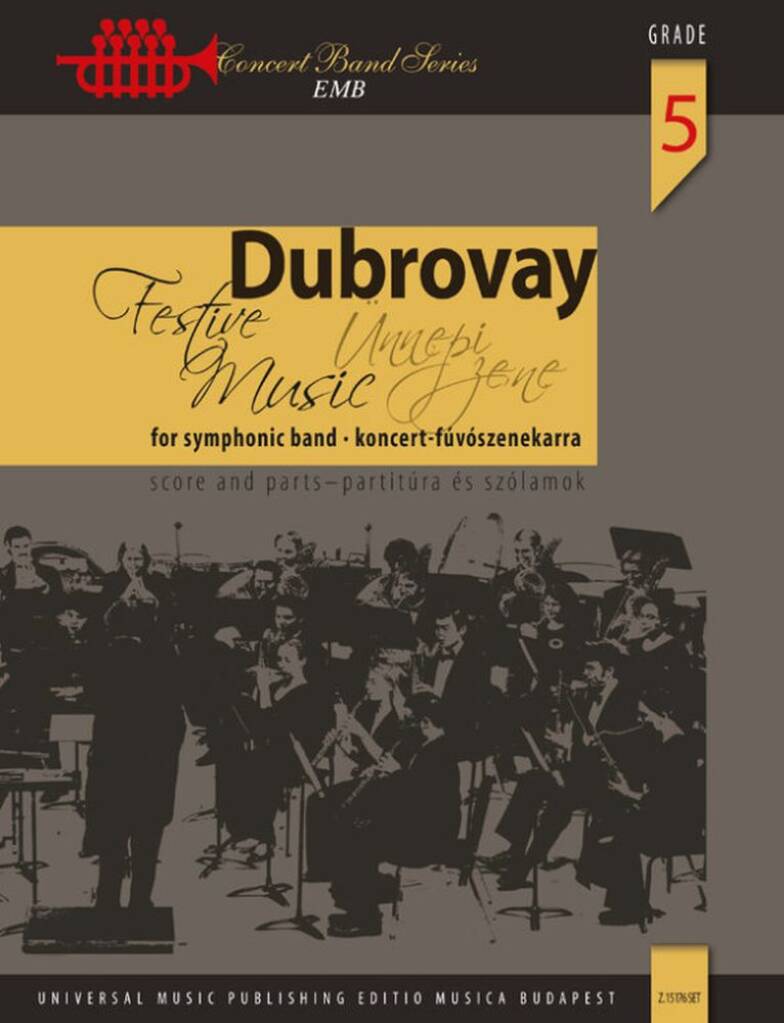
Festive Music
This work of festive atmosphere was written in 2000 for symphonic band, then the composer arranged it for symphony orchestra. In this piece, Lszl Dubrovay (*1943) parts with his special, hallmark concert band effects; rather, lively vibrations enriched with colliding seconds and distant overtones are brought to the foreground. The special sound is coloured by ornamental trills, appearing even in batches, and vibrating collisions in the high registers. The performance is rendered even more unique by the outer trumpets on both sides of the space. The trumpets and the flugelhorns can be divided into ten parts altogether, thus, the piece can be played by one ensemble or several bands together, as it is usual at the conclusion of large-scale festivals. This composition may be a great choice for festive concerts, since it is a solemn, innovative, and - by virtue of the free arrangement of the performing space - special work at the same time.
Estimated dispatch 7-14 working days
-
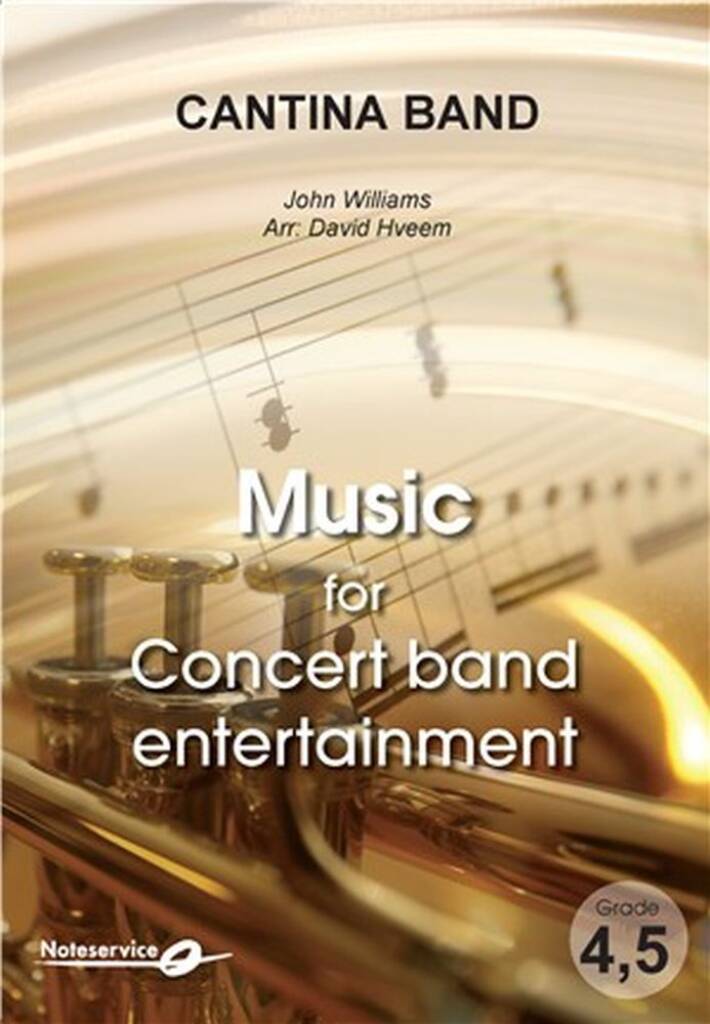 £155.90
Cantina Band - John Williams
Cantina Band (or Mad About Me) was written by John Williams in 1977 for the film Star Wars (later Star Wars IV: A New Hope). Even with quite a bit of the Star Wars music being quite well known, Cantina Band is literally in a style of its own. In the Star Wars-universe this style is called jizz, Williams' take on the more well-known genre jazz. Williams was tasked by Star Wars-creator George Lucas to make music that sounded like several creatures in a future century finding some 1930's Benny Goodman swing band music ... and how they might attempt to interpret it and ended up with Cantina Band #1 and #2. Both numbers are played in the legendary scene taking place in Chalmun's Spaceport Cantina where Luke Skywalker and Obi-Wan Kenobi gets in a fight causing even the band to stop playing.The band, which goes by the name Figrin D'an and the Modal Nodes, comes from the planet Clak'dor VII and specializes in jizz and the nearby, slightly older style of jatz. Performers of this music often go by the name "jizz-wailers", and the Bith people from Clak'dor VII are especially well suited for jizz-wailing since they can hold every note as long as they want thanks to a unique respiratory system - something many perhaps would like to be able to do in the performance of this arrangement as well.The arrangement is relatively faithful to Williams' original version, but with a somewhat different ending. Although the woodwind section undoubtedly has the biggest technical challenges, an understanding of the musical style is the very key to making the arrangement sound good - and here all groups must work together. Playing lightly but quite articulated, and very precise, will be an absolute necessity to get the music drifting off all the way to Tatooine.In measure 113 there is a small improvised solo in either trombone or trumpet, but if you want the real authentic Cantina Band-sound this is of course done on a steel drum.
Estimated dispatch 7-14 working days
 View Music