
Results
-
 £53.50
Like a Mighty Stream - Johnnie Vinson
Composed in remembrance of Dr. Martin Luther King, Jr., the title of this dramatic setting is taken from a biblical passage and quoted by Dr. King in his celebrated I Have a Dream speech in 1963. After a fanfare-like introduction, the piece is comprised of three sections. The Dream relects on Dr. King's famous speech. This is followed by Strife, which recalls the violence of the civil rights movement, and finally Hope, which looks to a brighter future and is a setting of the hymn We Shall Overcome. Performed with or without the narration, this is a stirring work for young bands. Dur: 5:20
Estimated dispatch 7-14 working days
-
£244.99
Zenith of Maya - Satoshi Yagisawa
By 200 B.C. the Mayan civilization was expansive, from the Yucatan Peninsula well into Central America. Their highly advanced technology still amazes us today, including their discovery of an accurate calendar derived from detailed astronomical observations and the use of the "0" in sophisticated mathematics.I. Royal ceremony and sacrifice of renewalThe first movement describes Mayan civilization at its zenith. An initial theme heralds admiration for a great king. A graceful choral then captures the magnificent setting of the Mayan world. After a folk melody for the populace, the agitated scene of a sacrificial ceremony is portrayed. The regal theme appears again in the coda, concluding in brilliance. This great civilization vanished in 10 A.D., leaving only remnants of a remarkably prosperous world. Thousands of ruins large and small remain locked in a dense world of jungle, with huge crumbled cities having lain forgotten for eight centuries.II. Glorious ruins still ariseII characterizes this civilization from glory, to destruction, to the present with its buried ruins. To begin, stone cities wait silently cloaked in jungle, steadfastly eluding discovery. As time passes slowly, the music reflects back to the glory of the Maya. Though wishing to turn back the hands of time for this incredible civilization, its fate and the gravity of its loss are carried forward in the profound silence of eternal loss. Finally, in the present, we marvel at the thousands of elegant remains, with a choral of praise for those with remarkable wisdom and strength, in a spectacular conclusion.(Satoshi Yagisawa)
Estimated dispatch 7-14 working days
-
 £59.80
Alte Kameraden - Carl Teike
It is the greatest tragedy in the life of a young composer if he happens to write his most successful piece at the beginning of his musical career. This holds true for Carl Teike, as the unsurpassed success at the beginning of his musical life was his march "Old Comrades". It is a sparkling piece that may well be labeled to be the German "march of marches". Carl Teike was born on Feb. 05, 1864 in Altdamm. After his parents had moved to Stettin, he had early contacts with military music as a youngster. The enthusiasm for this kind of music never left him throughout his life. He began a musical apprenticeship with City Music Director Bttcher in Wollin and already played in the spa orchestra of Bad Misdroy, which Bttcher conducted. Upon completing his apprenticeship, he enlisted as a volunteer in the band of the (5th Wrttemberg) King Karl Grenadiers No. 123 in Ulm. The musical and military environment there proved to be ideal for the ambitious young musician, who hoped to eventually study band music at the University of Music in Berlin. Above all, his military superior, bandmaster Julius Schreck supported young Teike wherever he could. Unfortunately the time in Ulm took a very unhappy turn, as Schreck's successor was extremely resentful towards Teike, and musical support was replaced by sheer harassment. On account of this, Teike retired from the military towards the end of 1889. Short employments in Ravensburg and Ulm evidently did not suit Teike, who was of northern German descent. This is why he applied for the Royal Police Force in Potsdam. Teike was accepted and entered service in 1895. The royal capital of the Hohenzollerns obviously stirred Teike to write a number of brilliant marches. He even became known abroad as the "musical policeman". Unfortunately he contracted a severe pneumonia while on duty, which eventually forced him to retire from the Royal Police Force in Potsdam. On February 01, 1909 he and his family moved to the prosperous provincial city of Landsberg on the Warthe (which is located east of Berlin in present-day Poland). There, Count Clairon d'Haussonville proved to be an understanding superior who paved the way for modest Carl Teike to continue composing, as his creativity had not suffered from this move. The disease which he had caught in Potsdam evidently was more severe than he was inclined to accept. In spring 1922, his state of health became worse, and in May of that year he passed away. Much too early - as many people felt. Teike's marches constitute an enrichment of the German concert march, as he never composed any street marches. Clear structures, musical ingenuity and a multitude of tone colors distinguish his works and shape them into something really new. It is this type of the march in particular that became the bedrock of the universal appeal of the German march. Even today Teike's marches stand unrivaled for musical quality and content - and they never are aggressive. Toward the end of his tour of duty in Ulm, Teike handed a new march to his superior, which, at the time, did not have a title yet. He in turn told Teike to "put it in a stove and burn it". As we know today, this was a classic misappraisal, as Teike subsequently named his march "Old Comrades" in view of his impending retirement. We do not even need to discuss the acceptance the march has met and still meets all over the world, as "Old Comrades" simply always has been a march of universal appeal. In his new arrangement, Siegfried Rundel did not change the essence of Teike's music, he rather sensitively adapted it to modern musical practice and to the instrumentation of the symphonic band on the basis of his deep respect for the works of Carl Teike.
Estimated dispatch 7-14 working days
-
£248.99
Odysseia - Maxime Aulio
Washed up on the Phaeacian shore after a shipwreck, Odysseus is introduced to King Alcinous. As he sits in the palace, he tells the Phaeacians of his wanderings since leaving Troy. Odysseus and his men fi rst landed on the island of the Cicones wherethey sacked the city of Ismarus. From there, great storms swept them to the land of the hospitable Lotus Eaters. Then they sailed to the land of the Cyclopes. Odysseus and twelve of his men entered the cave of Polyphemus. After the single-eyed giantmade handfuls of his men into meals, Odysseus fi nally defeated him. He got him drunk and once he had fallen asleep, he and his men stabbed a glowing spike into the Cyclop's single eye, completely blinding him. They escaped by clinging to the belliesof some sheep. Once aboard, Odysseus taunted the Cyclop by revealing him his true identity. Enraged, Polyphemus hurled rocks at the ship, trying to sink it. After leaving the Cyclopes' island, they arrived at the home of Aeolus, ruler of the winds.Aeolus off ered Odysseus a bag trapping all the strong winds within except one - the one which would take him straight back to Ithaca. As the ship came within sight of Ithaca, the crewmen, curious about the bag, decided to open it. The winds escapedand stirred up a storm. Odysseus and his crew came to the land of the cannibalistic Laestrygonians, who sank all but one of the ships. The survivors went next to Aeaea, the island of the witch-goddess Circe. Odysseus sent out a scouting party butCirce turned them into pigs. With the help of an antidote the god Hermes had given him, Odysseus managed to overpower the goddess and forced her to change his men back to human form. When it was time for Odysseus to leave, Circe told him to sail tothe realm of the dead to speak with the spirit of the seer Tiresias. One day's sailing took them to the land of the Cimmerians. There, he performed sacrifi ces to attract the souls of the dead. Tiresias told him what would happen to him next. He thengot to talk with his mother, Anticleia, and met the spirits of Agamemnon, Achilles, Patroclus, Antilochus, Ajax and others. He then saw the souls of the damned Tityos, Tantalus, and Sisyphus. Odysseus soon found himself mobbed by souls. He becamefrightened, ran back to his ship, and sailed away. While back at Aeaea, Circe told him about the dangers he would have to face on his way back home. She advised him to avoid hearing the song of the Sirens; but if he really felt he had to hear, thenhe should be tied to the mast of the ship, which he did. Odysseus then successfully steered his crew past Charybdis (a violent whirlpool) and Scylla (a multiple-headed monster), but Scylla managed to devour six of his men. Finally, Odysseus and hissurviving crew approached the island where the Sun god kept sacred cattle. Odysseus wanted to sail past, but the crewmen persuaded him to let them rest there. Odysseus passed Circe's counsel on to his men. Once he had fallen asleep, his men impiouslykilled and ate some of the cattle. When the Sun god found out, he asked Zeus to punish them. Shortly after they set sail from the island, Zeus destroyed the ship and all the men died except for Odysseus. After ten days, Odysseus was washed up on theisland of the nymph Calypso.
Estimated dispatch 7-14 working days
-
 £154.99
Achnaton - Jan Bosveld
The Egyptian pharaoh Amenhotep IV, better known as Achnaton, was the second son and successor of Amenhotep III. He reigned the New Kingdom from 1353 until 1336 BC. Achnatons lack of interest in the economic well-being of Egypt ushered ina revolutionary period in Egyptian history. His harsh reign induced much suffering under the population. During this period when it was customary for a pharaoh to have many wives, he had taken his cousin Nefertete to reign as queen at hisside. An elegant and very beautiful woman, she used her influence to ease the turmoil caused by Achnaton. Combined with her grace, her presence at public functions led to a greater popularity among her subjects than the pharaoh enjoyedhimself. Being mostly preoccupied with religious questions, he declared that all the other gods did not exist. There was only one god, the Aten, and it was the sun itself. It was now necessary to change his name: 'Amenhotep' meaning 'the god Amun is satisfied', because he didnt want to be associated with Amun or any of the other deities. He renamed himself 'Achnaton' which means 'servant of the Aten' -- a much more appropriate title! In the sixth year of his reignAchnaton also moved the capital to a brand new city called Achet-Aton ('the Horizon of the Aten') which was where Tel el-Amarna stands today. He did this to further isolate himself from the 'old' religion, since the previous capital Thebes was thecentre of worship of Amun. This new religion created an up rise among the population and high priests. In spite of Nefertetes influence, the falling economy and religious conflict resulted in the decline of the Egyptian empire. Hoping toforget it ever happened, people later tried to eradicate all traces of Achnaton and his successors rule by smashing their statues, mutilating their mummies, and ruining their relief carvings. From that moment on he was remembered as the'heretic king'. This composition was partially funded by the 'Prins Bernhard Cultuurfonds'.
Estimated dispatch 7-14 working days
-
£139.99
Algemiz - Ferrer Ferran
Algemesi is a town situated on the banks of the river Sucron, in the south of Valencia in Spain. Algemiz by Ferrer Ferran was inspired by two historical events connected with the town. When the Iberian peninsula was under the rule of the Romans a bloody battle took place between the armies of the generals Pompey and Sertorius known as The Battle of Sucron. Much later in the 13th century, Don Jaime 1, king of Aragon who had been defeated by the Maures d'Almenara, decided to lead an expedition to Sucron to evaluate the resistance of the Arab forces and conquer Alegmesi. This story of this expedition is told in The Dance of the Conquerors.
Estimated dispatch 7-14 working days
-
 £94.99
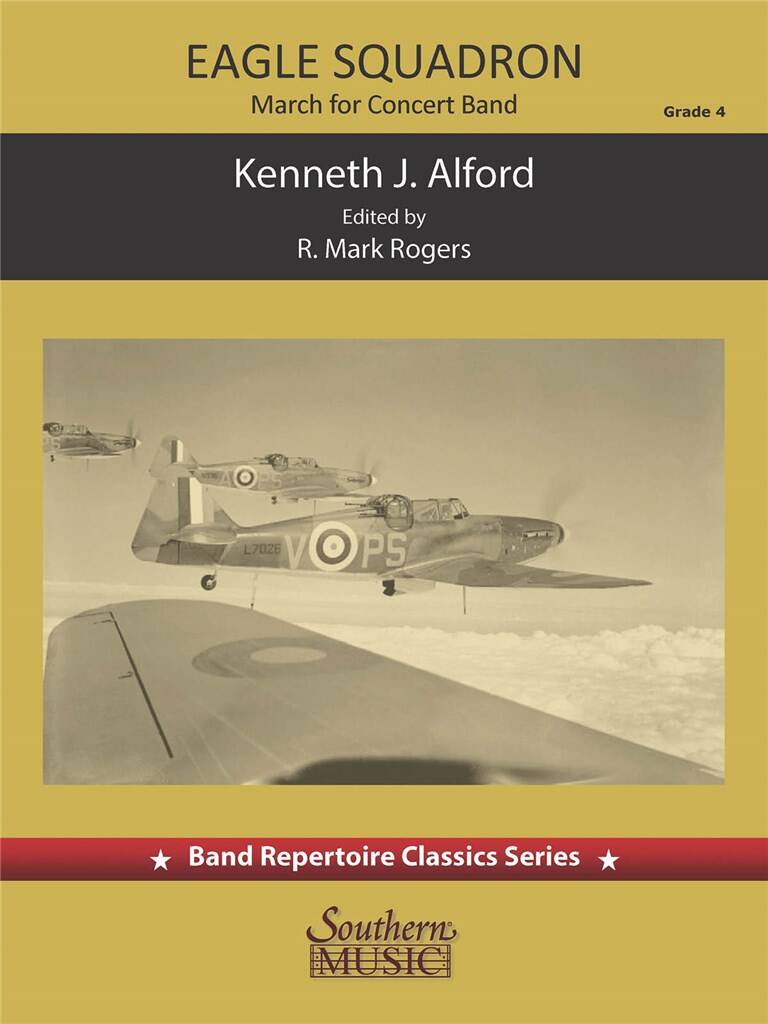
Eagle Squadron March - Kenneth J. Alford
When the Second World War began, the British March King Kenneth J. Alford (pseudonym for Major F. J. Ricketts, R.M.) was increasingly in bad health and had composed relatively little music recently. As Hitler's armies marched victoriously across Europe, Britain was soon alone facing the Nazi peril. Alford's great contribution to the war effort was the composition of two of his great masterpieces, ARMY OF THE NILE, celebrating the first Allied victories over the Germans in North Africa and EAGLE SQUADRON. The latter of these marches celebrates American airmen who travelled to England during the early years of the war (before the entry of the United States into the conflict) to volunteer for service with the Royal Air Force, serving with great distinction during the Battle of Britain. Alford skillfully weaves a number of well-known tunes into the fabric of the music, including the Royal Air Force March and The Star-Spangled Banner, while also including a reference to the Siegfried motive from Wagner's Ring of the Nibelung. Mark Rogers' edition of this classic march includes a handsome full score and concert size set of parts.
Estimated dispatch 7-14 working days
-
 £50.50
Holiday Party Mix
Get the party started with this energetic, upbeat medley of holiday favorites arranged by William Owens! Featuring "Jingle Bells," "Jolly Old Saint Nicholas," "Good King Wenceslas," "Up on the Housetop," and "Ode to Joy," the music may play very easy, but it grooves really hard!
Estimated dispatch 7-14 working days
-
 £127.30
Takk - Edvard Grieg
"Gratitude" is one of Grieg's beautiful lyrical pieces, Op. 62 No. 2.Eva Knardahl made a beautiful recording that I well remember was used as background for a picture cavalcade by the Norwegian Broadcasting Corporation during the passing of His Majesty King Olav V of Norway in 1991.In this arrangement for band, I have tried to vary the instrumentation, both for the sake of more colours and to emphasize the drama.This piece should be played rubato with elastic phrasing. The form can be described as AABACoda. The most dramatic section is the B part from measure 25, which peaks just before measure 38. The last four measures (from measure 53) can be done a bit 'meno' in tempo.Reid Gilje
Estimated dispatch 7-14 working days
-
 £76.99
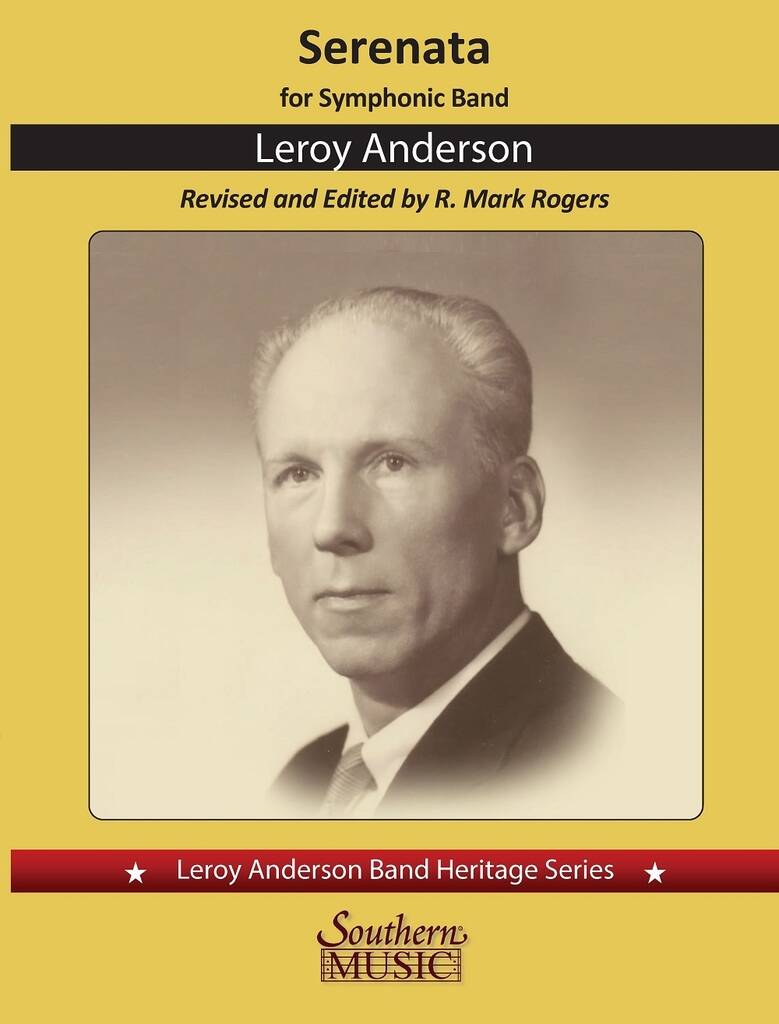
Serenata - Leroy Anderson
Serenata was first performed on May 10, 1947 as an encore at the Boston Pops, with Arthur Fiedler conducting. Fiedler would later praise the piece as among the conductor's favorites. Lyrics were added by Mitchell Parish in 1950, which would lead to recordings by the likes of Sarah Vaughan and Nat King Cole. With a beguine rhythm as a background, Anderson's inspiration from the Latin-American serenade would give the piece its title. This publication is the first-ever to offer a full score, edited by Mark Rogers, offering Anderson's enchanting work to new generations of audiences.
Estimated dispatch 7-14 working days
 View Music