
Results
-
 £87.50
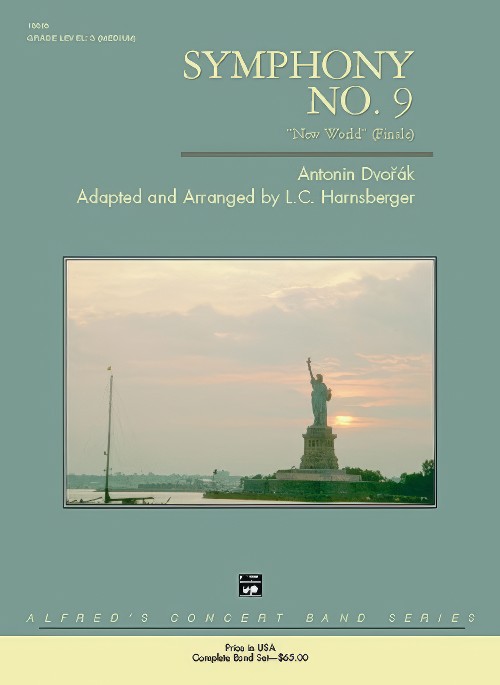
Symphony No. 9, from the New World (Finale) (Concert Band - Score and Parts) - Dvorak, Antonin - Harnsberger, L. C.
This surprisingly accurate, yet playable Dvor?k transcription will enhance any program. Great pains were taken to keep this transcription pure, and the result is a wonderfully written version of one of the orchestral repertoire's most popularly performed pieces. To further enhance the performance experience, the key has been changed from E minor to the more band-friendly key of F minor. Essential parts are cued, making this adaptation usable by bands with limited instrumentation. Give your audience the "new world" on your next concert! Duration: 5.20
Estimated dispatch 7-14 working days
-
 £71.50
Beethoven For Band - Ludwing Van Beethoven
This work introduces the major themes from three of the most famous and popular symphonies ever written - Beethovens Symphony No. 5, Symphony No. 7 and Symphony No. 9 - which are readily recognizable and easily learned, serving as a good introduction to some of the great masterpieces of western civilization. (2 minutes 45 seconds)
Estimated dispatch 7-14 working days
-
 £76.99
Ode to the Spirit of Man - James Curnow
A powerful work for the symphonic band, Ode to the Spirit of Man is based on thematic material taken from the fourth movement of Beethoven's Symphony No. 9 and developed into a fantasy of kaleidoscopic nature. The opening is ajoyful expression of the spirit of freedom and is based on the composer's own themes derived from Beethoven's music. Throughout the work, various themes from the symphony are interwoven, including Alla Marcia, Scherzo, Andantemaestoso and finally the uplifting Ode to Joy. Dur: 5:15
Estimated dispatch 7-14 working days
-
 £123.20
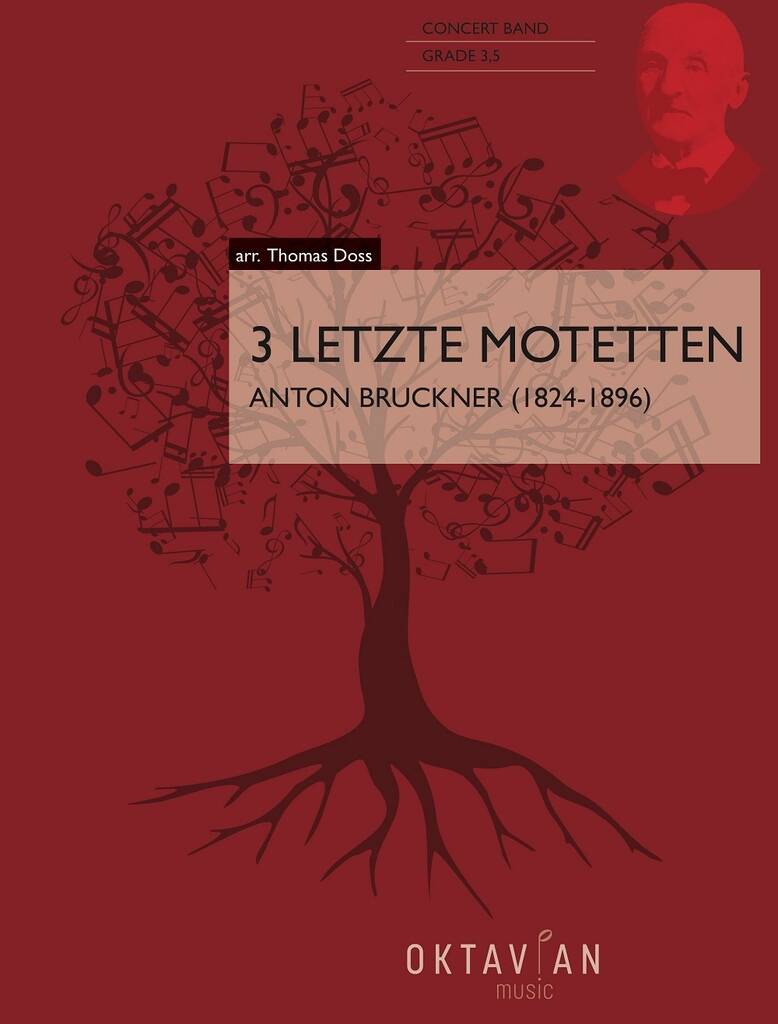
3 Letzte Motetten - Anton Bruckner
Anton Bruckner (b. 4.9.1824, Ansfelden, d. 11.10.1896, Vienna) didn't have it easy. Throughout his life, the Austrian composer was plagued by self-doubt. Anton Bruckner came from a simple, rural background. After the death of his father, he was accepted as a choirboy at the monastery of Sankt Florian in 1837. After several years as a school assistant and his own organ and piano studies, he first worked as organist in St. Florian, then from 1855 as cathedral organist in Linz. Introduced to music theory and instrumentation by Simon Sechter and Otto Kitzler, he discovered Richard Wagner as an artistic role model, whom he admired throughout his life and also visited several times in Bayreuth.In 1868 Anton Bruckner became professor of basso continuo, counterpoint and organ at the Vienna Conservatory; ten years later court organist; and in 1891 finally honorary doctor of the University of Vienna. He was considered an important organ virtuoso of his era, but had to wait a long time for recognition as a composer. It was not until Symphony No.7 in E major, composed between 1881 and 1883, with the famous Adagio written under the effects of Wagner's death, that he achieved the recognition he had hoped for, even if he was reluctant to accept it given his inclination towards scepticism and self-criticism.Anton Bruckner was a loner who did not want to follow a particular school or doctrine. He composed numerous sacred vocal works, such as his three masses, the Missa Solemnis in B flat minor (1854), the Te Deum (1881-84) and numerous motets. As a symphonic composer, he wrote a total of nine symphonies and many symphonic studies from 1863 onwards, tending to revise completed versions several times over. Bruckner's orchestral works were long considered unplayable, but in fact were merely exceptionally bold for the tonal language of their time, uniting traditions from Beethoven through Wagner to folk music, on the threshold between late Romanticism and Modernism.Anton Bruckner composed about 40 motets during his lifetime, the earliest a setting of Pange lingua around 1835, and the last, Vexilla regis, in 1892.Thomas Doss has compiled some of these motets in this volume for symphonic wind orchestra.These motets show many characteristics of personal expression, especially Bruckner's colourful harmony in the earlier works, which is in places aligned with Franz Schubert (changes between major and minor; and movements in thirds). Later works are characterised by many components which, in addition to the expanded stature of the movements, include above all a sense of the instrumentation as an outward phenomenon and the harmony as a compositional feature that works more internally. Some aspects of Bruckner's work are the result of his long period of study, which familiarised him not only with the tradition of his craft, but also gave him insights into the "modernity" of his time in such composers as Wagner, Liszt and Berlioz.From this developed his personal standpoint, which always pursues the connection between the old and the new.
Estimated dispatch 7-14 working days
-
 £256.00
14 Motetten - Anton Bruckner
Anton Bruckner (b. 4.9.1824, Ansfelden, d. 11.10.1896, Vienna) didn't have it easy. Throughout his life, the Austrian composer was plagued by self-doubt. Anton Bruckner came from a simple, rural background. After the death of his father, he was accepted as a choirboy at the monastery of Sankt Florian in 1837. After several years as a school assistant and his own organ and piano studies, he first worked as organist in St. Florian, then from 1855 as cathedral organist in Linz. Introduced to music theory and instrumentation by Simon Sechter and Otto Kitzler, he discovered Richard Wagner as an artistic role model, whom he admired throughout his life and also visited several times in Bayreuth.In 1868 Anton Bruckner became professor of basso continuo, counterpoint and organ at the Vienna Conservatory; ten years later court organist; and in 1891 finally honorary doctor of the University of Vienna. He was considered an important organ virtuoso of his era, but had to wait a long time for recognition as a composer. It was not until Symphony No.7 in E major, composed between 1881 and 1883, with the famous Adagio written under the effects of Wagner's death, that he achieved the recognition he had hoped for, even if he was reluctant to accept it given his inclination towards scepticism and self-criticism.Anton Bruckner was a loner who did not want to follow a particular school or doctrine. He composed numerous sacred vocal works, such as his three masses, the Missa Solemnis in B flat minor (1854), the Te Deum (1881-84) and numerous motets. As a symphonic composer, he wrote a total of nine symphonies and many symphonic studies from 1863 onwards, tending to revise completed versions several times over. Bruckner's orchestral works were long considered unplayable, but in fact were merely exceptionally bold for the tonal language of their time, uniting traditions from Beethoven through Wagner to folk music, on the threshold between late Romanticism and Modernism.Anton Bruckner composed about 40 motets during his lifetime, the earliest a setting of Pange lingua around 1835, and the last, Vexilla regis, in 1892.Thomas Doss has compiled some of these motets in this volume for symphonic wind orchestra.These motets show many characteristics of personal expression, especially Bruckner's colourful harmony in the earlier works, which is in places aligned with Franz Schubert (changes between major and minor; and movements in thirds). Later works are characterised by many components which, in addition to the expanded stature of the movements, include above all a sense of the instrumentation as an outward phenomenon and the harmony as a compositional feature that works more internally. Some aspects of Bruckner's work are the result of his long period of study, which familiarised him not only with the tradition of his craft, but also gave him insights into the "modernity" of his time in such composers as Wagner, Liszt and Berlioz.From this developed his personal standpoint, which always pursues the connection between the old and the new.
Estimated dispatch 7-14 working days
-
 £95.99
5 Tantum Ergo - Anton Bruckner
Anton Bruckner (b. 4.9.1824, Ansfelden, d. 11.10.1896, Vienna) didn't have it easy. Throughout his life, the Austrian composer was plagued by self-doubt. Anton Bruckner came from a simple, rural background. After the death of his father, he was accepted as a choirboy at the monastery of Sankt Florian in 1837. After several years as a school assistant and his own organ and piano studies, he first worked as organist in St. Florian, then from 1855 as cathedral organist in Linz. Introduced to music theory and instrumentation by Simon Sechter and Otto Kitzler, he discovered Richard Wagner as an artistic role model, whom he admired throughout his life and also visited several times in Bayreuth.In 1868 Anton Bruckner became professor of basso continuo, counterpoint and organ at the Vienna Conservatory; ten years later court organist; and in 1891 finally honorary doctor of the University of Vienna. He was considered an important organ virtuoso of his era, but had to wait a long time for recognition as a composer. It was not until Symphony No.7 in E major, composed between 1881 and 1883, with the famous Adagio written under the effects of Wagner's death, that he achieved the recognition he had hoped for, even if he was reluctant to accept it given his inclination towards scepticism and self-criticism.Anton Bruckner was a loner who did not want to follow a particular school or doctrine. He composed numerous sacred vocal works, such as his three masses, the Missa Solemnis in B flat minor (1854), the Te Deum (1881-84) and numerous motets. As a symphonic composer, he wrote a total of nine symphonies and many symphonic studies from 1863 onwards, tending to revise completed versions several times over. Bruckner's orchestral works were long considered unplayable, but in fact were merely exceptionally bold for the tonal language of their time, uniting traditions from Beethoven through Wagner to folk music, on the threshold between late Romanticism and Modernism.Hymns for four-part mixed choir a cappella (1846, St. Florian)No. 1 in E flat major (WAB 41/3): Quite SlowNo. 2 in C major (WAB 41/4): AndanteNo. 3 in B flat major (WAB 41/1): SlowNo. 4 in A flat major (WAB 41/2): SlowHymn for five-part (2 S, A, T, B) mixed choir and organNo. 5 in D major: SolemnlyThey are simple works, completely subordinate to their liturgical use, which nevertheless already show numerous characteristics of personal expression. These small pieces were able to stand up to the harsh scrutiny of the mature master: in 1888, Bruckner subjected them to a revision in which he made only minor corrections.
Estimated dispatch 7-14 working days
-
 £137.99
Everything Beautiful - Samuel R. Hazo
Premiered by Maestro Eugene Migliaro Corporon conducting the National Honor Band of America, this spectacular memorial for renowned band director Charles Campbell will surround your students and audiences in layers of emotion. Expressive moments upon moments allow the ensemble to follow their musical instincts, gaining an aesthetic reward each time. Typical of performances, the work fades into introspective silence, then is followed by lengthy applause. Available in the original three-movement set, and also just Mvt. 1, The Stillness of Remembering (HL04004298). Dur: 9:00 (Live concert recording by the University of Kentucky Wind Symphony - Dr. John Cody Birdwell, conductor - Samuel R. Hazo, guest conductor) Movements: I. The Stillness of Remembering II. Irish Tune III. While I Think on Thee, Dear Friend
Estimated dispatch 7-14 working days
-
 £93.50
Yuletide Flourish - R. Alan Carter
As the title suggests, Yuletide Flourish is a whirlwind of well-known carols. Fanfares and soaring melodies propel this work to its climactic rendition of Beethoven's Symphony No. 9 "Ode to Joy".
Estimated dispatch 7-14 working days
-
 £76.99
Ode to the Spirit of Man (Concert Band - Score and Parts) - Curnow, James
Fantasy on Themes of BeethovenA powerful work for the symphonic band, Ode to the Spirit of Man is based on thematic material taken from the fourth movement of Beethoven's Symphony No.9 and developed into a fantasy of kaleidoscopic nature. The opening is a joyful expression of the spirit of freedom and is based on the composer's own themes derived from Beethoven's music. Throughout the work, various themes from the symphony are interwoven, including Alla Marcia, Scherzo, Andante maestoso and finally the uplifting Ode to Joy.Duration: 5:15
Estimated dispatch 7-14 working days
-
 £61.95
The New World, Suite from (Concert Band - Score and Parts) - Dvorak, Antonin - Story, Michael
Antonin Dvorak's Symphony No.9 (from The New World) was composed in the late 1800s and is based on his research about the tonality of Indian and African-American music of the time. Michael Story has scored a suite of three brief movements for young band, encapsulating this major symphony. Suite from The New World will be an epic contribution to developing band literature. Duration: 4.30
Estimated dispatch 7-14 working days
 View Music