
Results
-
 £89.99
Aviation march - Wilco Moerman
Mankind has always had the desire to fly. Initially we tried to imitate birds to fly, which eventually resulted in the invention of balloons, airships, gliders and powered aircrafts. The first airship in the world that could fly in a controlled way, was invented by Henri Giffard. This airship flew on September 25, 1852 from Paris to Trappes. The ship was 43 meters long and flew 8 km per hour over a distance of 27 km. Other key names for the many changes and developments of the aviation industry, are the Wright brothers on December 17, 1903 with their first motorized flight, of 12 seconds over a distance of 37 meters with a homemade motorized aircraft called the Flyer. Later the same day this record was improved by a flight of 60 seconds over a distance of 260 meters. The first flight across the Channel between England and France was made by Louis Blriot on July 25, 1909. The distance of about 45 km was covered in a time of 37 minutes. In 1910, the first woman, a French pilot (Raymonde de LaRouche), made her first solo flight. She was also the first woman who got a license to fly.This march is a tribute to the many years of development within the aviation industry and gives voice of the pride, the romance, the heroism and the status of this way of transportation.
Estimated dispatch 7-14 working days
-
 £159.60
Suite Acadienne - Bernhard Bogisch
1. La belle Franoise.This song tells the story of the beautiful Franoise, who is visited by her lover on the eve of his departure. She helps him prepare for his voyage and they talk for the last time at the foot of a rock, which has been their trysting place. The next day, when he has left the harbour, he hears the sound of a bell. It is the bell that tolls for Franoise, who is being carried to her grave.2. Le Prince Eugne.At least two versions of this song are in existence, both of which are represented here. It tells of the prince Eugne, who, on his way to Paris, encounters twenty of his worst enemies. He manages to kill fourteen of them before his sword breaks. He then asks his page to get him another sword, but the lad is too afraid for his own life. This being the case the prince tells him to tell his wife to take care of his son, who 'will have his revenge by lighting a candle in Paris'.3. Pinson et Cendrouille.This song deals with the marriage of two not further specified animals, who have nothing with which to prepare a wedding feast, and need help from the other animals. But when the rat comes in carrying a fiddle, he is chased away.4. Le Dpart de l'Amant.At least two versions of this song are known, both of which are represented here. It is one of many songs dealing with departure, and is of Canadian origin. The lover is warned of the charms of the pretty 'canadiennes' which among Acadiens refers to French Canadians from Qubec. 'Be true to me save your heart. When I return from my voyage I will make you happy'.5. Le Remde son Talon.This, like many children's/folk songs is a bit of a nonsense song. Marguerite has trouble with the heel of her shoe, and asks her mother for help. Mom suggests various things, such as an onion (too round), a tomato (too flat) etc. In the end it turns out that a bachelor is her best bet.
Estimated dispatch 7-14 working days
-
 £186.20
La Inmortal - Ferrer Ferran
A game of chess took place in London between two great masters, Anderssen (English) and Kiesevitzki (Russian). That game was regarded as one of the most beautiful ever played in history. That was the reason why it was christened with the name of 'The Immortal One'. In that game, Anderssen sacrificed important pieces, such as the Queen, to achieve the spectacular checkmate. What would happen if that game got humanised in our imagination through the work of music? Great castles, cavalry, pawns as warriors divided into two Kingdoms that fight to get independent. At the start, the fighting troops fall in at a great open area to defend their fortresses and castles (introduction). The brasswind and drums calls work the start of the battle... Meanwhile, a great calm reigns in the castle foreboding the mighty outcome. The king and queen, unaware of the war, are dancing in the mirrors room but they are interrupted after the warning given about a new attack. Courage and sacrifice are reflected in the image of the queen, who finally sacrifices her life to save her people. She fights with all her strength but falls dead at the battlefield. The king, in revenge, gathers all his men and comes out to fight the cruel, bloody, final battle. The final apotheosis represents the songs of praise for the fallen at the battle.
Estimated dispatch 7-14 working days
-
 £90.30
Stevie Wonder Medley - Stevie Wonder
Here is a splendid arrangement of a selection of the most famous hits by this true artist: 'You are the sunshine of my life', 'Isn't she lovely', 'I just called', and the unforgettable 'Sir Duke'.
Estimated dispatch 7-14 working days
-
 £83.50
The Procession of the Nobles - Nikolai Rimsky-Korsakov
The Procession of the Nobles is the best-known piece that survived an ambitious project which was never completed due to lack of money. No less than five composers, several orchestras, choirs and ballet schools were to participate in what should become an enormousshow-piece of comprehensive theatre. The project failed because of lack of sponsors and internal conflicts, but it provided this magnificent composition. Mlada tells the story of Princess Voislava who kills her friend Princess Mlada because she is in love with Mlada's fianc Prince Jaromir. Mlada's spirit - personified by a female dancer - succeeds in convincing Jaromir in a dream of Voislava's cruel act. Jaromir revenges himself. Morena, goddess of the underworld, invoked by Voislava to chase Mlada's spirit, avenges the dying princess. An infernal storm brings death and destruction. In the final chorus of the opera the spirits of the deceased pay a tribute to the souls of the lovers Jaromir and Mlada united in death.
Estimated dispatch 7-14 working days
-
 £69.00
Eternal Promise - Naoya Wada
Eternal Promise is a wedding march written in 2013. Naoya Wada wrote this march to commemorate the wedding of his friend Yuka and her bridegroom Junya, which took place on 22 November 2013 with their son. She was Wada's college classmate and made a special study of trumpet. The premiere was performed by classmates. The composer send them both his best wishes for their lives together: Junya and Yuka, I congratulate you from the bottom of my heart!
Estimated dispatch 7-14 working days
-
 £127.30
Dalstroka innafor - Tone Hulbækmo
An old weather forecast on the Norwegian radio inspired Tone Hulbkmo to write this song. Folk musician and composer Tone Hulbkmo comes from Tolga, a small place in Norway. She have toured worldwide and many of her CD-released have received great acclaim both from the audiences and critics. Some of them have also won "Spellemannsprisen", the Norwegian equivalent to the Grammy award. Valleys Beyond is a Norwegian folk music style named "reinlender". It has to be played with a light swinging feel.
Estimated dispatch 7-14 working days
-
 £154.60
Den store dagen - Benny Borg
This beautiful song contains a huge contrast between the hopeful and the disappointing. A mother has her birthday and is waiting her children to celebrate it. Each verse starts optimistically, but the short chorus is characterized by the disappointment, that everyone calls, and cannot come. This has been tried recreated musically, mostly in the last two choruses, as it dawns on her that she will not receive a visit. It's a beautiful tune, but with a serious message that it's easy to take someone for granted.One of the elements the musicians came up with after rehearsal, was that they really liked the change between the ballad parts with even eights and the swing parts. This also gives the piece a sense of "parlando" character, which tells a story, and is therefore important to focus. It is not quite simple, as the melody also in those parts with even eights has some triplet rhythms. Therefore, this is a topic you can work on.Regarding instrumentation, Flugelhorn, Alto Saxophone and Euphonium have important roles, in addition to the rest of the first parts in the Band. The arrangement is written so you are not depending on "special" instruments. Important details are also often duplicated so you can use the arrangement for a smaller Wind Band.It is also possible to use a vocal soloist, but then you must soften the instruments that holds the melody.
Estimated dispatch 7-14 working days
-
 £292.00
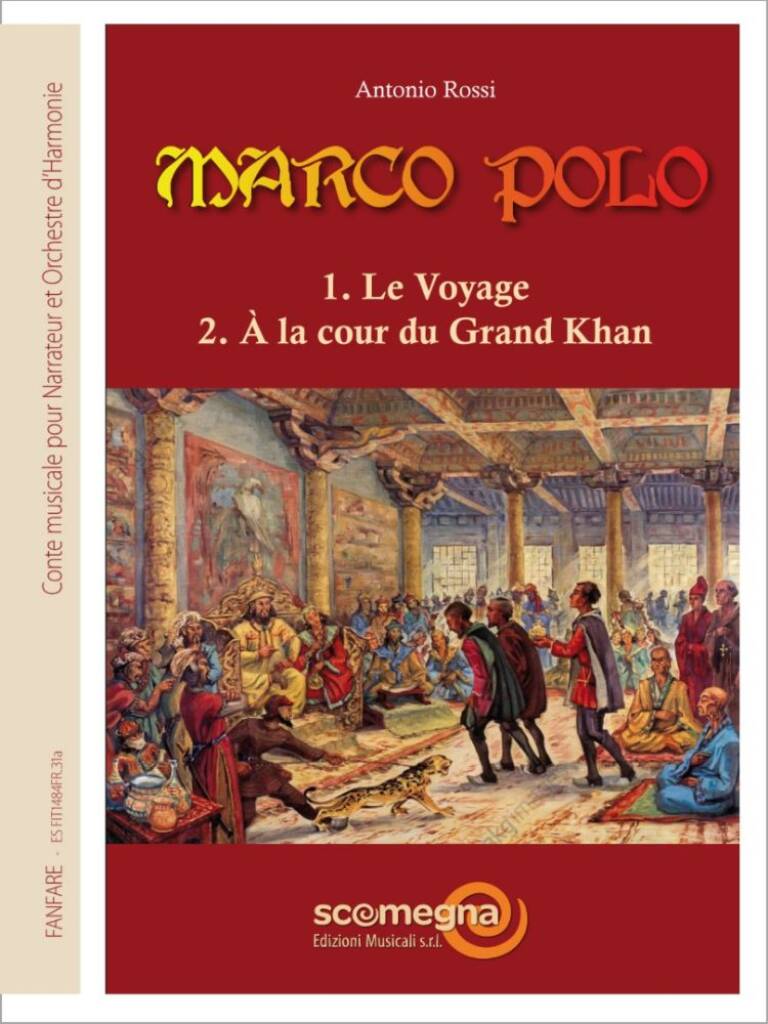
Marco Polo (French text) - Antonio Rossi
Marco Polo (Venice, 1254), son of Venetian merchants, left in 1271 with his father Niccol and his uncle Matteo, towards the distant China at the court of the Mongol emperor Kublai Khan. The long journey, which lasted three and a half years, led the Polos to cross Turkey, Central Asia, the Pamir, and the Gobi desert. The intelligence of the young Marco and his curiosity towards new customs and languages raises the interest of the emperor so much that he decides to keep him at his court by appointing him ambassador. This assignment takes him to newly conquered southern China and other parts of southern Asia. In 1292, the Great Kublai Khan agrees, albeit reluctantly, to let him go.Marco, after 17 years at his service, can finally return to Venice, but not before completing a last mission for the Grand Khan: accompanying his niece, Princess Kokachin, to Persia, where she would marry. A few years after his arrival in Venice, Marco finds himself involved in a naval battle against the Genoese people in which the Venetians are defeated. Consequently, Marco is captured and taken to prison in Genoa. There, he meets the storyteller Rustichello da Pisa to whom he tells the story of his adventurous journey. After his release, Marco returned to Venice and led a comfortable life until his death in 1324.
Estimated dispatch 7-14 working days
-
 £75.50
The Dream of Tiberius - David Campo
The Roman Emperor Tiberius was born in 42 BCE to Tiberius Claudius Nero and Livia Drusilla, both descendants of prestigious political families, at a time when Rome was undergoing significant political upheaval. Julius Caesar had begun a brutal civil war in 49 BCE to end Rome's rule as a Republic and consolidate his power as supreme ruler. Following Caeser's assassination in 44 BCE, Tiberius' father backed the forces wishing to return Rome to a Republic, but they were defeated by Caesarian loyalists led by Caeser's heir Octavian. As a result, Tiberius' early life was spent on the run and in political exile with his parents. In 27 BCE, Octavian would become the first Emporer of Rome and assume the name Augustus. Augustus forced Tiberius' parents to divorce and took Tiberius' mother as his new bride, separating the family and forcing Tiberius to live with his father. Upon his father's death, Tiberius went to live with his mother and Emporer Augustus, a situation Tiberius found extremely uncomfortable but one over which he had no control. Having been adopted by the Emperor, Tiberius assumed the military and political life thrust upon him. He proved to be an outstanding military and political leader, and with his marriage to Vipsania Agrippina his life took on a heretofore unknown stability. However, Augustus would intervene in Tiberius' life once more, forcing him to abandon his happy marriage and take Augustus' daughter Julia (Tiberius' step sister) as his new wife. This arrangement, while securing Tiberius' place as Augustus' heir and ensuring he would one day be Emperor of Rome, was disastrous. Julia's drunken licentiousness was a constant source of scandal and embarrassment for Tiberius (and her father, the Emperor) and she was eventually exiled by her father Augustus. Tiberius was named Emperor of Rome upon the death of Augustus in AD 14, assuming his position as the most powerful man on Earth. However, no matter how powerful he had become, Tiberius never felt as if he had ever had any control over his life, having been manipulated from childhood through adulthood by the whims of Augustus. As Emperor, he soon became disgusted with the political intrigue of the Roman Senate and by AD 26 left Rome and took up residence on the island of Capri, where he lived out the rest of his life. History does not regard Tiberius fondly and by all accounts towards the end of his reclusive life on Capri, he had become a miserable, sick and mentally unstable old man reveling in debauchery and cruelty. It is also informative to note that he was Emperor of Rome when Jesus of Nazareth was crucified, and while there is no indication that Tiberius was even aware of the existence of Jesus, as Emperor he was responsible for the appointment of Pontius Pilate as Governor of Judea. Even considering this, it is difficult to look on the life of the Emperor Tiberius and not feel some sympathy and pity. It's in this spirit that I composed "The Dream of Tiberius." I imagine the man sitting in thoughtful seclusion on the beautiful island of Capri imagining what his life might have happily been had not power been thrust upon him: husband, father and humble servant of the people.
Estimated dispatch 7-14 working days
 View Music