
Results
-
£16.50
Stai si, defenda! (Stand Up and Defend) - Score only
Stai si, defenda romontsch, tiu vegl lungatg (Stand up, defend your old Romansh language): This composition was named after a quotation from a poem by famous Romansh poet Giachen Casper Muoth. The arrangement deals with various well known songs for male choir such as A Trun sut igl ischi (In Trun under the malpe tree), Si sededesta Rezia (Wake up, land of Raetia), Il pur suveran (The independent farmer) or Il paun palus (The rosted bread). An atmospheric beginning over a pedal point uses quotations from these songs and leads eventually into a dark but warmly orchestrated section on Nossa viarva (Our language) by H. Erni. The piece ends, once more quoting A Trun sut igl ischi by J. Heim, a dedication to struggle for freedom and independence.
Estimated dispatch 7-14 working days
-
 £102.80
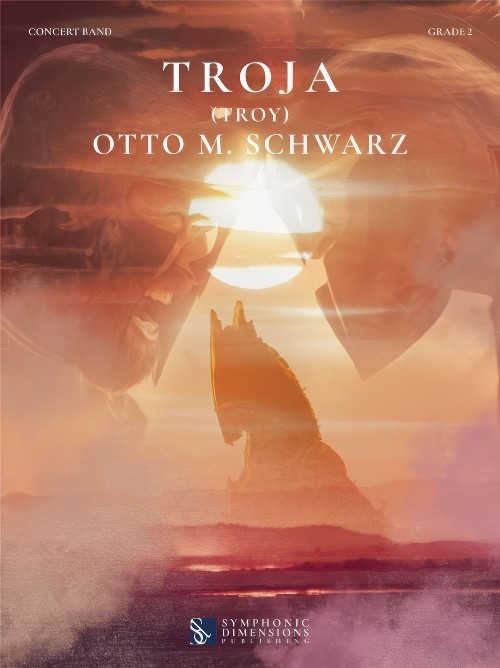
Troja (Troy) (Concert Band - Score and Parts) - Schwarz, Otto M.
The Greek poet Homer wrote about Troy and the Trojan War, which probably took place in what is now Asia Minor, in his Iliad in the 8th century B.C. Nowadays, the term Trojan generally refers to a malware program that is used to gain unauthorised access to computers. This use comes from the legendary Trojan Horse, which saw the turning point in the battle between Greeks and Trojans through the cunning of Odysseus. Let us return to the beginning of the story: Paris, son of the king of Troy, is tasked by Zeus with judging the beauty of the three goddesses Aphrodite, Pallas Athena, and Hera. Aphrodite, the goddess of love, flatters Paris by promising him the most beautiful woman in the world. Soon afterwards, on a journey to Greece, Paris meets the beautiful Helen, who immediately falls in love with him. Since however she is the wife of Spartan king Menelaus, she eventually lets herself be kidnapped by Paris voluntarily. The Greeks then form a large army and go to war against Troy to retrieve Helen, leading to a ten-year siege of the city. The city is eventually conquered not through combat, however, but through Odysseus' cunning ploy. He has the idea of building an enormous wooden horse with warriors hidden inside. The horse is placed at the gates of the city. Thus, the Trojans are tricked into giving up the siege when, despite various warnings, they bring the horse into the city to dedicate it to the goddess Athena. At night, the soldiers climb out of the horse and open the gate for the Greek army. The troops storm the city and burn it to the ground. The royal family and all the Trojan warriors are killed, only Aeneas, the son of Aphrodite, escapes. Later, following many years' wanderings he and his acolytes will become known as the founders of the Roman people. There are various accounts of the fate of the beautiful Helen. She is said to have returned to Sparta with Menelaus and to have ruled there until the end of her life. Or maybe not...Duration: 6.00
Estimated dispatch 7-14 working days
-
 £420.99
Four Earth Songs (Concert Band - Score and Parts) - Putz, Marco
The hymn Nun ruhen alle Wlder (Now All Forests Rest), arranged by J.S. Bach (No. 6, So sei nun, Seele, deine, from Cantata BWV 13), is a guiding light throughout this four-movement composition. Pu?tz wrote this work as a musical outcry against the wilful, profit-driven destruction of our environment. When Bach used the word "ruhen" (to rest) over 350 years ago, it probably had a different nuance from the meaning it has today. At the beginning of the 21st century - the so-called age of progress - "nun ruhen alle Wlder" should mean "now all forests die" . Massive industrialization and globalization, coupled with pure greed, corruption, political scandals, an ever-widening gap between the rich and poor, and other such senseless human actions, are pushing our blue planet closer and closer to the point of no return. This work is not intended to be a ranting accusation. It should remind us of the beauty and harmony that can exist all around us in nature, if we take care of it. Pu?tz hopes that this will, one day, help put a greater emphasis on humanity's survival, and coexistence with nature rather than the exploitation described earlier. All four texts were created by Australian poet Graeme King, whose works were discovered by Pu?tz, by chance on the internet. Pu?tz was especially captivated by King's clarity, and intrigued by the possibilities of adapting and melding the strong rhythmical structure of King's writing with his own musical language. The four movements are as follows: 1. Tears of Nature 2. Grrrevolution 3. Stand up! 4. Tomorrow The world premire of Four Earth Songs took place on 7 July 2009 at the 14th WASBE-Conference in Cincinnati (USA). This work is dedicated in friendship to Jouke Hoekstra, conductor, and the Frysk Fanfare Orkest (the Frisian Fanfare-Orchestra).Duration: 27:30
Estimated dispatch 7-14 working days
-
 £174.99
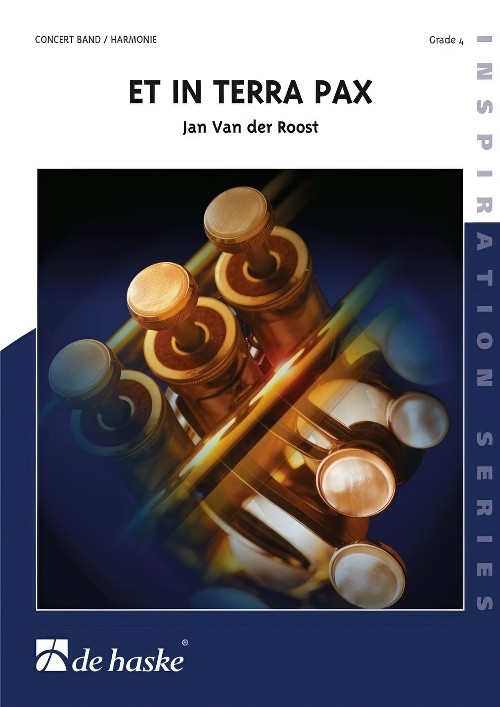
Et in terra Pax (Concert Band - Score and Parts) - Van der Roost, Jan
This piece was commissioned by the Concert Band Vlamertinge and is a plea for peace: the title translates as Peace on Earth. This is expressed by means of the vocal contribution expected from the performers. In various places of the piece you can recognize, the words Et In Terra Pax, an appeal for peace, at first jumbled together but later more rhythmically structured, developing into synchronized massed voices. The work starts with a pentatonic theme based on the notes D, E, G, A and C (taken from 'ConCErtbAnD VlAmErtinGE' and the name of the conductor, NiCk VAnDEnDriessChe). A somewhat sad melody is developed during an orchestral climax which leads to the first explosion of sound (measure 62 onwards). Suddenly the opening measures are recaptured, albeit with a differently coloured sound: the words Et in Terra Pax bring the first movement to a close. A restless Allegro follows which abruptly stops and is replaced by a calming chorale-like passage. A narrator reads aloud the poem 'Sonnet' by the young poet Charles Hamilton Sorley, who was killed during World War I. This poem fittingly puts into words the cruelty and senselessness of war. After the expanded recapitulation of the allegro, the broad, almost infinite atmosphere of the beginning returns. Clarinet and English horn play the pentatonic opening theme once more, this time broadly, while the words Et in Terra Pax are repeated again and again by the rest of the ensemble. The composer has purposely avoided all forms of aggression and bombastic sounds regularly used in works about war. Fear of violence and destruction can be heard and felt during the allegro passages. The charged opening makes way in the end for hope: May peacefulness replace cruelty in everyday life, too.Duration: 13:45
Estimated dispatch 7-14 working days
-
 £168.50
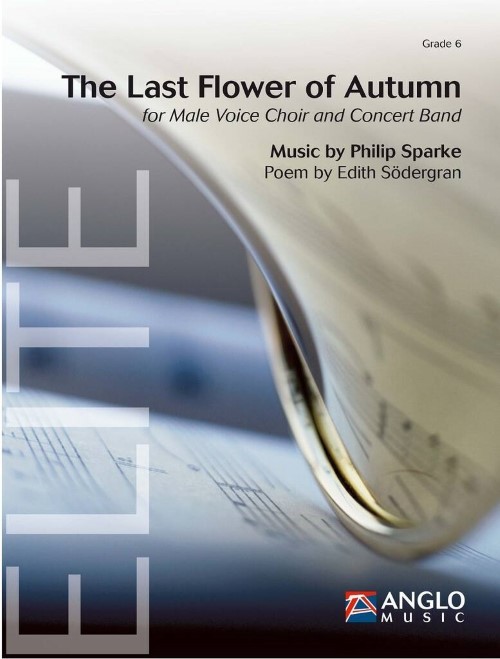
The Last Flower of Autumn (Male Voice Choir with Concert Band - Score and Parts) - Sparke, Philip
In this work for male voice choir and concert band, Philip Sparke aptly captures the mood of the poem The Last Flower of Autumn by Edith Sodergran (1892-1923), a Swedish-speaking Finnish poet. This solemn composition with extensive instrumentation echoes the idyllic, romantic mood of the poem, which can be understood as an allegory of human existence with all its hardships and life's inevitable difficulties.20 choral parts are included in the set, and extra Male Voice Choir parts can be ordered if needed.Duration: 10.15
Estimated dispatch 7-14 working days
-
 £63.50
Tigerstaden (The City of Oslo March) (Concert Band - Score and Parts) - Strand, Oyvind
The expression comes from the great poet Bjornstjerne Bjornson where he in the poem Siste sang (Last song) describes a battle between a tiger and a horse. The tiger symbolizes the big city (Oslo) while the horse symbolizes the countryside, ie the traditional battle city vs country. Hence Oslo (Kristiania) got the negative nickname Tigerstaden (Tiger City), but as time went on, the name established itself as something positive and familiar, and has become a beloved nickname, without negative associations, in the Capital. Duration: 3.30
Estimated dispatch 7-14 working days
-
 £94.99
The Temple Musician (Concert Band - Score and Parts) - De Haan, Jan
The title of this work is based on the name of the commissioning band: Music Society Asaf (Dutch for Asaph). In the Hebrew Bible, the poet, singer and seer Asaph is in charge of the choir in the house of King David. Various psalms, including Psalm 81, which is used in this work, are attributed to him. The melody of this psalm is flanked by a march-like initial part, and the traditional klezmer melody Uri Tzion features as a spectacular finale.Duration: 7.00
Estimated dispatch 7-14 working days
-
 £74.00
Swirling in the Light Bulbs (Concert Band - Score and Parts) - Sciaino, Peter
Infectiously rhythmic and energizing, "Swirling in the Light Bulbs" is a refreshing addition to any concert program! Conjuring images of an electrical current through swirling melodic lines and irresistible grooves, this engaging selection explores the wonder of harnessed energy. "Swirling in the Light Bulbs" is inspired by former U.S. Poet Laureate Billy Collins's take on this often overlooked modern miracle. In his poem "August," Collins writes "and time to offer some thanks to the electricity swirling in the light bulbs." Allow audiences to be captivated as your ensemble generates a relentless pulse and builds exhilarating sonic momentum before a whimsically abrupt ending signals the band "powering off." Duration: 3.30
Estimated dispatch 7-14 working days
-
 £60.50
And So He Also Loves the Bow (Concert Band - Score and Parts) - Barrett, Roland
Honouring four students who lost their lives, this powerful original work draws its title and its inspiration from poet Kahlil Gibran's "On Children." Like the poem, the composition musically invokes emptiness, restlessness and longing but provides reassurance to those grieving with peace, hope and optimism.Duration: 4:45
Estimated dispatch 7-14 working days
-
 £75.00
Of the Father's Heart Begotten (Concert Band with Optional Choir - Score and Parts) - Noble & Willcocks
Of the Father's Heart Begotten alternatively known as Of the Father's Love Begotten is a doctrinal hymn based on the Latin poem 'Corde natus' by the Roman poet Aurelius Prudentius. The ancient poem was translated and paired with a medieval plainchant melody Divinum mysterium. Divinum mysterium was a Sanctus trope - an ancient plainchant melody which over the years had been musically embellished. An early version of this chant appears in manuscript form as early as the 10th century, although without the melodic additions, and trope versions with various melodic differences appear in Italian, German, Gallacian, Bohemian and Spanish manuscripts dating from the 13th to 16th centuries. Dissatisfied with an earlier translation, Roby Furley Davis (1866-1937), a scholar at St. John's College, Cambridge, wrote a new version for the English Hymnal of 1906. This version was also used in the popular Carols for Choirs series by David Willcocks. This arrangement represents one in the Series of Band Arrangements compatible with David Willcocks' Carols for Choirs.
Estimated dispatch 7-14 working days
 View Music