
Results
-
 £225.99
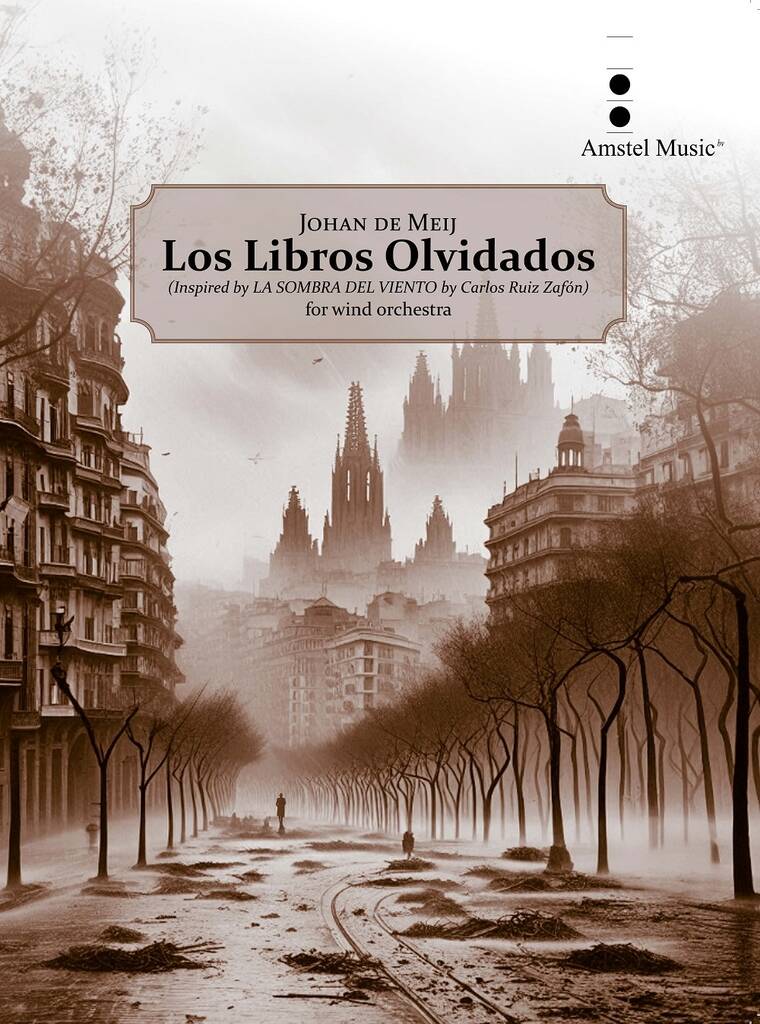
Los Libros Olvidados - Johan de Meij
1. Barcelona 19452. Los Libros Olvidados - El Cementerio3. Las Ramblas - Els Quatre Gats4. Coubert - El Hombre sin Rostro5. Bea (Beatriz)6. El Inspector Fumero7. La Ciudad de las SombrasThis is a story wrapped within a story that unfolds in Barcelona 1945, following World War II. The protagonist, Daniel Sempere, is the teenage son of an antiquarian book dealer, who one day takes him to the Cemetery of Forgotten Books, a mysterious place with labyrinthine corridors where rare and banned books are stacked in massive dusty piles. His father tells Daniel to select a book, but it will be his responsibility to protect it. Daniel picks La Sombra del Viento (The Shadow of the Wind), a novel by a forgotten author Julin Carax. Daniel immediately starts reading the book, and the story unwinds itself into a compelling and complicated plot. As he reads, Daniel finds himself and his own life merging into the story's plot. It transpires that there is a mysterious man named Lan Coubert ('the man without a face') who is determined to destroy all copies of Carax's books. Daniel is threatened by Coubert and is determined to find out what happened to Carax, who fled to Paris and subsequently disappeared. Daniel finds that his own life has much in common with the author's. The book mixes magic realism, page-turning mystery, and Daniel's own real life. Daniel's once ordinary teenage existence is now filled with larger-than-life colorful and at times, terrifying characters. Among them are Fermn Romero de Torres, a beggar who Daniel and his father befriend and employ in the family bookstore; the evil police inspector Javier Fumero, who could be compared to Scarpia in Puccini's opera Tosca or Javert in Les Misrables. The corrupt Fumero uses the war as an excuse to practice his sadism and is widely feared in Barcelona. He is represented in the music by a fascist military march. The city of Barcelona becomes a character in the book and in the music. The Ramblas, the boulevard running through Barcelona's Gothic Quarter and the famous caf Els Quatre Gats (the four cats) come alive in the score through a Cobla, the traditional wind ensemble playing a sardana, typical Catalan folk music. Two parallel love stories turn up the heat: Julin Carax's passionate, forbidden love for Penlope, and Daniel's equally passionate and forbidden love for Beatriz (Bea). Bea's sultry love theme is based on the first three letters of her name, with the ascending intervals B-E-A. Johan de Meij New York, October 17th, 2023
Estimated dispatch 7-14 working days
-
£264.99
Diferencias on an Old Spanish Song - Yasuhide Ito
I am immensely happy that my Gloriosa, symphonic poem for band (1990), has been performed by so many bands in the last thirty years.During this period, the growth of the internet has made it much easier to access information.When I composed Gloriosa, I only had limited information about the period when Christianity and Western music was first introduced to Japan, and had to rely a lot on my imagination.However, nowadays, it is easy to obtain various source materials and to read interesting studies on the music of the past.In recent years, the music of Luis de Narvez (born ca.1500 - died between 1555-1560), Spanish composer and vihuela player, has become increasingly known, and several CDs of his music are now available.Narvez composed the earliest-known set of diferencias, a forerunner of the variation form. One of his works is Seys diferencias sobre el himno "O gloriosa domina" [Six diferencias on the hymn "O gloriosa domina"] (1538), based on the Spanish Marian hymn, and it was this melody I used in the first movement of my Gloriosa.Western music has been my musical roots since childhood, and throughout my career as a composer, it has continued to fascinate me. One could say that this has provided the inspiration for Diferencias on an Old Spanish Song, my own take on the diferencias form.Actually, such music from the early sixteenth century could sound fresh to our modern ears. So I decided to quote the melody from Narvez's Sey diferencias at the beginning and end of the piece, in order that people can get the feel for the period.The main section (bars 42-390) is formed of 13 diferencias, similar to the first movement of the Gloriosa.In the middle section, which begins after the eighth diferencia(from bar 187), one should be totally absorbed in the tranquility and the beauty of the music. Although it's in the style of a sarabande, it should be taken slower and played as pianissimo as possible.This is followed by folk-style dance music. (As only standard percussion instruments are used, try to be creative with tonal colours and sense of rhythm).The structure of the work is simple, but be aware of the connection between the sections when constructing the whole.Also, think about the tonality. Overall, the work is in F minor. The main section is basically in D minor, but from bar 102, it modulates to A flat minor and G minor, and then in the middle section it suddenly switches to A flat major (which is the furthest key from D minor, and the relative major of F minor). From bar 219, it modulates to F minor and then to C minor, then back to F minor by way of A minor.N.B. The Oboe II part can be substituted by the English Horn (as indicated in the parts). One can choose according to the player's skills or preference.Recent new compositions for wind band are often full of rhythm, dynamism, and tonal colour, and compositional techniques and orchestration have also evolved greatly. Yet on the other hand, they tend to feature fewer melodic or expressive elements. Since this work is the test piece for WMC Kerkrade 2022, I had to think about what "tests" or "challenges" to set, and I decided to compose something that doesn't involve a lot of technical display, but requires beautiful sounds and harmonies, and above all, musical expressivity. I didn't put many expression markings in the score, because I wanted the performers to think about how best to express this music. If it is played merely as notated, it's not going to sound very interesting.Christianity was introduced to Japan in the mid-16th century, but it was subsequently banned and Japan entered a period of national isolation, which meant that there was hardly any international exchange for two hundred years. As a result, the Christian hymns that were introduced prior to the isolation became almost unrecognizable over the centuries. This was the theme I explored in my Gloriosa thirty years ago.Now, in 2021, the whole world has been forced to "isolate" due to the Covid-19 pandemic. In such times, it seems pertinent that I've written a work using this melody again. I sincerely hope that people will be able to gather in Kerkrade in 2022.(English Translation:Nahoko Gotoh)
Estimated dispatch 7-14 working days
-
 £72.99
The Spheres - Ola Gjeilo
This evocative work is a wind band version of the composer's mass for choir and string orchestra entitled Sunrise. The piece is built around a five-note chorale theme, and the opening section features an overlapping fade-in/fade-out effect meant to give a sense of floating in space, as if surrounded by stars and planets. A stunning composition from an exciting new voice in the band world - Ola Gjeilo. Dur: 5:20 Online audio sample was recorded by the Pacific Lutheran University Wind Ensemble - Dr. Edwin Powell, conductor Watch the featurette about The Spheres here.
Estimated dispatch 7-14 working days
-
 £37.95
The Year of the Dragon (Prestige Concert Band - Score only) - Sparke, Philip
The 2017 version of The Year of the Dragon was commissioned by the Siena Wind Orchestra and given its world premiere on June 17th 2017 in Bunkyo Civic Hall, Tokyo, conducted by the composer.The original wind band arrangement of The Year of the Dragon was made in 1985, a year after the composer wrote the brass band version. At that time he was still learning the intricacies of writing for wind band (and still is!) and in the 32 years which have elapsed since then, his approach to scoring for the medium has developed and, hopefully, improved.Here are the main differences between the two versions:In the 1980's, the wind band movement was much less international than it is now. British wind bands were still to some extent based on the military band tradition of the time, which tended to use rather smaller instrumentation than the then-dominant American university model. The new version embraces a much more international instrumentation, including low woodwinds and string bass, as well as an expanded percussion section.In the original version there was a touch of naivety in the way the composer wrote for the woodwinds; much of their articulation was transferred too literally from the brass version, resulting in some unidiomatic writing, which he has tried to improve in the new version.In addition to the above, Philip's own compositional style has matured and developed in the intervening 32 years. There are some passages in the original which he simply would not write today - not because they are 'wrong', but because his way of writing has changed. The new version is perhaps how he would have written it today, rather than simply dressing the original version in new clothes.The work is in three movements:Toccata opens with an arresting side drum figure and snatches of themes from various sections of the band, which try to develop until a broad and powerful theme from the middle of the band asserts itself. A central dance-like section soon gives way to the return of this theme, which subsides until faint echoes of the opening material fade to a close.Interlude takes the form of a sad and languid solo for alto saxophone. A chorale for the whole band introduces a brief spell of optimism but the saxophone solo returns to close the movement quietly.Finale is a real tour-de-force for the band with a stream of rapid semi-quavers running throughout the movement. The main theme is heroic and march-like but this is interspersed with lighter, more playful episodes. A distant fanfare to the sound of bells is introduced and this eventually returns to bring the work to a stirring close.
Estimated dispatch 7-14 working days
-
£199.95
The Year of the Dragon (Prestige Concert Band - Score and Parts) - Sparke, Philip
The 2017 version of The Year of the Dragon was commissioned by the Siena Wind Orchestra and given its world premiere on June 17th 2017 in Bunkyo Civic Hall, Tokyo, conducted by the composer.The original wind band arrangement of The Year of the Dragon was made in 1985, a year after the composer wrote the brass band version. At that time he was still learning the intricacies of writing for wind band (and still is!) and in the 32 years which have elapsed since then, his approach to scoring for the medium has developed and, hopefully, improved.Here are the main differences between the two versions:In the 1980's, the wind band movement was much less international than it is now. British wind bands were still to some extent based on the military band tradition of the time, which tended to use rather smaller instrumentation than the then-dominant American university model. The new version embraces a much more international instrumentation, including low woodwinds and string bass, as well as an expanded percussion section.In the original version there was a touch of naivety in the way the composer wrote for the woodwinds; much of their articulation was transferred too literally from the brass version, resulting in some unidiomatic writing, which he has tried to improve in the new version.In addition to the above, Philip's own compositional style has matured and developed in the intervening 32 years. There are some passages in the original which he simply would not write today - not because they are 'wrong', but because his way of writing has changed. The new version is perhaps how he would have written it today, rather than simply dressing the original version in new clothes.The work is in three movements:Toccata opens with an arresting side drum figure and snatches of themes from various sections of the band, which try to develop until a broad and powerful theme from the middle of the band asserts itself. A central dance-like section soon gives way to the return of this theme, which subsides until faint echoes of the opening material fade to a close.Interlude takes the form of a sad and languid solo for alto saxophone. A chorale for the whole band introduces a brief spell of optimism but the saxophone solo returns to close the movement quietly.Finale is a real tour-de-force for the band with a stream of rapid semi-quavers running throughout the movement. The main theme is heroic and march-like but this is interspersed with lighter, more playful episodes. A distant fanfare to the sound of bells is introduced and this eventually returns to bring the work to a stirring close.
Estimated dispatch 7-14 working days
-
 £450.00
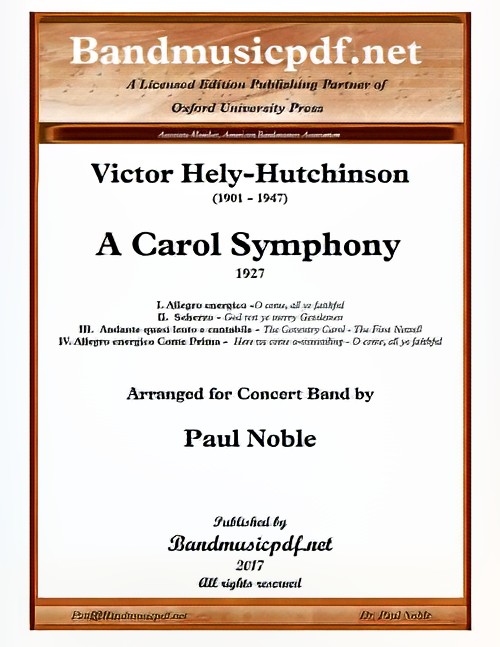
A Carol Symphony (Concert Band - Score and Parts) - Hely-Hutchinson, Victor - Noble, Paul
Victor Hely-Hutchinson is best known for his Carol Symphony, composed in 1927, from which the third movement was used for the title music of the 1943 Children's Hour and 1984 BBC children's television adaptation of John Masefield's The Box of Delights, in particular the variation on the theme of The First Nowell. The first movement is based on O come, all ye faithful, with the second movement being based on God rest ye merry Gentlemen. The third movement includes The Coventry Carol and The First Nowell, with the final movement concluding with Here we come a-wassailing and a return to O come, all ye faithful. The movements may be performed separately. This arrangement for Concert Band adds not only another new seasonal offering, but a very strong piece for advanced bands around the world.
Estimated dispatch 7-14 working days
-
 £125.00
A Carol Symphony, 1st Movement (Concert Band - Score and Parts) - Hely-Hutchinson, Victor - Noble, Paul
Victor Hely-Hutchinson is best known for his Carol Symphony, composed in 1927, from which the third movement was used for the title music of the 1943 Children's Hour and 1984 BBC children's television adaptation of John Masefield's The Box of Delights, in particular the variation on the theme of The First Nowell. The first movement is based on O come, all ye faithful, with the second movement being based on God rest ye merry Gentlemen. The third movement includes The Coventry Carol and The First Nowell, with the final movement concluding with Here we come a-wassailing and a return to O come, all ye faithful. The movements may be performed separately. This arrangement for Concert Band adds not only another new seasonal offering, but a very strong piece for advanced bands around the world.
Estimated dispatch 7-14 working days
-
 £125.00
A Carol Symphony, 2nd Movement (Concert Band - Score and Parts) - Hely-Hutchinson, Victor - Noble, Paul
Victor Hely-Hutchinson is best known for his Carol Symphony, composed in 1927, from which the third movement was used for the title music of the 1943 Children's Hour and 1984 BBC children's television adaptation of John Masefield's The Box of Delights, in particular the variation on the theme of The First Nowell. The first movement is based on O come, all ye faithful, with the second movement being based on God rest ye merry Gentlemen. The third movement includes The Coventry Carol and The First Nowell, with the final movement concluding with Here we come a-wassailing and a return to O come, all ye faithful. The movements may be performed separately. This arrangement for Concert Band adds not only another new seasonal offering, but a very strong piece for advanced bands around the world.
Estimated dispatch 7-14 working days
-
 £125.00
A Carol Symphony, 3rd Movement (Concert Band - Score and Parts) - Hely-Hutchinson, Victor - Noble, Paul
Victor Hely-Hutchinson is best known for his Carol Symphony, composed in 1927, from which the third movement was used for the title music of the 1943 Children's Hour and 1984 BBC children's television adaptation of John Masefield's The Box of Delights, in particular the variation on the theme of The First Nowell. The first movement is based on O come, all ye faithful, with the second movement being based on God rest ye merry Gentlemen. The third movement includes The Coventry Carol and The First Nowell, with the final movement concluding with Here we come a-wassailing and a return to O come, all ye faithful. The movements may be performed separately. This arrangement for Concert Band adds not only another new seasonal offering, but a very strong piece for advanced bands around the world.
Estimated dispatch 7-14 working days
-
 £125.00
A Carol Symphony, 4th Movement (Concert Band - Score and Parts) - Hely-Hutchinson, Victor - Noble, Paul
Victor Hely-Hutchinson is best known for his Carol Symphony, composed in 1927, from which the third movement was used for the title music of the 1943 Children's Hour and 1984 BBC children's television adaptation of John Masefield's The Box of Delights, in particular the variation on the theme of The First Nowell. The first movement is based on O come, all ye faithful, with the second movement being based on God rest ye merry Gentlemen. The third movement includes The Coventry Carol and The First Nowell, with the final movement concluding with Here we come a-wassailing and a return to O come, all ye faithful. The movements may be performed separately. This arrangement for Concert Band adds not only another new seasonal offering, but a very strong piece for advanced bands around the world.
Estimated dispatch 7-14 working days
 View Music