
Results
-
 £228.70
Konsertouverture - Viktor Widqvist
This piece was composed in 1937 in the composer's later part of life. Here, Widqvist shows his broad competence as a composer by using both classic marching and late-romantic thematic elements with exciting harmonic twists. In addition, you can find a perfect fugue where the composer shows that he masters this advanced composition technique. One can imagine that Widqvist wanted to show off his entire repertoire of knowledge to take the lead in the unspoken competition with colleague and friend Sam Rydberg. Rydberg had several years earlier composed a concert overture with a similar form. However, this piece is simpler in its design and lacks the technical brilliance that Widqvist shows in his contrapuntal treatment and harmonious diversity.The concert overture was re-orchestrated in 1939 by the composer for symphony orchestra, and it is this version and the original score for a large military orchestra that form the basis for this edition. My aim has been to keep all of Widqvist's original intentions, but still make use of all the possibilities of the modern symphonic wind orchestra. The composer's own arrangements for symphony orchestra have been of great help in this work.- Niclas Blixt -
Estimated dispatch 7-14 working days
-
 £98.20
Space Lab - Giuseppe Ratti
A long pedal-note of evanescent chords, based on empty parallel fifths, announces the theme;flutes and reed instruments exploit some almost imperceptible micro-fragments, supported by muted trumpets, creating what is an almost surreal and spatial atmosphere. This was Giuseppe Ratti's starting point for his "Space Lab", a laboratory of sounds and, later (when the main theme is taken up once more), of rhythms. Although it may sound complicated, this piece is ultimately based on a single motif: the descending fourth played on the second beat by the woodwinds. In this piece, Giuseppe Ratti, with his usual pallet of clear, transparent colours at hand, appropriate for the general public, together with simple, effective themes, has sought to experiment with new atmospheres and rhythms. First of all we hear the entire theme in the Allegro. Then the rhythm changes in a simple but at the same time complex manner: almost a genetic mutation. The part leading up to the final Lento flows smoothly for the listener but requires great skill and experience on the part of those performing it. In the final lento the main theme reappears in all its simplicity and sincerity, purified of all contrasts. A metaphor for a life that leads us towards unimaginable frontiers but which, in the end, always brings us back to the point from where we started.
Estimated dispatch 7-14 working days
-
 £109.50
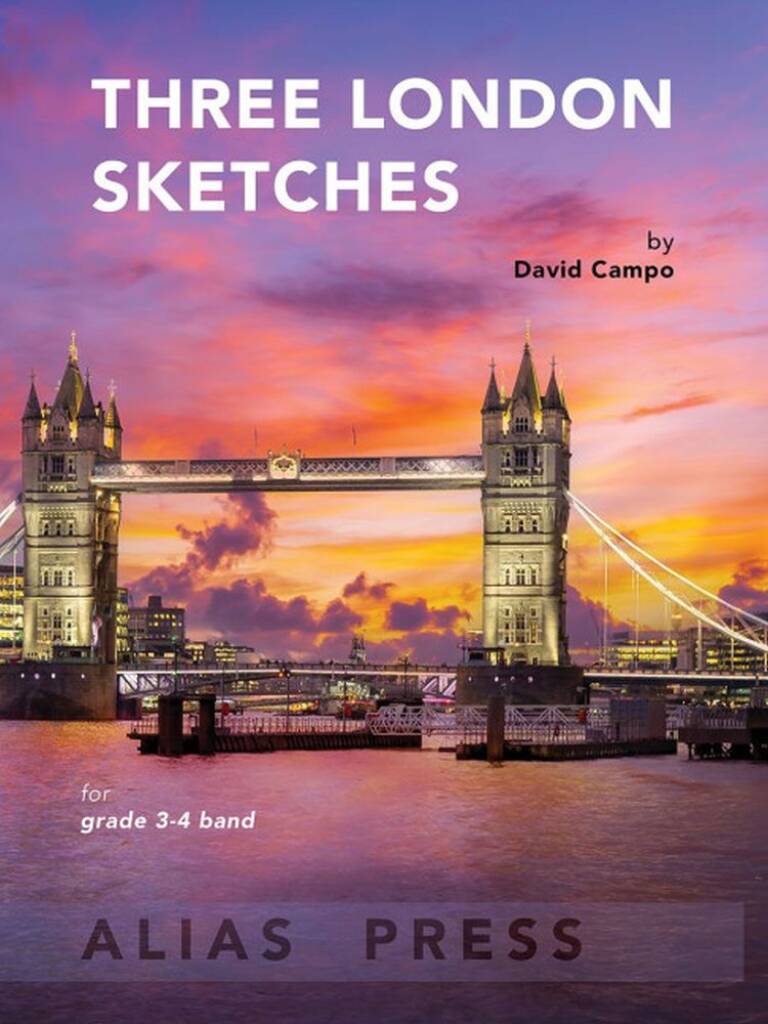
Three London Sketches - David Campo
London is one of my favorite cities in the world, and in 2016 I was invited there to serve as an adjudicator for the London New Year's Day Parade and Gala Concerts. While I was there, I was fortunate to meet and spend time with The Lord Mayor of Westminster Councillor Steve Summers. While his title sounds formidable and intimidating, I found Steve to one of the nicest, most easygoing people I've ever met. And boy, does he love London! He was fond of saying that he had "the best job in the greatest city in the world." He spoke passionately about London and his favorite places in the city, and his enthusiasm was contagious. Some of his favorite places became some of my favorite places, and the inspiration for this piece. I hope that this work not only conveys the beauty and history of these iconic places, but Steve's deep and abiding love for them as well. I. Tower Bridge - The Tower Bridge was built over 120 years ago to ease road traffic while maintaining river access to the busy Pool of London docks. Its giant moveable roadways lift up for passing ships, making it a true engineering marvel. It is also one of the most iconic sites in London, and was used to display the Olympic Rings during the 2012 Olympics. II. St. Paul's (The Whispering Gallery) - The history of St. Paul's Cathedral goes back well over a thousand years, but construction on the current St. Paul's began in 1669 after a fire destroyed the earlier structure. The dome of St. Paul's Cathedral is a whispering gallery; you can whisper against the wall on the inside of the dome and it can be clearly heard on the other side of the dome over 100 ft. away. Imagine the secrets that have passed there... III. Trafalgar Square - The name commemorates the 1805 naval Battle of Trafalgar and is marked by Nelson's Column, a monument to Admiral Horatio Nelson, the hero of the Battle of Trafalgar. It is the heart of London; full of life and constant energy and home to iconic buildings including the National Gallery, St. Martin-in-the-Fields, Canada House and South Africa House. Londoners say that all roads in London lead to Trafalgar Square.
Estimated dispatch 7-14 working days
-
 £118.99
Portsmouth Point Overture - William Walton
Portsmouth Point is an overture for orchestra by English composer William Walton, composed in 1925. The overture was inspired by a print by Thomas Rowlandson which depicts the colorful life of 18th century sailors at Portsmouth Point. In the work, Walton_x001A_s style has been notably influenced by Stravinsky, jazz rhythms, as well as the rhythm of the Catalan sardana dance. This transcription for symphonic band was written by Donald Patterson for the President's Own U.S. Marine Corps Band.
Estimated dispatch 7-14 working days
-
 £199.99
Suite Pastorale - Franco Cesarini
Suite Pastorale, made up of three movements - Idyll, Playful Shepherd Boys, Rain Upon the Fields - is characterized by an idealization of the simplicity of country life in close contact with nature. Suite Pastorale depicts the eternal and fascinating myth of Arcadia: a world in which man lives in harmony with nature, immersed in bucolic forest landscapes, one of the most important imaginary places to escape to for those who were, and still are, tired of culture and civilization. The evocative Arcadian world is made almost mythological by the attention dedicated to it by poets, writers, playwrights, painters, and composers who over the centuries have drawn lifeblood from it for their works. Full of metaphorical meanings, it is a place of shelter, a place to live and sing about love, even if it means disappointment, and it is the place of civilization opposed to barbarism. It is a symbol of happiness, a real and intact image of reality, motionless in space and time, where nothing changes. The myth of the "locus amoenus" has not disappeared but has kept all its charm intact over the centuries.Suite Pastorale was commissioned to Franco Cesarini by the concert band of Aldeno (Trento/Italy) for the 100th anniversary of its foundation (1923-2023.Suite Pastorale: an ideal concert piece that will delight your audience!
Estimated dispatch 7-14 working days
-
 £74.99
Contrapunctus IX - Johann Sebastian Bach
Composed in the last year of Bach's life, "Contrapunctus IX" is an exciting double fugue that has been adapted to provide an exciting and challenging work for the modern concert band-wind ensemble. Full of independence throughout, every part is important and all sections get plenty of chances to shine in this powerful arrangement which will be a true showcase for better bands. An impressive choice for any concert or contest performance!
Estimated dispatch 7-14 working days
-
£91.99
Rejoissant! - David Shaffer
As the title suggests, is a celebration of life's conquering obstacles, specifically of the composer's own personal battle against cancer. Written for the Upper Sandusky High School (Ohio) Wind Ensemble and with the thanks from the composer for the support and opportunity to compose this piece during a very difficult period of time, "Rejoissant!" opens with a slower dramatic fanfare in the brass and percussion. The simple but forceful melody is repeated in several forms throughout the piece, including the beautiful and melodic middle section. This exceptionally emotional and energetic composition is suitable for all concerts and especially festival performances.
Estimated dispatch 7-14 working days
-
 £72.95
Boundless Hope - Mark Lortz
Starting with a mallet percussion ostinato, this contemporary ballad for developing bands would also work well as a reflective selection for more advanced ensembles or as a contrasting selection in concert or contest. Written to represent thoughts, feelings and emotions during one's life, the composition is based on the Lydian mode, which naturally gives a sense of positivity, hopefulness, inspiration, and heavenly colors. Use this to introduce the study of modes, develop lyrical playing skills and as inspiration for all performers and listeners.
Estimated dispatch 7-14 working days
-
 £128.60
Det e min snn - Lars Bremnes
The composer's sister, Kari Bremnes, has had great success with this song through her album "Det vi har" from 2017. Subsequently, Elisabeth Andreassen has also performed it on the TV program "Hver gang vi mtes".The lyrics are about the thoughts one has when their son has to leave for military service and the new life it brings in an increasingly uncertain world.Lars Bremnes has been a soloist with the bands of the Norwegian Armed Forces several times, and this arrangement is written for such an occasion.
Estimated dispatch 7-14 working days
-
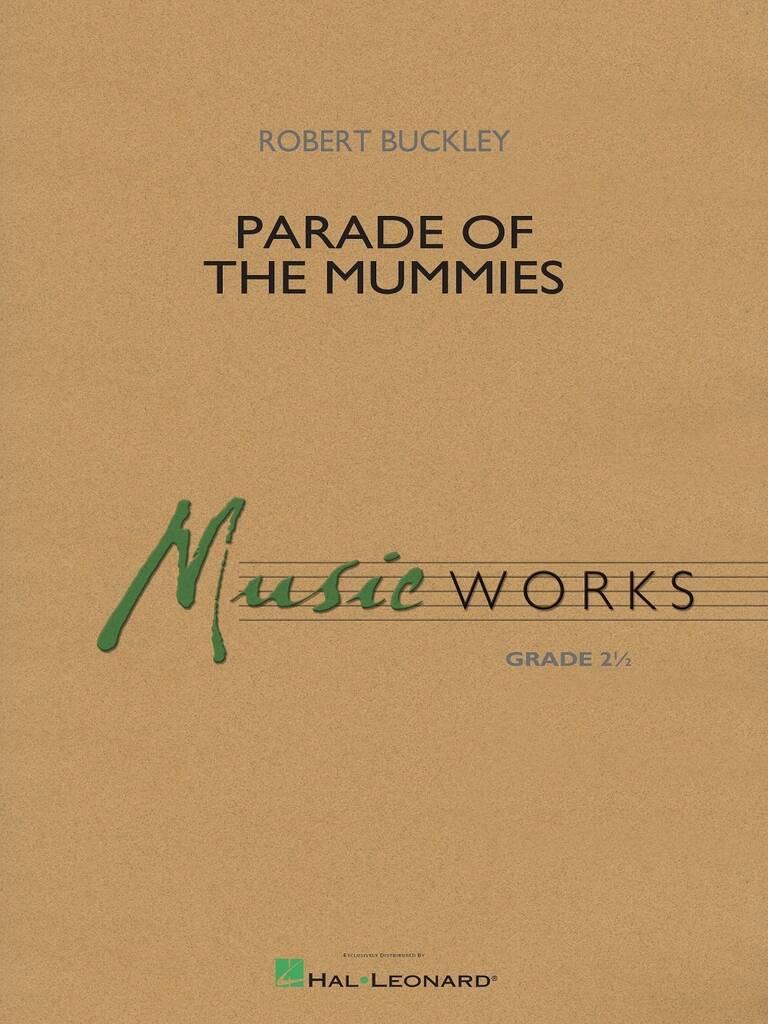 £60.99
Parade of the Mummies - Robert Buckley
Parade of the Mummies is a whimsical and lively composition that invites listeners on a fantastical procession of ancient mummies coming to life and parading through the streets! Packed with plenty of variety, creepy effects, and sinister frame, this is a fun choice for any occasion, but especially for Halloween! Dur: ca. 2:30
Estimated dispatch 7-14 working days
 View Music