
Results
-
 £8.78
Progressive Steps to Syncopation for the Modern Drummer - Ted Reed
Voted second on Modern Drummer's list of 25 Greatest Drum Books in 1993, is one of the most versatile and practical works ever written for drums. Created exclusively to address syncopation, it has earned its place as a standard tool for teaching beginning drummers syncopation and strengthening reading skills. This book includes many accented eighths, dotted eighths and sixteenths, eighth-note triplets and sixteenth notes for extended solos. In addition, teachers can develop many of their own examples from it.
Estimated dispatch 3-5 working days
-
 £13.17
Suzuki Violin School, Volume 4: Violin Book - Shinichi Suzuki
Teach violin with the popular . The Suzuki Method of Talent Education is based on Shinichi Suzuki's view that every child is born with ability, and that people are the product of their environment. According to Shinichi Suzuki, a world-renowned violinist and teacher, the greatest joy an adult can know comes from developing a child's potential so he/she can express all that is harmonious and best in human beings. Students are taught using the "mother-tongue" approach. Each series of books for a particular instrument in the Suzuki Method is considered a Suzuki music school, such as the Suzuki Violin School. Suzuki lessons are generally given in a private studio setting with additional group lessons. The student listens to the recordings and works with their Suzuki violin teacher to develop their potential as a musician and as a person. This Suzuki book is integral for Suzuki Violin Lessons. This revised edition of the Suzuki Violin School, Volume 4 features: * Revised editing of pieces, including bowings and fingerings * Additional exercises, some from Shinichi Suzuki, plus additional insight and suggestions for teachers * Text in English, French, German, and Spanish * Musical notation guide * Fingerboard position. Titles: Lullaby (Tonalization) (Schubert) * Lullaby (Tonalization) (Brahms) * Concerto No. 2 in G Major, Op. 13, 3rd Movement (Seitz) * Concerto No. 5 in D Major, Op. 22, 1st Movement (Seitz) * Concerto No. 5 in D Major, Op. 22, 3rd Movement (Seitz) * Concerto in A Minor, 1st Movement, Op. 3, No. 6 (Vivaldi/Nachez) * Concerto in A Minor, 3rd Movement, Op. 3, No. 6 (Vivaldi/Nachez) * Perpetual Motion, "Little Suite No. 6" (Bohm) * Concerto for Two Violins in D Minor, BWV 1043, 1st Movement, Violin II (Bach). For a complete list of the most recent printings by AMPV number, go to alfred.com/suzuki. This title is available in MakeMusic Cloud. The International editions include an updated title page that designates the book as the International Edition. A Federation Festivals 2020-2024 selection.
Estimated dispatch 3-5 working days
-
 £13.17
Suzuki Cello School, Volume 2: Cello Book
Teach cello with the popular . The Suzuki Method of Talent Education is based on Shinichi Suzuki's view that every child is born with ability, and that people are the product of their environment. According to Shinichi Suzuki, a world-renowned violinist and teacher, the greatest joy an adult can know comes from developing a child's potential so he/she can express all that is harmonious and best in human beings. Students are taught using the "mother-tongue" approach. Each series of books for a particular instrument in the Suzuki Method is considered a Suzuki music school, such as the Suzuki Cello School. Suzuki lessons are generally given in a private studio setting with additional group lessons. The student listens to the recordings and works with their Suzuki cello teacher to develop their potential as a musician and as a person. This Suzuki Book is integral for Suzuki cello lessons. Titles: Long, Long Ago (T. H. Bayly) * May Time, Komm Lieber Mai (Longing for Spring) from , K. 96 (W. A. Mozart) * Minuet No. 1, Minuett III from , BWV 822 (J. S. Bach) * Minuet No. 3, Minuet in C, BWV Anh. II (J. S. Bach) * Chorus from (G. F. Handel) * Hunters' Chorus from 3rd Act of the Opera (C. M. von Weber) * Musette in G, Gavotte II or the Musette from , BWV 808 (J. S. Bach) * March in G (J. S. Bach) * Theme from (N. Paganini) * Tonalization: The Moon over the Ruined Castle (R. Taki) * The Two Grenadiers, Die Beiden Grenadier, Op. 49, No. 1 for Voice and Piano (R. Schumann) * Gavotte (F. J. Gossec) * Bourre from , HHA IV/18, No. 8-EZ (G. F. Handel). This title is available in MakeMusic Cloud. For a complete list of the most recent printings by AMPV number, go to alfred.com/suzuki. The International editions include an updated title page that designates the book as the International Edition. A Federation Festivals 2020-2024 selection.
Estimated dispatch 3-5 working days
-
 £13.17
Suzuki Cello School, Volume 3: Cello Book
Teach Cello with the popular . The Suzuki Method of Talent Education is based on Shinichi Suzuki's view that every child is born with ability, and that people are the product of their environment. According to Shinichi Suzuki, a world-renowned violinist and teacher, the greatest joy an adult can know comes from developing a child's potential so he/she can express all that is harmonious and best in human beings. Students are taught using the "mother-tongue" approach. Each series of books for a particular instrument in the Suzuki Method is considered a Suzuki music school, such as the Suzuki Cello School. Suzuki lessons are generally given in a private studio setting with additional group lessons. The student listens to the recordings and works with their Suzuki cello teacher to develop their potential as a musician and as a person. This Suzuki Book is integral for Suzuki cello lessons. Titles: Berceuse, Wiegenlied or Lullaby, Op. 98, No. 2 (F. Schubert) * Tonalization: The Moon over the Ruined Castle (Taki) * Gavotte (Lully) * Minuet from No. 11, Op. 11, No. 5 in E Major (Boccherini) * Tonalization: The Moon over the Ruined Castle (Taki) * Scherzo (Webster) * Minuet in G, Wo0 10, No. 7 for Piano (Beethoven) * Gavotte in C Minor, Gavotte en Rondeau from , BWV 822 (Bach) * Minuet No. 3, BWV Anh. II 114/Anh. III 183/Anh. II, 115 (Bach) * Humoresque, Op. 101, No. 7 for Piano (Dvork) * La Cinquantaine (Gabriel-Marie) * Allegro Moderato from (Bach). For a complete list of the most recent printings by AMPV number, go to alfred.com/suzuki. This title is available in MakeMusic Cloud. The International editions include an updated title page that designates the book as the International Edition. A Federation Festivals 2020-2024 selection.
Estimated dispatch 3-5 working days
-
£32.00
Beer Party - Dennis Armitage - Bertrand Moren
Score: CHF 35.-- / Parts (see the list on the 1st page of the score) : each CHF 5.-- (to order please contact us)
Estimated dispatch 10-14 working days
-
 £57.50
The Thunderer (Concert Band - Score and Parts) - Sousa, John Philip - Bocook, Jay
On the all-time hit list of best-known marches, this tuneful Sousa favorite is near the top of the list. Jay's masterful adaptation makes it playable by younger bands without sacrificing any of the charm or style of the original. This is one of those marches that belongs in every band's library.
Estimated dispatch 7-14 working days
-
 £102.99
Maneskin Greatest Hits (Concert Band - Score and Parts) - Schenk, Markus
Maneskin is an Italian rock band that first set foot on the international stage in 2021, when it won the 65th Eurovision Song Contest with Zitti e buoni. 2021 was an excellent year for the group in more ways than one, since they were also declared best rock band at the MTV European Music Awards. More successes followed: their cover of the Four Seasons song Beggin' became a worldwide hit and even reached the American Billboard Hot 100, as well as the global Spotify hit list. The band's name was definitively established with songs like I Wanna Be Your Slave, The Loneliest and Supermodel. Markus Schenk has brought together all of these hits in a fantastic pop-rock medley for concert band. Sturdy music that is unsuitable for softies, but it will certainly go down well with the audience!Duration: 7.15
Estimated dispatch 7-14 working days
-
 £66.95
Winchester Cathedral (Flexible Ensemble - Score and Parts) - Stephens, Geoffrey - Sunde, Inge
You see that a song has done well when you see the long list of artists who have recorded cover versions. Here are some of them, after the original recording with The New Vaudeville Band in 1966; Dizzy Gillespie (1966), Frank Sinatra (1966), Ray Conniff (1967), Petula Clark (1967), The Shadows (1967) and The Four Freshmen (1968). This arrangement reflects the original and also allows for highlighting soloists.Flexible instrumentation (Flex 5 ShowBlow) makes it playable for small as well as larger ensembles.Duration: 3.00
Estimated dispatch 7-14 working days
-
 £210.80
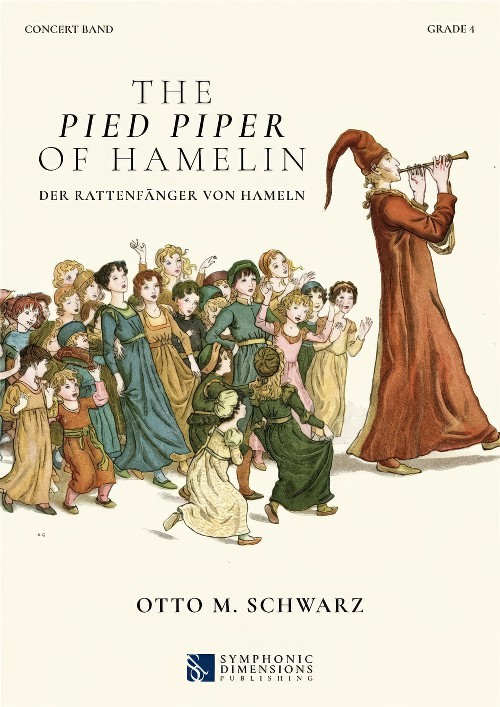
The Pied Piper of Hamelin (Concert Band - Score and Parts) - Schwarz, Otto M.
Stories, sagas and legends--who among us don't know them? Always delivered with a tinge of brutality, these cautionary tales are a legacy of moral education from times past: inquisitive children alone in the forest are generally eaten by a witch; the 'Soup-Kasper' of Hoffmann's Struwwelpeter dies from starvation rather than eating his soup; anyone letting in strangers usually gets devoured; anyone who plays with matches gets burned; and thumb-suckers get their thumbs cut off. The list of unfortunate demises is almost endless.In the tale of The Pied Piper of Hamelin, parents lose their children through greed, ridicule, scorn and a failure to appreciate art. There is still a street in the town of Hamelin in which neither drumming nor playing has not been allowed since 130 children disappeared into a mountain, never to be seen again. This composition by Otto M. Schwarz opens with exactly this scene, taking us back to the year 1284. As in many towns at the time, Hamelin in Germany suffered with hygiene problems--rats and mice began to multiply rapidly, and the town was overrun with the plague. There appeared a man dressed in colourful clothes who promised the locals to free them from this burden. They agreed and settled on a fee. Then the man pulled out a pipe and began to play. When the rats and mice heard this, they followed him. He led the animals into the Weser River, where they all drowned. Back in town, the people refused to pay him. They didn't recognise this man's skills and knowledge and were only prepared to pay for simple labour. A pact with the devil was made, which led to the Pied Piper leaving the town in a furious rage. One Sunday, when many people were at church, he returned, took out his flute and began to play. The town's children were so enchanted by his playing that they followed him. He led them out of the town and disappeared with them forever into a mountain forever. Of all the children, only two survived--however one was mute, and one was blind. In the street from which the children left Hamelin, music may no longer be played in memory of this event. The work may be performed in two different versions: 1. Purely instrumental (without narrator)--the GPs (pauses) must be kept short 2. With narrator--he speaks in the GPs but not during the music.Duration: 14.15
Estimated dispatch 7-14 working days
-
 £84.99
Respect (Concert Band - Score and Parts) - Schaars, Peter Kleine
Peter Kleine Schaars is one of the top arrangers at De Haske. His catalogue consists of the very best songs from different genres. Respect as performed by the Queen of Soul, Aretha Franklin, is an addition to his list of arrangements - an all-time classic with a message that is still very relevant.Duration: 2.30
Estimated dispatch 7-14 working days
 View Music