
Results
-
 £116.40
Premiere Symphonie des Noels - Michel-Richard Delalande
The French composer and organist Michel Richard de Lalande (Paris, 1657 - Versailles, 1726), a contemporary of Jean-Baptiste Lully, was music teacher of the daughters of King Louis XIV and was appointed Court Composer and conductor (Matre et compositeur de la chapelle royale, surintendant et compositeur de la musique de la chambre). His music was a harmonious synthesis of the French and Italian styles. He mainly composed ballet and religious music (numerous motets), as well as some famous orchestral pieces such as the famous 'Symphonies pour les Soupers du Roi' and the four Symphonies de Nols (Christmas symphonies). The latter are orchestrations of traditional French Carols sung at Christmas Eve in the chapel of the castle at Versailles. Dsir Dondeyne, conductor of the Paris Metropolitan Police Band (Musique de Gardiens de la Paix) from 1954 to 1979, wrote this fine arrangement for symphonic band.
Estimated dispatch 7-14 working days
-
 £76.80
Marcia Rhapsodia Di Bonelli - Sam Rydberg
This march is of a quite special kind. As its name indicates, it is a march in the form of a rhapsody. We've got changing tempi, exuberant fanfares, power and lyricism. One of the highlights from the catalogue of Sam Rydberg, Sweden's March King.
Estimated dispatch 7-14 working days
-
 £122.40
Elegia Romana - Franz Watz
Impressive and yet gentle, the proud eagle soars over the mountaintops and through the ravines of the Karpaten. As the uncrowned king of the air, he observes all earthly events from Romania's highest peaks, and from the highest altitudes, with his sharp and watchful eyes, he sees all......
Estimated dispatch 7-14 working days
-
 £38.20
A Royal Fanfare - Feike van Tuinen
Opening fanfare in honour of the abdication in the Netherlands in 2013. The Dutch national anthem is subtly woven throughout this musical portret for the new king.A real festive fanfare!
Estimated dispatch 7-14 working days
-
 £138.00
San Pedro de Alcntara - Valdemar Gomes
The Spanish war galleon with 64 cannons, built in Cuba between 1770 and 1771 for an English shipowner in the service of the King of Spain left Peru for Cadiz in 1784 with a huge cargo of copper, gold, silver and other valuables on board. There were also more than 400 people on board, including passengers, crew and Inca prisoners after a revolt. The Atlantic crossing went smoothly, passing Portugal to take advantage of favourable winds. The shipwreck off Peniche was the result of human error, apparently due to French maps with dramatic errors in the position of the islands of Berlengas and neighbouring islets. On 2 February 1786, the sea was calm and the night clear, but they hit the rock formation Papoa and the hull immediately broke in two. The bottom sank quickly, while the deck remained afloat for some time. 128 people lost their lives, including many Indians who were trapped in the basement. This shipwreck is considered one of the most important in maritime history.What the composer wants to convey, and what can be felt as one listens, is first of all the sound of power, of hope, of the glory of conquest, of the splendour of wealth. This is followed by the perception of the maritime environment, the harmony with the softness of the ocean, the gliding of the hull in the foam of the sea on sunny, blue days. But along with this tranquillity, you soon hear a rhythmic chain that makes you feel a representation of the hustle and bustle, of the busy crew, of the hard work of a sailor, of the desperation of an exotic people imprisoned in a dark, damp cellar. A distinct rhythm that reminds us of the "salero" of Andalusia, with its Arab influences and its people, the soothing of the resignation of others who are forced to submit. Then we clearly hear a crescendo that makes us imagine the agony of the collision that precedes the shipwreck. The breaking of the hull, the water flooding everything, the despair, the clash of bodies on the rocks, the tragedy to come. Before the "grand finale", in which the return of musical softness reminds us that the story is over. The supremacy of nature over human greed. The waves, though gentle, sweep the wreckage, the lives and the treasures of the New World to the bottom of the sea.
Estimated dispatch 7-14 working days
-
 £38.20
Under the Double Eagle - J.F. Wagner
The Austrian military bandmaster Josef Franz Wagner (1856-1908) used to be called the 'Austrian March King'. He wrote some 400 compositions, 250 of which have been published. Among his well-known marches we mention 'Tiroler Holzhacker Buab'n', 'Erzherzog Johann Jodler', 'Wiener Brger', '47er Regimentsmarsch' and, of course, 'Unter dem Doppeladler' (Under the Double Eagle) opus 19. The title of this immortal march refers to the double eagle in the coat of arms of the Austro-Hungarian double monarchy. The march became so popular that it was recorded thrice by the Sousa-band before J.F.Wagner died at the age of 52. It became the official regimental march of the 1st Austrian Artillery Regiment Number 2.
Estimated dispatch 7-14 working days
-
 £38.20
Swedish Cavalery March - Per Berg
Aggressive strains with blaring trumpets characterize the marches made by the Swedish composer Per Berg. He was director of music at the Royal Vsterbotten Regiment '30-'41 and at the Royal Sdermanland Regiment '41-'53. Four of his about 15 marches have become official marches in the Swedish Defence Forces. 'Hertigen av Vsterbotten is a cavalry march dedicated to the Prince Gustaf Adolf, the father of the present King Carl XVI Gustaf. In 1987 it was adopted as the common march past for the remaining Swedish cavalry units.
Estimated dispatch 7-14 working days
-
 £95.95
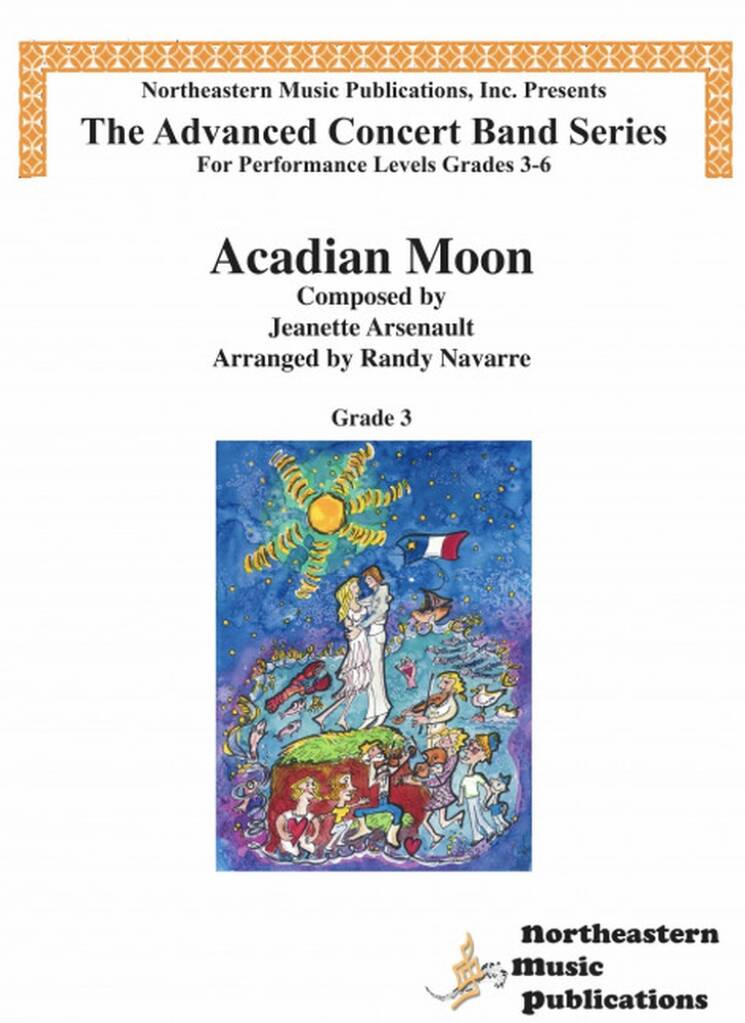
Acadian Moon - Jeanette Arsenault
Acadia, Nova Scotia, Canada is the first French settlement in North America. In 1752, the King of England demanded they pledge allegiance to England or they must leave. Many left, but many also returned. The Acadian people and culture still reside there today. Also, the Acadians are the ancestors of the Cajuns who settled in Southern Louisiana. Only the 1st clarinets cross the break. 1st trumpet's highest note is G.
Estimated dispatch 7-14 working days
-
 £174.10
Street Life - Sample
Randy Crawford led R&B veterans the Crusaders on the transatlantic hit "Street Life" (1979). A specially re-recorded version was featured in the soundtrack for the films Sharky's Machine and Jackie Brown. The composer Joseph Leslie "Joe" Sample (February 1, 1939 September 12, 2014) was an American pianist, keyboard player, and composer. He was one of the founding members of the Crusaders. but he enjoyed also a successful solo career and guested on many recordings including Miles Davis, George Benson, Jimmy Witherspoon, B. B. King, Eric Clapton, Steely Dan, Joni Mitchell, and the Supremes. Sample incorporated jazz, gospel, blues, Latin, and classical forms into his music. This arrangement can be used with a singer, but then need some attention to balance and please take away most melody lines. Electric Bass, Piano and Guitar are optional. If you would like to add an improvisation, please repeat bar 54 -62 without melody as many times you want. (Look at the piano part for chords).
Estimated dispatch 7-14 working days
-
 £149.40
Answer Me, My Love - Fred Rauch
"Answer Me, My Love" was originally written with German lyrics by Fred Rauch and music by Gerard Winkler under the title "Mutterlein". Shortly after, Carl Sigman wrote the English lyrics and gave it the title "Answer Me, My Love" which is now the most famous version. It became a hit in 1953, but it was during 1954 that Nat King Cole recorded it and made it a chart-topper in both the US and Europe. In 2000 the Canadian composer and singer Joni Mitchell included it on her successful record album "Both Sides Now". Available solo parts in this arrangement: C-Instruments TC C-Instruments BC Bb-Instruments Eb-instruments
Estimated dispatch 7-14 working days
 View Music