
Results
-
 £3.95
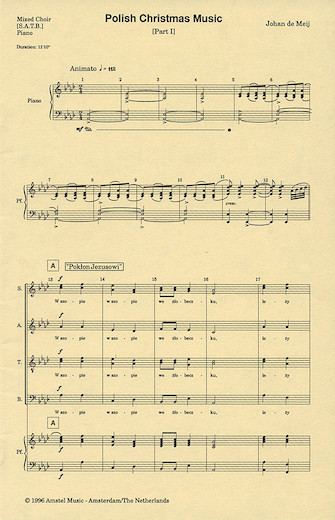
£3.95Polish Christmas Music - Part I (SATB Choral Octavo) - De Meij, Johan
For many centuries Poland has bosted a very rich tradition of Christmas Carols. Some hymns belong to church music, while others definitely do have a folk music character. Johan de Meij has used both these elements in this suite. You can hear the songs: Poklon Jezusowi; Mizerna, cicha; Aniol pasterzom mowil; Gdy sliczna Panna and Jam jest dudka. Duration: 11.15
Estimated dispatch 7-14 working days
-
 £148.00
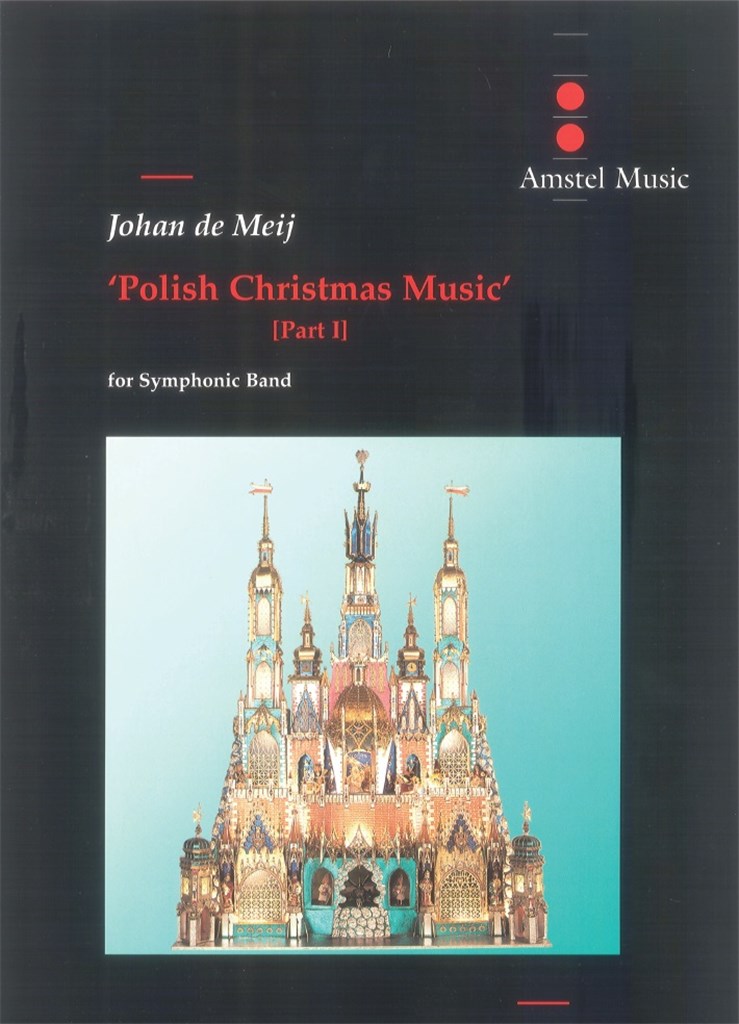
Polish Christmas Music - Part I (Concert Band - Score and Parts) - De Meij, Johan
For many centuries Poland has bosted a very rich tradition of Christmas Carols. Some hymns belong to church music, while others definitely do have a folk music character. Johan de Meij has used both these elements in this suite. You can hear the songs: Poklon Jezusowi; Mizerna, cicha; Aniol pasterzom mowil; Gdy sliczna Panna and Jam jest dudka. Duration: 11.15
Estimated dispatch 7-14 working days
-
 £107.00
Funeral Music (Concert Band - Score and Parts) - Grieg, Edvard - De Meij, Johan
The funeral music from the melodrama Bergliot by the Norwegian composer Edvard Grieg consists of two instrumental fragments, that musically illustrate the dramatic events of the story. Johan de Meij incorporates strong emotions such as sadness and resignation, but also anger and powerlessness in his arrangement: a beautiful musical unity. Duration: 8.00
Estimated dispatch 7-14 working days
-
 £72.99
Spectroduction (Concert Band - Score and Parts) - Nijs, Johan
The title of this thrilling piece indicates exactly what composer Johan Nijs wants his new work to be, a spectacular introduction. Spectroduction does not disappoint on both counts, grabbing the audiences attention from the first beat. This will make for a spectacular way to open your next concert.Duration: 0:50
Estimated dispatch 7-14 working days
-
 £148.00
Trois Rag - Caprices (Concert Band - Score and Parts) - Milhaud, Darius - De Meij, Johan
The French composer Darius Milhaud (1892-1974) was a member of the Groupe des Six. This group of six composers gathering Honegger, Poulence, Auric, Durey, Tailleferre and Milhaud, imitated Erik Satie by revolting against the deeply rooted traditional conventions of that time. They reacted against impressionism (Debussy) and romanticism (Wagner, Mahler) and felt very strongly about the music of Satie and Stravinsky. Milhaud's most popular work is undoubtedly the ballet La Creation du Monde, one of the most striking examples of jazz influences in classical music. The premiere at the Theatre des Champs Elysees in October 1923 caused a real scandal with the Paris public. The Trois Rag-Caprices for piano were composed one year earlier, in the summer of 1922, and could be considered as a kind of preliminary sketch for La Creation du Monde. There are indeed clear similarities between both compositions as to the rhythmical and harmonic aspects. The Trois Rag-Caprices were orchestrated for symphony orchestra by Milhaud himself some time later. The same happened to Saudades do Brasil (1920), a piano composition punctuated with Latin-American influences, which was written after his stay in Rio de Janeiro (1917-18) exactly as his ballet Le Boeuf sur le Toit. Johan de Meij's orchestration of Trois Rag-Caprices for symphonic band is a most welcome addition next to the original band works of Milhaud, such as Suite Francaise (1945) and West Point Suite (1951).Duration: 8.00
Estimated dispatch 7-14 working days
-
 £128.00
Ratatouille Satirique (Concert Band - Score and Parts) - Satie, Erik - De Meij, Johan
Erik Satie, born in Honfleur in Normandy (France) in 1866 is undoubtedly one of the most striking personalities in the history of French music. He composed in various, often quite divergent, styles. Besides light-hearted, entertaining works he also wrote several serious compositions, among which the three ballets: Parade, Rel che and Les Aventures de Mercure. However his piano pieces, such as Trois Gymnopedies or Gnossiennes will remain his most popular compositions. Satie co-operated with almost all great artists of his time: Pablo Picasso, Jean Cocteau, Sergej Diaghilev and Georges Braque and the composers Darius Milhaud (Le Groupe des Six) and Claude Debussy. Johan de Meij made an orchestration of three short pieces by Erik Satie: I. Prelude (from: Jack in the Box) II. Reverie (from: Trois petites pieces montees) III. Marche: Le Piccadilly (1904) It was only after Satie's death in 1925 that the manuscript of the piano piece Jack in the Box was recovered. Satie himself thought he had lost the manuscript in a bus. When his flat in Arceuil was cleaned out, a small notebook was discovered behind his piano and it contained the manuscript which was assumed to be lost forever. The R?verie (De l'Enfance de Pantagruel) is an extract from Trois petites pieces montees, originally composed for small symphony orchestra. In this suite it is meant as a restful intermezzo. It is clear that, as with Milhaud (La Creation du Monde) and Debussy (Golliwogg's Cakewalk; Le Petit Negre), it is hard to deny obvious influences of jazz music in Erik Satie's compositions. Le Piccadilly, dating from 1904, displays a lot of similarities with the compositions of Scott Joplin. Duration: 7.00
Estimated dispatch 7-14 working days
-
 £148.00
Aladdin Suite (Concert Band - Score and Parts) - Nielsen, Carl - De Meij, Johan
The large creative output of the Danish composer Carl Nielsen (1865 - 1931) contains six symphonies, chamber music, vocal works and music for the theatre: two operas (Saul & David and Maskerade) and stage music for sixteen different plays. The stage music for Aladdin was written at the request of Johannes Nielsen, the director of the Royal Theatre in Copenhagen. This production was based on the drama Aladdin (1805) by the Danish author Adam Oehlenschlager. Already before the premiere at the Royal Theatre, Carl Nielsen had adapted some of the music for the concert hall: he conducted the first performance of six of the seven movements of the concert suite on February6th, 1919. Johan de Meij's transcription for symphonic band contains the following movements: I. Oriental Festival March; II. Aladdin's Dream / Dance of the Morning Mist; III. African Negro Dance
Estimated dispatch 7-14 working days
-
 £128.00
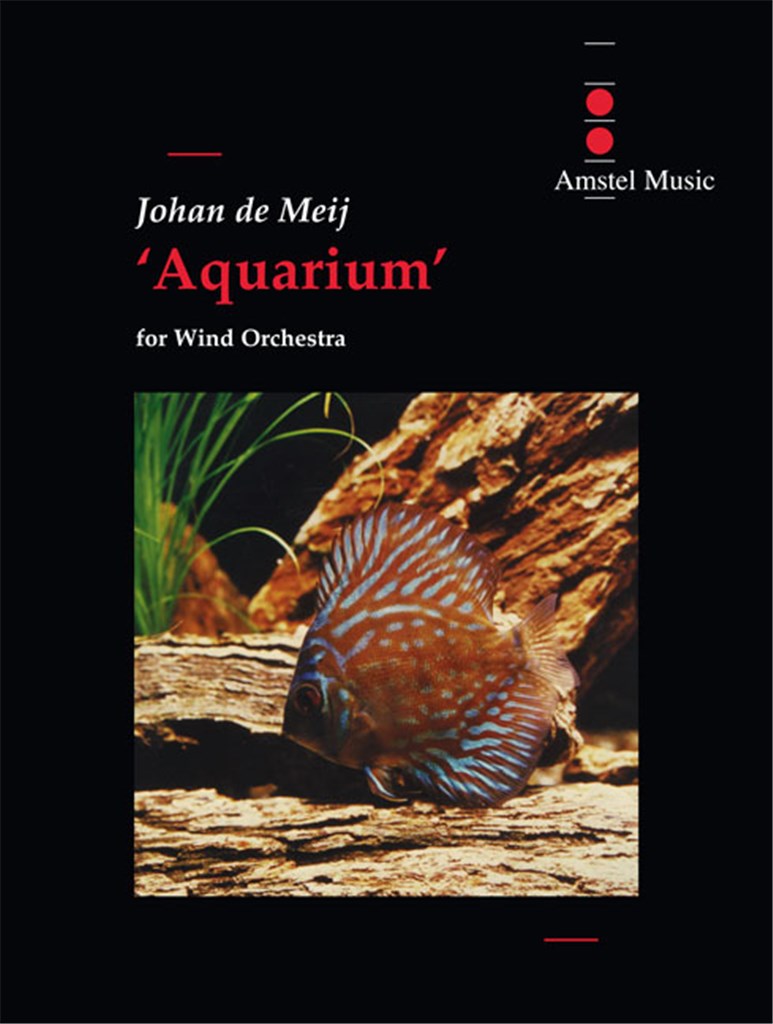
Aquarium (Concert Band - Score and Parts) - De Meij, Johan
The Suite Aquarium is Johan de Meij's third composition for symphonic band and features six tropical fishes, each of them represented by a motif, and surfacing as such in several guises. The composition consists of three movements of which the second and third merge uninterruptedly into each other. I) Allegretto grazioso (Neon Tetra, Electric Eel and Angelfish) II) Andante / Adagio (Sea Horse and Zebrafish) III) Finale: Allegro giocoso (Guppy & Co.) The Neon Tetra motif functions as a kind of 'Leitmotiv' and describes the beautifully coloured, frisky fish: A number of variants have been derived from this theme and will also appear in the other movements. The Electric Eel in fact is not represented by a motif, but by a rhythm based on the restless electric pulses made audible in some aquaria. The Angel fish is represented by elegant cluster chords. In the second movement the Sea Horse emerges out of the water vegetation and starts a dialogue with the Zebrafish, which is represented by one melodic phrase in unison, getting more and more threatening by added parallel fifths and octaves. Simultaneously with the Sea Horse motif the Neon Tetra theme emerges, this time in 3/4 time and in Eb minor. The third movement starts with only two instruments (trumpet and xylophone), but as it is often the case with Guppies their number rapidly increases. Piccolo and Alto Saxophone introduce the Guppy Theme followed by several instrumental combinations. Every theme from the first movement 'swims by' once more, after which the principal motif leads us to a brilliant ending.Duration: 9.00
Estimated dispatch 7-14 working days
-
 £93.10
Remember Them All (Very Easy Concert Band - Score and Parts) - Nijs, Johan
An Original work from the expert pen of Johan Nijs
Estimated dispatch 7-14 working days
-
 £154.99
The Robber Knight - Rob Goorhuis
In the year 1368 a rapacious character takes up residence in the castle of Rijnesteyn at Cothen. He is Johan,bastard son of the Bishop of Utrecht.Round this now so peaceful castle eventful matters are enacted. In part one Johan and Willem Gulik of Guelders set out to do battle against King Charles of France. On their return,in part two, Johan captures two French goldsmiths in Hainault and incarcerates them at Castle Rijnesteyn. Part three is a musical representation of a courtly ballet in medieval style. The final part relates how Jan van Rijnesteyn goes to war against Hendrik van Vianen and Lord of 'Goy,Viscount of Utrecht.Jan loots hispossessions and threathens to conquer all. In het jaar 1368 betrekt een roofzuchtig heerschap het kasteel Reijnestein te Cothen.Het is Johan, de bastaardzoon van de Utrechtse bisschop. Rond dit nu zo vredig gelegen ridderslot hebben zich toen geruchtmakende taferelen afgespeeld. In het eerste deel trekt Johan met Willem Gullik, de hertog van Gelre, ten strijde tegen koning Karel van Frankrijk. De terugreis speelt zich af in het tweede deel. Tijdens deze reis neemt Johan in Henegouwen twee Franse goudsmeden gevangen en sluit ze op in de kerker van slot Rijnesteyn. Deel 3 is de muzikale weergave van een hoofs ballet in middeleeuwse stijl. In het laatste deel wordt verteld hoe Jan van Rijnesteyn in 1396 ten strijde trekt tegen Hendrik van Vianen en de heer van't Goy, burggraaf van Utrecht. Jan plundert diens goederen en dreigt diens bezittingen te veroveren.
Estimated dispatch 7-14 working days
 View Music