
Results
-
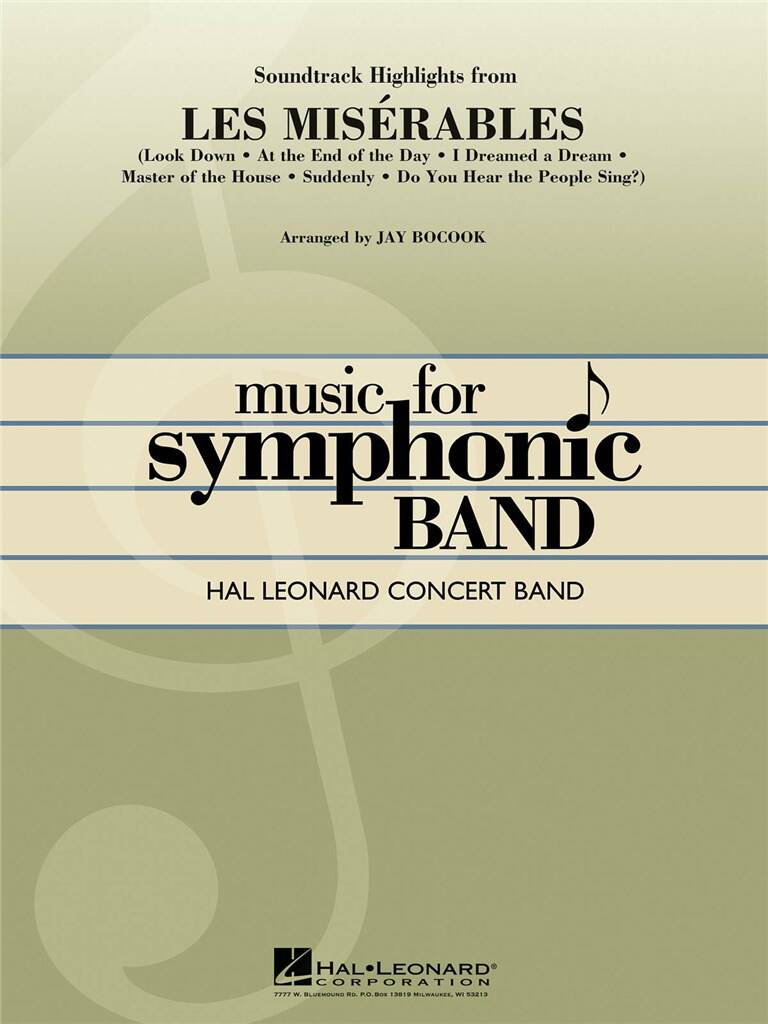 £79.99
Soundtrack Highlights from Les Miserables - Alain Boublil
Here is a powerful symphonic setting of music from the award-winning movie based on the Broadway classic. This medley includes the new song Suddenly, composed for the film, in addition to the familiar melodies Look Down, At the End of the Day, I Dreamed a Dream, Master of the House and Do You Hear the People Sing?
Estimated dispatch 7-14 working days
-
 £140.80
On the Village Green - Werner van Cleemput
Almost any village or town in Flanders boasts an inn called 'Under the Clock Tower'. This composition describes the atmosphere of the musical life in the village, concentrated around the market place or the ... village green.I. To play under the trees: A quiet, charming evocation.II. To play for the landlady and her daughter: The older musicians do their utmost to please the mother, whereas the youngsters try to draw the attention of her daughter.III. To play at the annual Saint Cecilia Festivities: This is festive music, sometimes solemn, sometimes caustic, always light and fresh; towards the end there is a strong enlargement and a stretto. This work was selected by the Belgian Radio for the 1977 ERU Contest in Yougoslavia and was performed by the Belgian Gendarmerie Band conducted by Roland Cardon.
Estimated dispatch 7-14 working days
-
 £108.50
Matt Bianco Medley - Mark Reilly
Do you remember this one? In the 80's the British pop group Matt Bianco had a number of big hits, three of which have been incorporated into this medley. After an easy More Than I Can Bear, we go to the samba groove of Half A Minute, swinging out with Get Out Of Your Lazy Bed.
Estimated dispatch 7-14 working days
-
 £67.95
Ever Forward, Ever Onward - Amy Webb
Ever Forward, Ever Onward is a wonderful piece written in concert B-flat and only uses notes within the scale. The clarinets do not go over the break. If students have been playing for at least a semester, this piece will be just challenging enough to make them want to work, but not so hard that they give up. The lines are interesting, too, no matter what instrument you can play. Students will love to play this and I hope you have fun. 1st trumpet's highest note is A.
Estimated dispatch 7-14 working days
-
 £435.40
Continental Divide - Stig Nordhagen
The title is "Continental Divide" and it has nothing to do with tectonic plates, but is another word for "Watershed". It is the place where the the water flows in opposite directions. For example, when you drive up a mountain, the water flows downwards, the same does it when you drive down the other side. On top there is usually a water, and it is in this water, or musical idea if you like, that it is a continental divide. What I intend is that in this piece there are some musical motifs that change character and direction. They can be in the foreground and carry the play, or they may be in the background as a countermeasure. It can also be from horizontal lines to vertical. Orrhythmical patterns that dont find their match until far into the piece.
Estimated dispatch 7-14 working days
-
 £64.99
Music from Les Miserables - Alain Boublil
The songs included are Work Song, I Dreamed a Dream, Master of the House, and Do You Hear the People Sing?
Estimated dispatch 7-14 working days
-
 £76.99
Highlights from Les Misrables - Alain Boublil
Some of the most memorable songs ever written for the stage come from the musical sensation, Les Misrables. Now in a blockbuster 2012 motion picture, Johnnie Vinson's beautiful medley includes: At the End of the Day, I Dreamed a Dream, Master of the House, Do You Hear the People Sing?, and On My Own.
Estimated dispatch 7-14 working days
-
 £275.99
Performance Favorites, Volume 1
by Michael Sweeney, Paul Lavender, John Higgins, John Moss and James Curnow Song contents: African Sketches Barrier Reef Do You Hear What I Hear Elves' Dance Firebird Gaelic Dances Irish Legends On Broadway Regimental Honor Spinning Wheel The Streets of Madrid Summon the Heroes You're a Grand Old Flag Kit contents: 1 Conductor Book 1 Full Performance CD 6 Flute 1 Oboe 1 Bassoon 3 Clarinet 1 3 Clarinet 2 1 Bass Clarinet 2 Alto Saxophone 1 2 Alto Saxophone 2 1 Tenor Saxophone 1 Baritone Saxophone 3 Trumpet 1 3 Trumpet 2 2 F Horn 2 Trombone 1 Baritone B.C. 1 Baritone T.C. 1 Tuba 2 Percussion 1/2 1 Keyboard Perc/Timpani
Estimated dispatch 7-14 working days
-
 £84.99
Selections from Les Miserables - Alain Boublil
Includes: At The End Of The Day, I Dreamed A Dream, Master Of The House, On My Own, and Do You Hear The People Sing.
Estimated dispatch 7-14 working days
-
 £164.95
Elgar Variations (Concert Band - Score and Parts) - Ellerby, Martin
The year 2007 marked the 150th anniversary of the birth of the British composer Sir Edward Elgar (1857-1934) and as such I thought it an appropriate moment to write something in tribute to this event. There are quite a few enigmas about this piece and they are all intentional! First and foremost is that the variations are not constructed on any of Elgar's actual themes. Rather I have written a sequence of contrasting sections (all played without a break) on the essence and character of his musical style. I have also written this work with bands, the soloists within, conductors and, not least, their audience firmly in mind. The language is essentially tonal and the test musical rather than overtly technical. There are no tempo indications other than suggested metronome marks. I have deliberately kept things to a minimum as the true test here is to find the style and interpret that aspect over the whole structure. Whereas the faster sections are more or less self explanatory the slower parts require deliberate rubato and much feeling. This is for the conductors to discover and I encourage them to do so. Adjudicators should be fully aware that I sanction this aspect but it requires an insight and understanding to successfully execute so 'any old thing' will not suffice! The 'variation' commencing at rehearsal letter P is the emotional core of the piece and requires a passionate but not saccharine approach to pacing and sensuality. The cadenza type material is built into the process rather than being a separate sequence of entities. There are many allusions to the music of Elgar here without recourse to blatant pastiche - if it is thought of as a series of songs and dances this may help. The final comment is the dedication, after one of Elgar's own but subtly adjusted: to my friend pictured within - never to be revealed - now there's an enigma!- Martin EllerbyDuration: 14.00Recorded on Polyphonic QPRM155D Scenes from Childhood (Great British Music for Wind Band Vol.15), Royal Northern College of Music Wind Orchestra
Estimated dispatch 7-14 working days
 View Music