
Results
-
 £109.99
The Duke's Finest - Duke Ellington
Duke Ellington (1889- 1974) was a very successful American pianist, conductor, composer and arranger. His orchestra existed for decades and was able to survive thanks to the enormous hits that he and his collaborators wrote. Many of those songs now belong to the standard repertoire of jazz musicians.Billy Strayhorn (1915-1967) was arranger and composer with the orchestra from 1939, and also wrote Take the A-Train, which became the band's favourite song from 1941. Many recordings were made of it. Juan Tizol (1900-1984, valve trombone) played with Duke Ellington almost his entire career and composed Latin songs for the orchestra. He is co-composer of Caravan and Perdido.Just likein the original Duke Ellington concerts, the medley begins with Take the A-Train, followed by a number of classics from the repertoire of the legendary orchestra. In some songs there are soloists, notable a solo on kettledrums in C- Jam Blues. This solo can also be improvised.When rehearsing a lot of attention has to be paid to the drum and bass, which together form the rhythm section and drive the orchestra on. The other sections have to be tight and create a coherent swing effect. The swing shouldn't be too stiff, and can vary per song. For example in "In a Sentimental Mood", the melody can be played almost straight (classically), while the rhythm section continues swinging.
Estimated dispatch 7-14 working days
-
£18.99
Festival Chime - Gustav Holst
May be performed with chorus and band or band alone. Includes:1- Full Score1- Condensed Score1- Piccolo (C)2- Flutes I/II2- Oboes I/II1- Eb Clarinet3- Bb Clarinet I, II, & III1- Eb Alto Clarinet1- Bb Bass Clarinet2- Bassoons I/II2- Eb Alto Sax I/II1- Bb Tenor Sax1- Eb Baritone Sax2- Bb Cornet I, II, & III2- Horns I/II ( F & E-flat)2- Horns III/IV (F & E-flat)1- Trombone I, II, & III1- Baritone TC1- Baritone BC3- Basses (Tuba)2- Percussion1- Timpani1- Bells
Estimated dispatch 7-14 working days
-
 £159.60
Sculptures Of An Exhibition - Kees Vlak
This composition was commissioned by the village of Midden-Beemster to commemorate the 375th anniversary of the polder of the same name. It was premiered in august 1987 by the Beemster Fanfare Band. On this occasion some twenty sculptors were invited to create a work of art. Those sculptures were set up at the most picturesque areas of the polder. On a 40 km long bicycle route one can admire the curious statues wile enjoying the beautiful scenery as well. The compostition is based on two themes: a main theme and the promenade theme.1.Introduction: After the grandiose presentation of the main theme, on the dominant, we leave the village to the sound of some pretty music.2.Promenade and Watchman: After some time, we discover a dark statue hidden in the bushes; it is shaped like a square standing on one of its corners. It is called "Watchman". We hear the promenade theme as a solo and all next themes will be variations.3.A Building of Willow-trees: Far away on a dike, we discover the huge skeleton of a kind of house. It is a construction of skilfully interwoven willow-branches. The musical themes are also interwoven. The sculpture is called "Construction of wood used by the farmers".4."Die Flsse, ah die Flsse"and Promenade: We continue our trip and see now a horn of plenty, made of brown ceramics and set up on the green slope of an old fortress. The sun shines on the sheep being at pasture under the willow-trees. No doubt, this scene will have something to do with abundance.5.Cardplayers in front of the Nightingale: A statue in cast iron, representing two carplayers, has been erected in front of the windmill called "The Nightingale". This sculpture suggests a rather animate atmosphere. The opponents with the trumpets and the trombones suggest the cardgame. The trumpets are constantly changing from players. At a certain moment the trumpet gets hold of the decisive trick and starts a victorious blow. The trombone, however, repeats this shout of joy with quite some perverse delight and in a completely wrong pitch. The game continues and after a climax all cards are finally thrown on the table.6.Autumn and Promenade: The trip now brings us a white sculpture in ceramics, decorated with some autumn leaves. Is this a seated man or a chair? Anyway, it looks very nostalgic. This is the time for a moment of reflection with the oboe or the saxophone. It is called "Autumn".7. The Powerlifter: Somewhat hidden in a ditch, we discover a small statue in cast iron, representing a powerlifter who is going to give way under the weight. The music uses the main theme with powerlifting euphoniums, saxophones and clarinets.8.The Bull: Here we have another cast iron sculpture, but this time it is a really powerful figure. This "Bull" statue uses the same theme as that of the powerlifter, but it gets a stronger foundation from the bass insturments.9.Mirror and Promenade: While strolling alongside the channel we suddenly see four mirrors. They not only reflect themselves, but also mirror in the water of the channel. These reflections are suggested by the use of tuned percussion. The promenade theme is also used in mirror image.10.Reflictions or...?: On top of the dike we have a nice view on a farmyard with its orchard. A very big net, coverd with sparkling tin plates, has been stretched between the trees. This sculpture is called "Reflections of ...?. Of what? Yes, of course, reflections of the times when the polder was a lake and the sun was reflecting in the wild waves.11.Willpower: Finally we discover a big statue in cast iron. It is not clear whether it is a man or a woman. Anyway the enormous bundles of muscles in the legs and the thighs are striking. This sculpture is called "Willpower". The idea of determination is musically suggested by a very long preamble to the promenade theme in one great stringendo, leading to the conclusion of the trip.12.The beautiful country: Here we have the most beautiful picture. The magnificent Beemster Polder in bloom. We see a nice windmill with decorated wings. We hear the main theme, now on the tonic.
Estimated dispatch 7-14 working days
-
 £110.99
T-Bone Concerto, Part I - Rare - Johan de Meij
The T-Bone Concerto was Johan de Meij's first composition for solo instrument and symphonic band. It consists of three movements called respectively 'Rare', 'Medium' and 'Well Done'. In addition to the solo trombone, an important role has been allotted to a kind of chamber music ensemble within the band. This group introduces new thematic material and accompanies the soloist, thus creating a delightful transparant accompaniment. The ensemble consists of a double wind quintet (2 flutes, 2 oboes, 2 clarinets, 2 french horns and 2 bassoons) plus a cor anglais and a double bass. Part I is written in the A-B-A form and allow the soloist to display both the technical and the lyricalcharacteristics of the instrument.
Estimated dispatch 7-14 working days
-
£110.99
T-Bone Concerto, Part II - Medium - Johan de Meij
The T-Bone Concerto was Johan de Meij's first composition for solo instrument and symphonic band. It consists of three movements called respectively 'Rare', 'Medium' and 'Well Done'. In addition to the solo trombone, an important role has been allotted to a kind of chamber music ensemble within the band. This group introduces new thematic material and accompanies the soloist, thus creating a delightful transparant accompaniment. The ensemble consists of a double wind quintet (2 flutes, 2 oboes, 2 clarinets, 2 french horns and 2 bassoons) plus a cor anglais and a double bass. Part II is written in the A-B-A form and allow the soloist to display both the technical and the lyricalcharacteristics of the instrument. Part III at first develops into a kind of neo-baroque style using the thematic material of the first and second movement, and finally leads to a triumphant finale and a virtuoso conclusion.
Estimated dispatch 7-14 working days
-
 £110.99
T-Bone Concerto, Part III - Well Done - Johan de Meij
The T-Bone Concerto was Johan de Meij's first composition for solo instrument and symphonic band. It consists of three movements called respectively 'Rare', 'Medium' and 'Well Done'. In addition to the solo trombone, an important role has been allotted to a kind of chamber music ensemble within the band. This group introduces new thematic material and accompanies the soloist, thus creating a delightful transparant accompaniment. The ensemble consists of a double wind quintet (2 flutes, 2 oboes, 2 clarinets, 2 french horns and 2 bassoons) plus a cor anglais and a double bass. Part III at first develops into a kind of neo-baroque style using the thematic material of the first andsecond movement, and finally leads to a triumphant finale and a virtuoso conclusion.
Estimated dispatch 7-14 working days
-
 £340.99
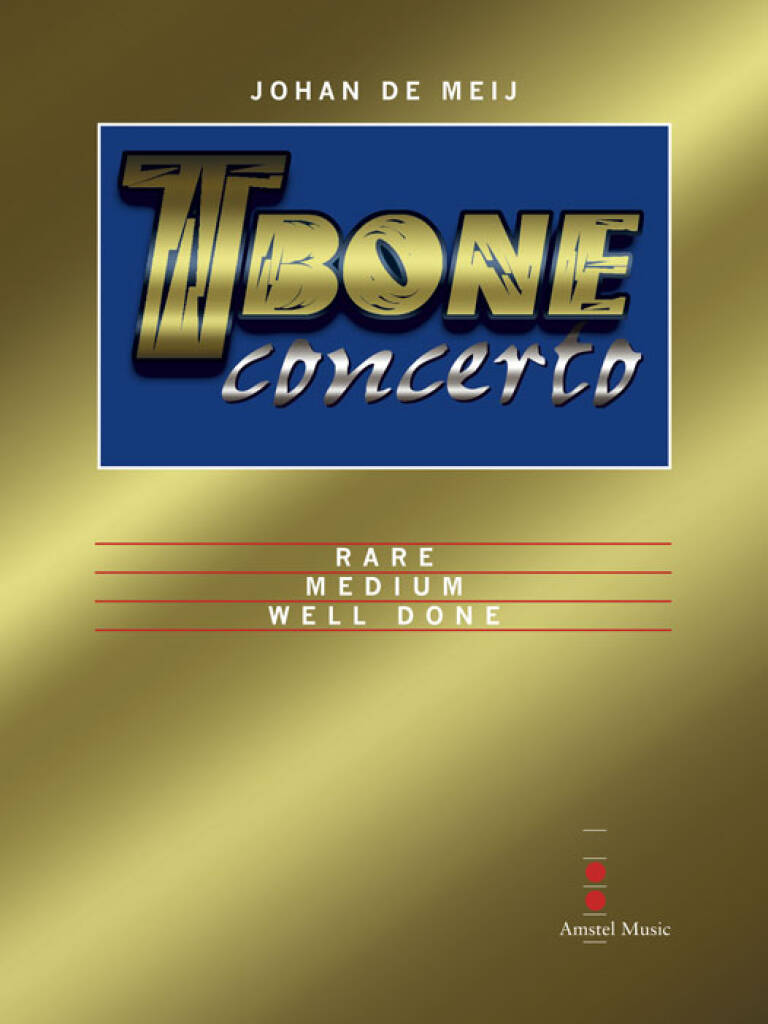
T-Bone Concerto (Complete Edition) - Johan de Meij
The T-Bone Concerto was Johan de Meij's first composition for solo instrument and symphonic band. It consists of three movements called respectively 'Rare', 'Medium' and 'Well Done'. In addition to the solo trombone, an important role has been allotted to a kind of chamber music ensemble within the band. This group introduces new thematic material and accompanies the soloist, thus creating a delightful transparant accompaniment. The ensemble consists of a double wind quintet (2 flutes, 2 oboes, 2 clarinets, 2 french horns and 2 bassoons) plus a cor anglais and a double bass. Parts I and II are written in the A-B-A form and allow the soloist to display both the technical and thelyrical characteristics of the instrument. Part III at first develops into a kind of neo-baroque style using the thematic material of the first and second movement, and finally leads to a triumphant finale and a virtuoso conclusion.
Estimated dispatch 7-14 working days
-
 £154.60
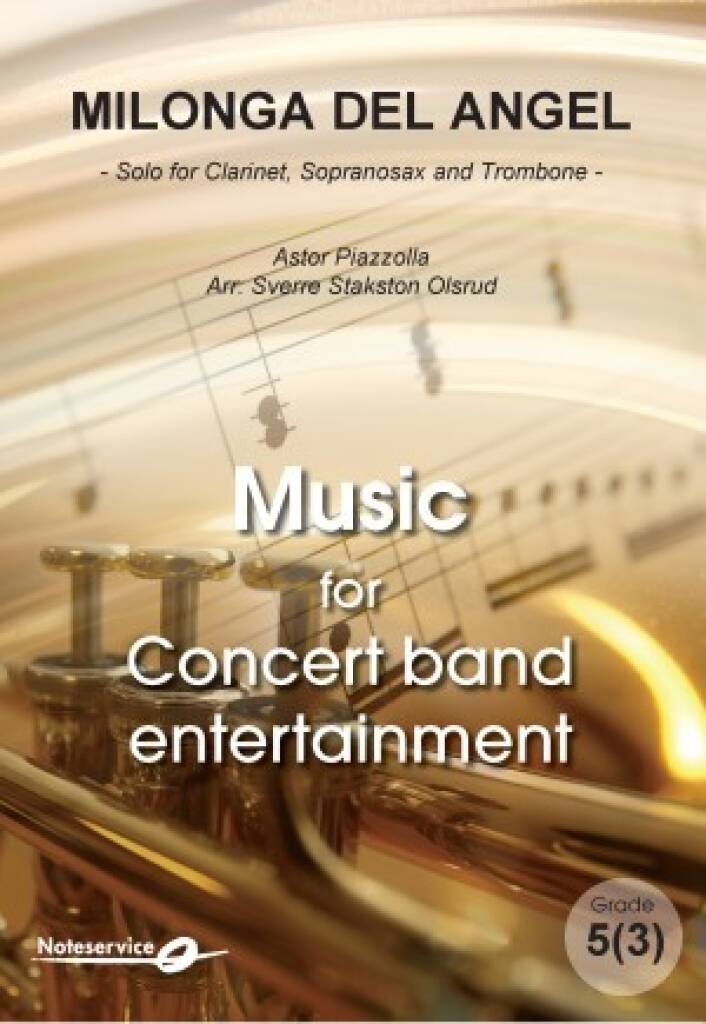
Milonga Del Angel - Astor Piazzolla
This arrangement was made after hearing Astor Piazzolla's 1986 recording of his own work written in 1965.The original instrumentation of bandoneon, violin and string bass is here arranged for three wind soloists with Concert Band.The Soprano Sax is the main soloist (filling the bandoneon role), while the trombone and clarinet shares the violin part as a kind of flirting undertone to the sopranosax.It's not possible to make a 100% correct notation of the solo parts, so it's recommended to listen to the record album "Zero Hour" from 1986 to get the best impression of the work.Enjoy "Milonga Del Angel" and imagine a small, dark caf in Buenos Aires!
Estimated dispatch 7-14 working days
-
 £109.99
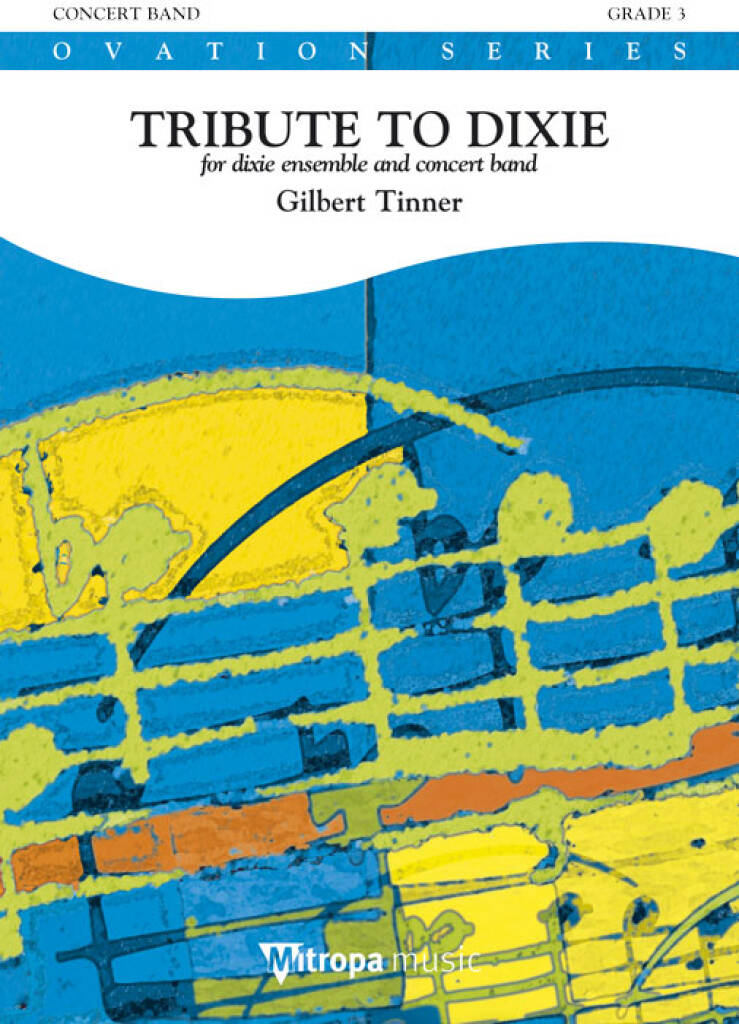
Tribute to Dixie - Gilbert Tinner
This scintillating work was written as a tribute to the jazz musicians of the New Orleans, Dixieland and Chicago styles of the 20s and 30s. It consists of an opening swing section in true Dixieland style, followed by a sleazy blues section. Ideally the band should be divided so there is a separate Dixieland band consisting of trumpet, clarinet, alto or tenor saxophone, trombone, banjo (optional) and tuba or double bass. Although the Dixieland band are mostly accompanied by the remainder of the concert band the accompanying players also get the chance to shine as every now and again they take over the musical themes.
Estimated dispatch 7-14 working days
-
 £72.99
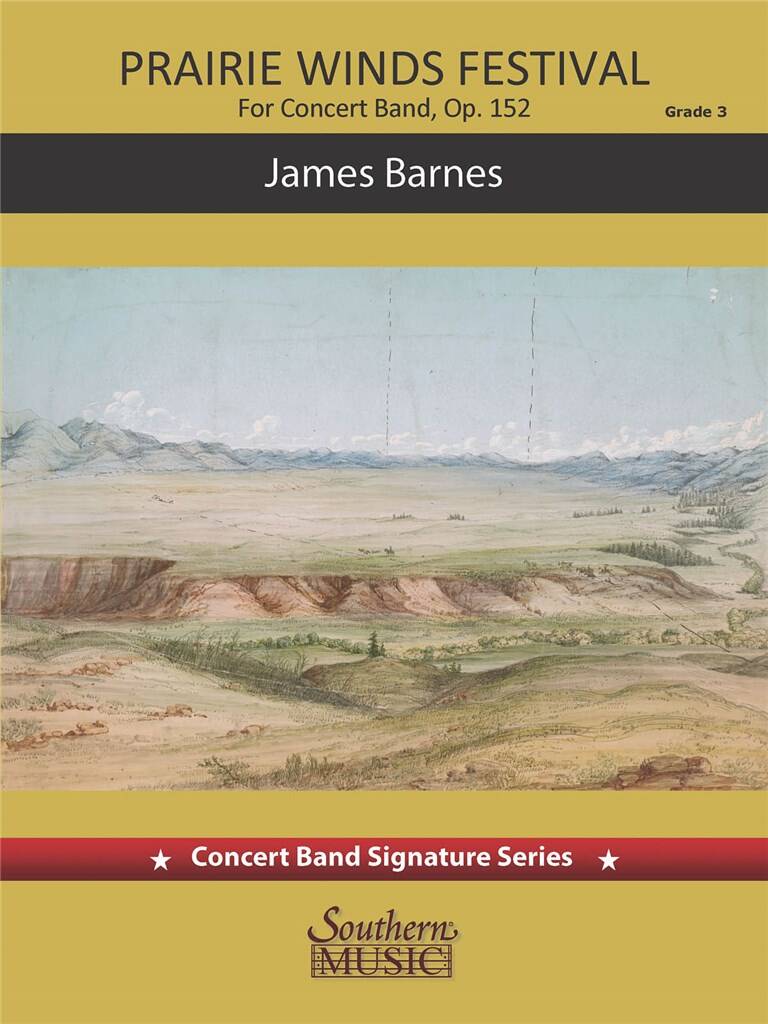
Prairie Winds Festival - James Barnes
Prairie Winds Festival is a fast, happy-go-lucky concert opener. It is very carefully scored and cross-cued, so that almost any size band can perform it. The Piccolo, 2nd Oboe, 2nd Bassoon, Contra-Alto Clarinet, 3rd Trombone and Double Bass parts are all optional, but if you have these instruments, it will sound more full.
Estimated dispatch 7-14 working days
 View Music