
-
 £59.00
Among the Stars (Concert Band - Score and Parts) - Galvin, Lisa
Among the Stars is an exciting composition, perfect for a concert opener, feature or closer! The dotted rhythms and interesting syncopation will coax your developing young band into sounding like a much more advanced ensemble. The lyrical middle section begins with a brass quartet, providing an opportunity to showcase some of your outstanding players. If you're looking to explore women composers with your students, this accessible work is sure to be a perfect choice! Duration: 4.30
Estimated dispatch 7-14 working days
-
 £53.95
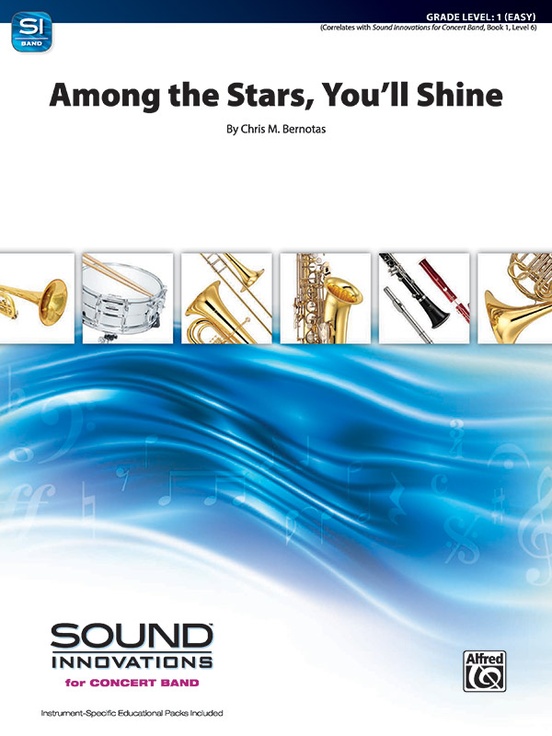
Among the Stars, You'll Shine (Concert Band - Score and Parts) - Bernotas, Chris M.
Embodying the idea of being part of something larger than yourself, but also valued as a unique individual, Among the Stars, You'll Shine, by Chris M. Bernotas, is the perfect choice for developing an expressive style of performance with your students. While predominantly lyrical, there are plenty of contrasts and opportunities for all your students to shine.Duration: 2.45
Estimated dispatch 7-14 working days
-
 £70.00
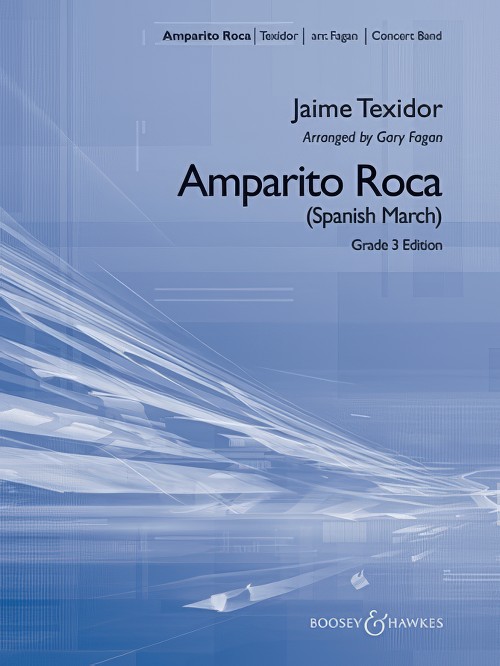
Amparito Roca (Concert Band - Score and Parts) - Fagan, Gary
This classic Spanish march by Jaime Texidor has been expertly re-cast for younger players in this authentic-sounding edition by Gary Fagan. Instrumentation and brass ranges have been modified, however, the charm and energy of the original has been left unchanged. Duration: 2.45
Estimated dispatch 7-14 working days
-
 £94.30
AMPARITO ROCA (Intermediate Concert Band) - Texidor, Jamie - Woodfield, Ray
Spanish March. Grade: medium. Recorded on Obrasso OBRCD947 Just for You.
Estimated dispatch 7-14 working days
-
 £60.99
Amparito Roca (Spanish March) (Flexible Ensemble - Score and Parts) - Texidor, Jamie - Curnow, James
Composed in 1925 by Spanish composer Jaime Texidor, this attractive, moderately paced march (paso doble) has a proven long-lasting appeal and musicality. Authentically adapted here by James Curnow, this version for flexible instrumentation will sound great for virtually any occasion.
Estimated dispatch 7-14 working days
-
 £164.95
Amphibiosity (Concert Band - Score and Parts) - Ellerby, Martin
Amphibiosity was commissioned by the Royal Marines Band Service with funds made available by the Royal Navy and Royal Marines Charities for the 2014 Mountbatten Festival of Music held at the Royal Albert Hall in London.The work was written in celebration of the 350th Anniversary of the Royal Marines Corps and utilises many familiar tunes associated with them. Although the piece is cast in one continuous movement it falls into an introductions, ten sections and a coda.The Introduction sets the tone with the Amphibiosity mofif - a call to attention, it is of serious intent. During the course of the work it returns as a point of reference. The first section makes use of The Globe and Laurel (Original Regimental Slow March of the Royal Marines, the tune (Early One Morning) making an apt appearance, it has been played in the minor and like much of the quotational material in the piece is of a referenced nature being symbolic in meaning. However it soon turns to the major to provide a less sombre aspect to the introduction proper. There follows an interlude, the Amphibiosity motif returning rather like a ritornello to give cohesion to the structure and act as a point of change.Section two presents Sarie Marais (Regimental March Past of the Royal Marine Commandoes), the first half of the tune used as a fugal subject (placed in the minor) and as such providing the impression of a building up of activity. The ensuing third section is light-hearted commencing with an original hornpipe leading into the fourth section, Seascape, representing the fleet at sea. Another interlude follows, the Amphibiosity motif reappearing as a woodwind fanfare making way for the fifth section. Anticipation, serious matters lie ahead, there is trouble in the papers, the Corps will be placed on standby.Section six is subtitled Preparation, all hands-on deck, time to get set: A Life on the Ocean Wave (Regimental March of the Royal Marines) is alluded to. On reaching section seven, Assault, the landing goes ahead. Within this section there is an internal interlude reflecting on things past: other men have been in this position before. It is a taut and trying situation, training must pay off!Section eight is named Victory, but not gung-ho, and here the Seascape music is revisited. The penultimate ninth section is called Rememberances, although all made it this time, it was not always the case in times past and the Naval Hymn (Eternal Father) provides a moment of tribute to the fallen of previous generations.The Finale (section ten) delivers By Land and Sea (Slow March of the Royal Marines) in a bright and positive orchestration, the mood being celebratory. In a brief Code, the Amphibiosity motif makes a last triumphant appearance.Duration: 10.30
Estimated dispatch 7-14 working days
-
 £32.95
Amphibiosity (Concert Band - Score only) - Ellerby, Martin
Amphibiosity was commissioned by the Royal Marines Band Service with funds made available by the Royal Navy and Royal Marines Charities for the 2014 Mountbatten Festival of Music held at the Royal Albert Hall in London.The work was written in celebration of the 350th Anniversary of the Royal Marines Corps and utilises many familiar tunes associated with them. Although the piece is cast in one continuous movement it falls into an introductions, ten sections and a coda.The Introduction sets the tone with the Amphibiosity mofif - a call to attention, it is of serious intent. During the course of the work it returns as a point of reference. The first section makes use of The Globe and Laurel (Original Regimental Slow March of the Royal Marines, the tune (Early One Morning) making an apt appearance, it has been played in the minor and like much of the quotational material in the piece is of a referenced nature being symbolic in meaning. However it soon turns to the major to provide a less sombre aspect to the introduction proper. There follows an interlude, the Amphibiosity motif returning rather like a ritornello to give cohesion to the structure and act as a point of change.Section two presents Sarie Marais (Regimental March Past of the Royal Marine Commandoes), the first half of the tune used as a fugal subject (placed in the minor) and as such providing the impression of a building up of activity. The ensuing third section is light-hearted commencing with an original hornpipe leading into the fourth section, Seascape, representing the fleet at sea. Another interlude follows, the Amphibiosity motif reappearing as a woodwind fanfare making way for the fifth section. Anticipation, serious matters lie ahead, there is trouble in the papers, the Corps will be placed on standby.Section six is subtitled Preparation, all hands-on deck, time to get set: A Life on the Ocean Wave (Regimental March of the Royal Marines) is alluded to. On reaching section seven, Assault, the landing goes ahead. Within this section there is an internal interlude reflecting on things past: other men have been in this position before. It is a taut and trying situation, training must pay off!Section eight is named Victory, but not gung-ho, and here the Seascape music is revisited. The penultimate ninth section is called Rememberances, although all made it this time, it was not always the case in times past and the Naval Hymn (Eternal Father) provides a moment of tribute to the fallen of previous generations.The Finale (section ten) delivers By Land and Sea (Slow March of the Royal Marines) in a bright and positive orchestration, the mood being celebratory. In a brief Code, the Amphibiosity motif makes a last triumphant appearance.Duration: 10.30
Estimated dispatch 7-14 working days
-
 £52.95
Amplitude (Concert Band - Score and Parts) - Gassi, Vince
Amplitude rhymes with attitude and that's just what this new rock chart has plenty of! And because you ordered by midnight, you also get a heap o' drivin' rhythm, an infectious beat, and a way cool tune. 'Nuff said!Duration: 2.30
Estimated dispatch 7-14 working days
-
 £225.00
Amsterdam Suite (Concert Band - Score and Parts) - Curtis, Matthew - Noble, Paul
The Amsterdam Suite, written in 1995 and first performed by the Slaithwaite Philharmonic Orchestra the following year, seeks to convey some impressions of a city I have visited several times. It opens with the waltz sequence, Barrel Organs, recalling the hurdy-gurdies positioned at strategic points in the city with the aim of parting tourists with their loose change. The tunes, however, are mine rather than an attempt to reproduce the real thing. Amsterdam takes its Saturday nights seriously, with the result that those who get up (or are still up) early on Sunday morning will find themselves in eerily deserted streets, whose atmosphere to me suggests one instrument above all, the saxophone, which plays a prominent part in Lonely City. The Saturday nights themselves are depicted in Trams and Crowds. I have taken liberties with the chronology for the obvious musical reason of wanting to go out with a bang rather than a whimper. The basic structure is very much that used by Eric Coates for similar piece, a bustling outer section with a quick march trio, presented in a fuller and more embellished orchestration on each of its three appearances. - Matthew Curtis.
Estimated dispatch 7-14 working days
-
 £85.00
Amsterdam Suite, 1st Movement (Concert Band - Score and Parts) - Curtis, Matthew - Noble, Paul
The Amsterdam Suite, written in 1995 and first performed by the Slaithwaite Philharmonic Orchestra the following year, seeks to convey some impressions of a city I have visited several times. It opens with the waltz sequence, Barrel Organs, recalling the hurdy-gurdies positioned at strategic points in the city with the aim of parting tourists with their loose change. The tunes, however, are mine rather than an attempt to reproduce the real thing. Amsterdam takes its Saturday nights seriously, with the result that those who get up (or are still up) early on Sunday morning will find themselves in eerily deserted streets, whose atmosphere to me suggests one instrument above all, the saxophone, which plays a prominent part in Lonely City. The Saturday nights themselves are depicted in Trams and Crowds. I have taken liberties with the chronology for the obvious musical reason of wanting to go out with a bang rather than a whimper. The basic structure is very much that used by Eric Coates for similar piece, a bustling outer section with a quick march trio, presented in a fuller and more embellished orchestration on each of its three appearances. - Matthew Curtis.
Estimated dispatch 7-14 working days
Searching for Brass Band Music? Visit the Brass Band Music Shop
 View Music