
Results
-
 £214.80
Dance Suite - Joseph Horovitz
This work follows a tradition established at the end of the seventeenth century: the creation of a musical structure by using a succession of dance movements, composed in such a way that a satisfying cumulative effect is produced. This method can be traced, starting from the works of Corelli, through the so-called Mannheim school to Mozart, and on to Brahms and beyond. Indeed, most classical symphonies owe their origin to this tradition.Each of the three movements of Dance Suite contains themes and motifs which are based on clearly identifiable dance patterns, more or less traditional and tonal in harmonic language.The first movement is a mixture af march- and gavotte elements, but these occur as variants of a single main theme. The tempo is brisk and the strongly accentuated four-beat measures creates a feeling of motoric drive. This is often counteracted by unexpected syncopation and surprising modulations. Horovitz dispenses with a second subject in favour of a very elaborate development, which makes the final quotation of the theme into a sort of recapitulation.In contrast, the second movement is a gentle, gracefully undulating dance, using two steady beats in every measure. Here there are two themes, the first more rhythmic, the second more lyrical. The second theme always uses the first as accompaniment, rather as a singer might use a guitar. Both themes undergo several modulations before returning to the home key. A Spanish flavour pervades the rhythmic and melodic elements of this movement.The finale is a fast rondo (in 6/8) whose main theme is best described as a tarantella. This alternates several times with a more solid, rustic theme (in 2/4). However, the main theme is recalled in varying guises, including a parody Latin-American version. The orchestration becomes mor elaborate and exciting as the movement proceeds, and the whole work ends with a coda recalling the main rond-theme with an enthusiastic flourish.Joseph Horovitz wrote about Dance Suite: "Most of the melodies and rhythms in the Dance Suite have been in my thoughts for many years, ever since my eraly career as conductor of ballet, and later as composer of some sixteen ballet scores. Some of these ideas were sketched on manuscript paper, others remained in my head and even in my dreams. The composition of this work gave me the chance to search among these half-subconscious sources and to offer my discoveries to the wind-orchestra repertoire."
Estimated dispatch 7-14 working days
-
 £115.60
Fernando - Andersson
This song was released as single record by Swedish pop group ABBA in 1976. The lyrics is about two older veteran talking about the Mexican-American war. In this arrangement, the verse occurs in two different instrumentations. Please be aware of the balance between the melody and accompaniment. In the beginning of the arrangement, the bass ostinato may be devided by Tuba and Baritone.
Estimated dispatch 7-14 working days
-
 £129.99
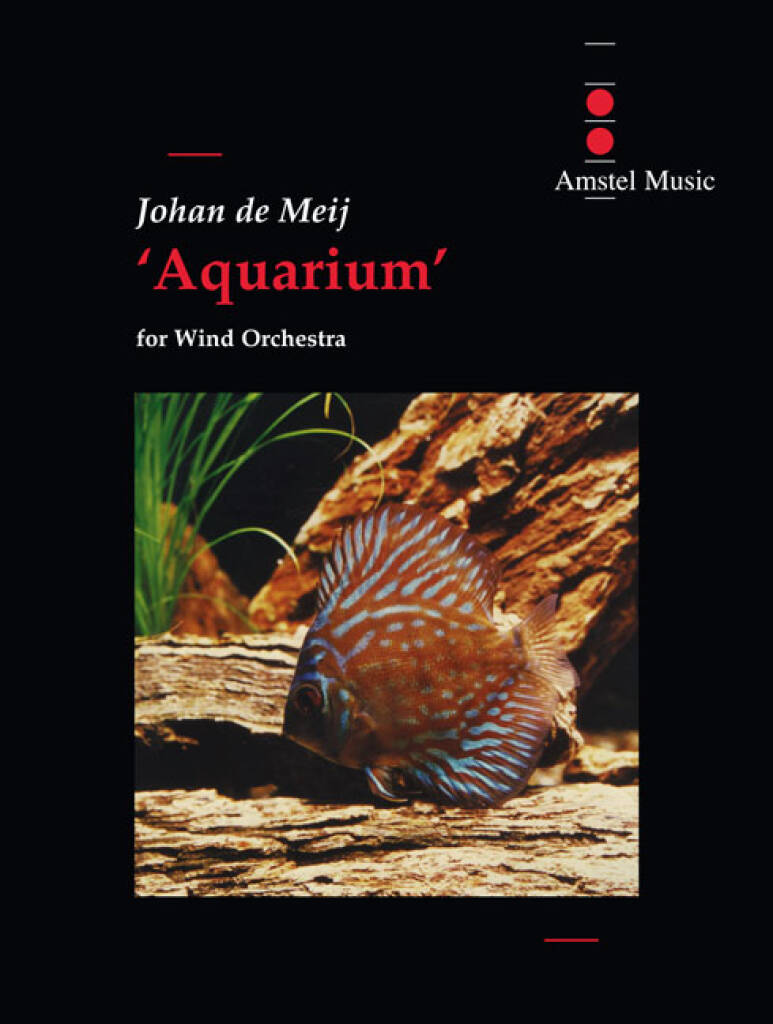
Aquarium - Johan de Meij
The Suite 'Aquarium' is Johan de Meij's third composition for symphonic band and features six tropical fishes, each of them represented by a motif, and surfacing as such in several guises. The composition consists of three movements of which the second and third merge uninterruptedly into each other. I) Allegretto grazioso (Neon Tetra, Electric Eel and Angelfish) II) Andante / Adagio (Sea Horse and Zebrafish) III) Finale: Allegro giocoso (Guppy & Co.) The Neon Tetra motif functions as a kind of 'Leitmotiv' and descibes the beautifully coloured, frisky fish: A number of variants have been derived from this theme and will also appear in the other movements.The Electric Eel in fact is not represented by a motif, but by a rhythm based on the restless electric pulses made audible in some aquaria. The Angel fish is represented by elegant cluster chords. In the second movement the Sea Horse emerges out of the water vegetation and starts a dialogue with the Zebrafish, which is represented by one melodic phrase in unison, getting more and more threatening by added parallel fifths and octaves. Simultaneously with the Sea Horse motif the Neon Tetra theme emerges, this time in 3/4 time and in Eb minor. The third movement starts with only two instruments (trumpet and xylophone), but as it is often the case with Guppies their number rapidly increases. Piccolo and Alto Saxophone introduce the Guppy Theme followed by several instrumental combinations. Every theme from the first movement 'swims by' once more, after which the principal motif leads us to a brilliant ending.
Estimated dispatch 7-14 working days
-
 £39.95
Music for Junior Wind Band - Vol. 5 - More Carols - Adrian Taylor
The arrangements and compositions in these books were written by Adrian Taylor for various beginner or school bands that he has conducted over the years. Children joined these bands on the 2nd parts, usually having only been playing for a year and they then progressed to the 1st parts the following year.The 2nd parts are written without key signatures in treble clef, in B flat major for bass clef trombone and euphonium and in E flat major for bass clef tuba. 1st parts are written with the appropriate key signatures for each piece, reflecting the greater understanding and skills of the players on these parts. Most of the pieces can be played with only a few parts being covered, the addition of the other parts usually enhancing the arrangement rather than simply doubling existing musical lines. The essential parts are the two Trumpet (and Clarinet or Cornet) parts, the two Trombone/Euphonium parts and preferably also the 1st Horn part. A piano part helps to fill out the harmonies where other parts are missing. The brass parts in the wind band versions are identical to those in the brass versions.
Estimated dispatch 7-14 working days
-
 £39.95
Music for Junior Wind Band - Vol. 7 - Adrian Taylor
The arrangements and compositions in these books were written by Adrian Taylor for various beginner or school bands that he has conducted over the years. Children joined these bands on the 2nd parts, usually having only been playing for a year and they then progressed to the 1st parts the following year.The 2nd parts are written without key signatures in treble clef, in B flat major for bass clef trombone and euphonium and in E flat major for bass clef tuba. 1st parts are written with the appropriate key signatures for each piece, reflecting the greater understanding and skills of the players on these parts. Most of the pieces can be played with only a few parts being covered, the addition of the other parts usually enhancing the arrangement rather than simply doubling existing musical lines. The essential parts are the two Trumpet (and Clarinet or Cornet) parts, the two Trombone/Euphonium parts and preferably also the 1st Horn part. A piano part helps to fill out the harmonies where other parts are missing. The brass parts in the wind band versions are identical to those in the brass versions.
Estimated dispatch 7-14 working days
-
 £85.50
Liberty Fleet - Karl L. King
It doesn't get any better than to have the wonderful opportunity to hear or perform a classic march composed by the great Karl King. Interesting themes, strong counter-melodies, and tasteful percussion parts are a trademark of his uncanny writing skills. Now add the talents of James Swearingen's arranging skills, and the combination of these two musical giants is the perfect match for achieving a highly successful performance. Two names that you can trust!
Estimated dispatch 7-14 working days
-
 £89.99
Preludio all' atto I - Giuseppe Verdi
Ernani (1844), Giuseppe Verdi's fifth opera, is based on the homonymous tragedy by Victor Hugo. Verdi's success with Ernani, as well as Nabucco and I lombardi alla prima crociata, can be ascribed to two distinct ideas: the melodic idea and the patriotic idea. The melodic idea is very important to move and touch the audience, while the patriotic idea is the source of enthusiasm and emotions. Approximately ten years elapse between two similar stories: the one of the outlaw Ernani and the one of Manrico, the troubadour. In the prelude to Act I, in only three minutes, Verdi has succeeded in skillfully concentrating the main elements of the entiredrama. One can clearly observe the themes of love, oath, and death.
Estimated dispatch 7-14 working days
-
 £74.99
Sextet from Lucia - Gaetano Donizetti
This unique "Gem of the Concert Band" features a brass sextet accompanied by band. A great example of the "bel canto" style of brass performance, your sextet of two trumpets, horn (or trombone/euphonium), two trombones (or euphoniums), and bass trombone will wow audiences! Transcribed from the famous operatic vocal sextet, this brilliant work from the golden age of the concert band is a real crowd-pleaser. Our highest recommendation!
Estimated dispatch 7-14 working days
-
£106.95
The Masks - Ronald Lo Presti
The Masks was composed in 1955 as a two movement orchestral suite that was part of the American Composers' Edition series produced by Eastman in conjunction with Carl Fischer music publishers. Lo Presti, a student of Howard Hanson is perhaps best known for his Elegy for a Young American written for concert band. Indeed, The Masks is reminiscent of the Elegy in its romantic style with rich contemporary harmonies. There is no programmatic significance to the title, according to Lo Presti, other than the fact that the two movements are in contrasting moods, much like the Greek masks of comedy and drama. Gregory Rudgers transcription is authentic to the orginal piece and gives bandseverywhere a new LoPresti piece of significance.
Estimated dispatch 7-14 working days
-
 £157.50
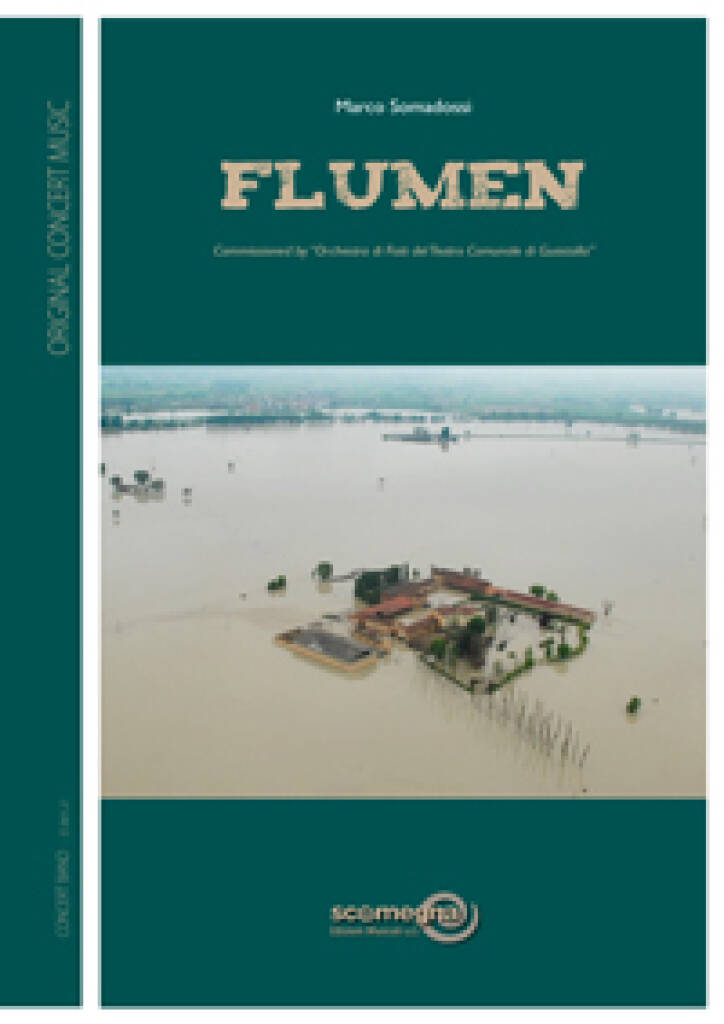
Flumen - Marco Somadossi
In October 2000, the River Po produced its highest flood waters in the last hundred years, provoking a natural disaster of dramatic dimensions. To the thousands of valiant men and women committed to defending their villages against the threat of the flood is dedicated the symphonic poem entitled "Flumen" (river, in Latin), inspired by the thematic material in the Gregorian sequence, "Victimae paschali laudes". The main melody is elaborated and its essence is transfigured in an alchemy of modern sounds from which, at times, archaic echoes emerge. The composition is structured in two parts: the first ("The River") is sullen and menacing, with sounds that portray the turbulent water and the inexorable and frightening rise of the flood;this contrasts with a second section ("The People"), with its primitive rhythms and vaguely multiethnic character (expressed through modal harmonies). Here the work evokes man's ancestral struggle against the forces of nature: the strenuous defence of the Po riverside communities to against the threat of flooding. In the finale, the two themes interweave and overlap, re-establishing a symbolic and primordial equilibrium where man and nature are again in harmony with each other.
Estimated dispatch 7-14 working days
 View Music